
IAD Framework: Deciphering the Hidden Interaction DNA of Social Media Diffusion
IAD: Interaction-Aware Diffusion Framework in Social Networks
This paper introduces IAD (Interaction-Aware Diffusion), a framework that models information spread in social networks by jointly considering multi-dimensional interactions. It utilizes a novel LDA-S (Latent Dirichlet Allocation with Sentiment) topic model and a co-training classifier to achieve SOTA performance in predicting user adoption behaviors on the Weibo dataset.
TL;DR
Information doesn't spread in a vacuum. The IAD (Interaction-Aware Diffusion) framework moves beyond the traditional "Independent Cascade" assumption by proving that social roles, explicit content categories, and topic-specific sentiments interact to determine whether a user clicks "forward." By modeling these as explicit interactions, researchers achieved a significant accuracy boost and 10x faster training speeds compared to previous SOTA latent models.
Academic Context: This work bridges the gap between traditional epidemic-style diffusion models and modern sentiment-aware NLP, positioning itself as a robust tool for viral marketing and social sentiment monitoring.
The "Independent Diffusion" Fallacy
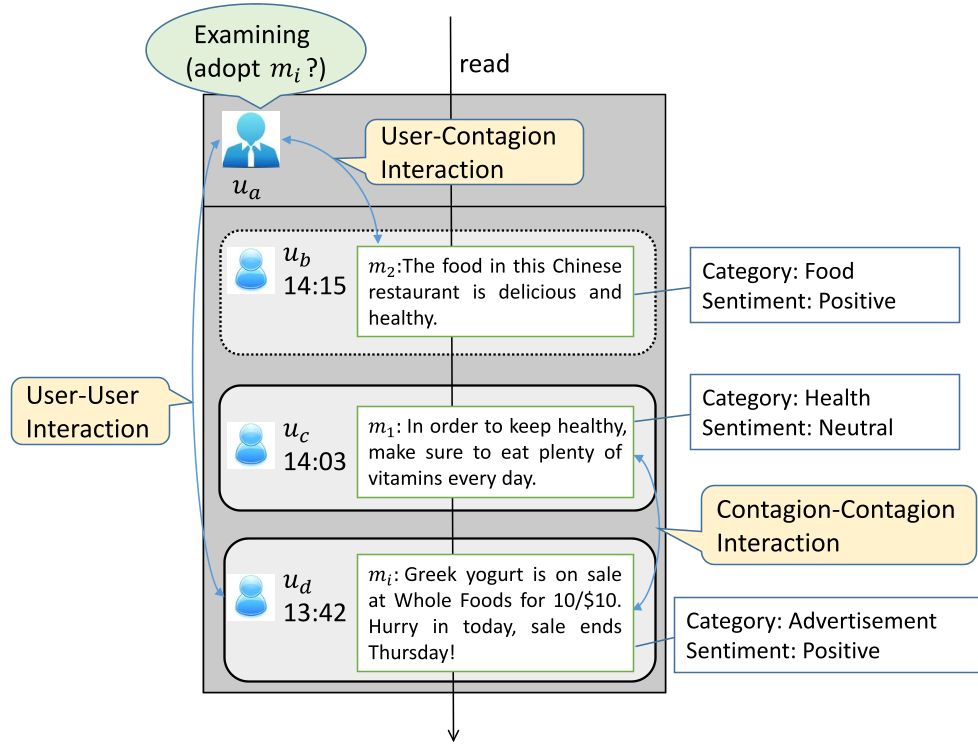
For decades, models like SIR or Independent Cascade assumed that Topic A spread regardless of whether Topic B was trending. In reality, a "Samsung Battery Explosion" news piece (Negative) might suppress "Samsung Product Launch" (Positive) but promote "Competitor News."
Existing models like IMM attempted to handle this using latent clusters, but they suffered from two fatal flaws:
- Lack of Interpretability: Why are these two things interacting? Latent variables won't tell you.
- Role Blindness: Not all users are equal. An "Authority" user (media) behaves differently than a "Hub" user (prolific sharer).
Methodology: The Three Pillars of IAD
The researchers break down the probability of infection into a unified framework of additive interactions.
1. The Interaction Matrix Architecture
The engine of IAD lies in transforming massive user-to-user matrices into manageable Role-Role and Category-Category interactions.
- User Roles (C1): Using PageRank and HITS, users are classified via a Mixture of Gaussians into Authority, Hub, and Ordinary roles.
- LDA-S (C2): A specialized LDA variant for short texts (Weibo/Twitter) that extracts sentiments tied specifically to topics (e.g., "low" is negative for "speed" but positive for "fat").
2. Co-Training for explicit Categories
Since labeling millions of Weibo posts is impossible, IAD uses a Co-Training approach. It views a contagion from two perspectives: the post itself and the "user profile" (other posts by the same user). This semi-supervised loop allows the model to map latent topics to 15 real-world categories like "Politics," "Food," or "Tech" with minimal manual labels.
Experimental Breakthroughs
Testing on the Chinese Weibo dataset (over 14 million scenarios), the IAD framework consistently beat the competition.
- Predictive Power: IAD w/ LDA-S reached an Accuracy of ~74.4% and F1-score of ~73.6%, significantly better than the standard IP (Infection Probability) and the cluster-based IMM.
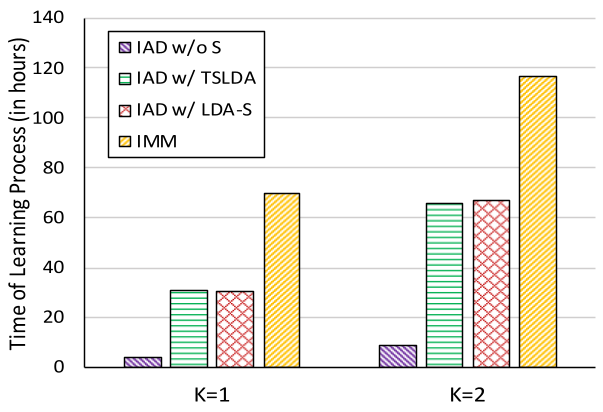
- Efficiency: Because IAD learns interactions between roles and categories (small matrices) rather than users and posts (massive matrices), it is significantly faster.
Deep Insights: What Actually Happens in Social Networks?
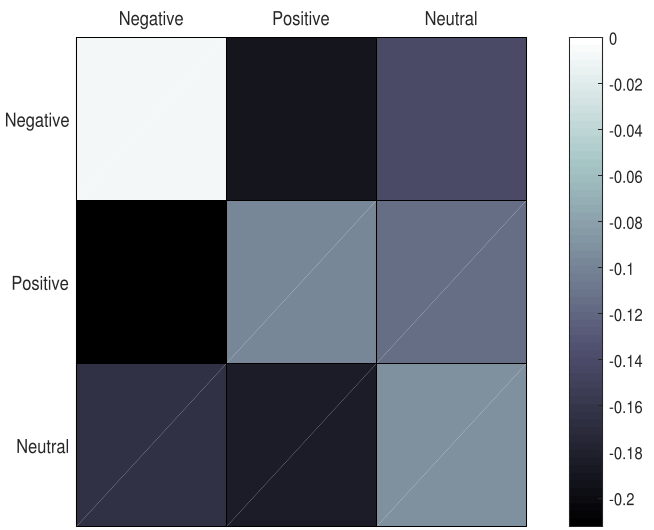
The heatmaps generated by IAD reveal several "ground truths" of social psychology:
- Sentiment Warfare: Positive and Negative contagions exhibit "Mutual Suppression." If a user is in a negative "loop," they are less likely to share positive content.
- Role Seniority: Authority users (Verified accounts) primarily interact with other authorities, creating a "status gradient."
- Category Cooperation: Contagions in the same category (e.g., Two different "Food" posts) actually cooperate to become hot topics, whereas different categories usually compete for a user's limited attention.
Critical Analysis & Conclusion
IAD is a masterclass in making complex network dynamics interpretable. By introducing LDA-S, the authors successfully addressed the sparsity of short texts.
Takeaway: For marketing professionals, IAD suggests that the "context" of a user's recent feed is just as important as the content of the ad. If you want to promote an energy drink, placing it near "Sports" news (Positive correlation) is mathematically superior to placing it near general "News."
Limitations: The model relies on reverse-chronological feeds (common in 2012). Modern algorithmic feeds (TikTok/Facebook) might require a modified "Attention Window" logic.