
Facebook as a Digital Lifeboat: Reducing Distance Education Dropout through Social Connectivity
Interaction on Distance Education in Virtual Social Networks: A Case Study with Facebook
This paper presents a hybrid qualitative-quantitative case study on the "Aluno Integrado" distance education course in Brazil, investigating the use of Facebook closed groups to enhance student-tutor interaction. The study demonstrates that leveraging familiar social networks significantly improves student engagement and reduces dropout rates in public high school distance learning environments.
TL;DR
Distance education is often a lonely journey, especially for public high school students. This study examines the "Aluno Integrado" project in Brazil, proving that integrating Facebook closed groups into formal curricula can bridge the interaction gap. By utilizing tools students already use daily, the course achieved faster feedback loops, higher engagement, and a crucial reduction in student attrition.
Background: The Interaction Crisis in DE
In the landscape of Distance Education (DE), interaction is the currency of learning. Traditional Learning Management Systems (LMS) often feel like "ghost towns"—static repositories of PDFs and forums that students rarely visit. For the 2014 edition of the "Aluno Integrado" course, researchers hypothesized that the missing link was the Social Learning Manifold: the informal, rapid-fire interaction found on social networks.
The Problem: Friction and Isolation
The study identifies a dual challenge:
- Technological Friction: Students find formal platforms cumbersome and non-intuitive.
- Psychological Isolation: Low-income teenagers in non-formal courses are highly prone to dropping out if they feel disconnected from their tutors and peers.
The "Instructional Design" of the past relied on student-content interaction. This paper shifts the focus toward Student-Tutor and Student-Student dynamics within a familiar environment.
Methodology: The Virtual Classroom Mirror
The researchers didn't replace the LMS but augmented it.
- The Subjects: 158 students (mostly aged 14-17) and 37 tutors.
- The Setup: 63 closed groups were created on Facebook—one for each class.
- The Goal: Use these groups as the "front office" for questions, deadlines, and social proof, while the LMS remained the "back office" for content and assessments.
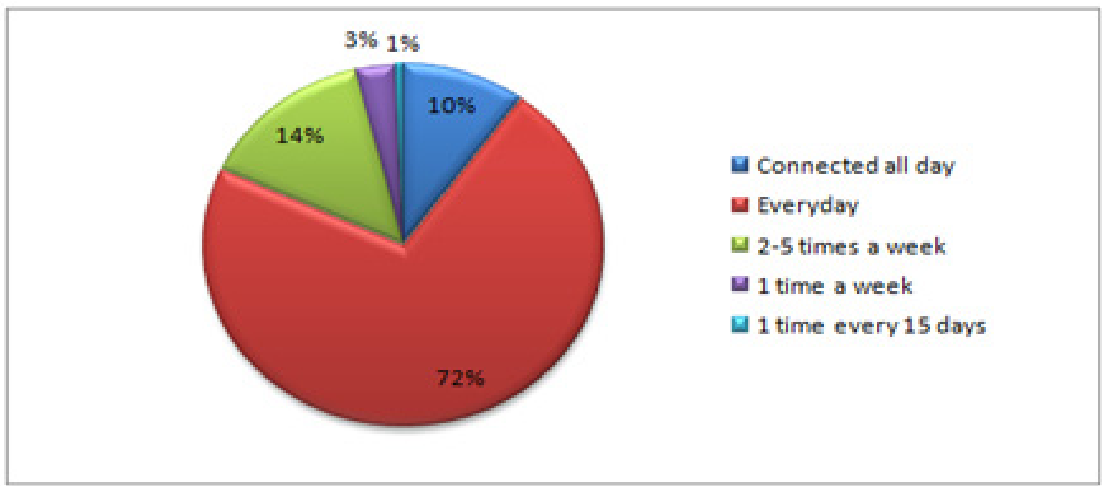 Figure 1: While home computers dominate, mobile access (Cell phone + Tablet) is a significant and rising force among these students.
Key Insights & Results
1. Meeting Students Where They Are
The study found that 99% of students had no difficulty using Facebook. This eliminates the "learning the tool" curve. Furthermore, 89% use it to stay in touch with friends, making the educational transition a matter of adding professional value to an existing social habit.
2. The Speed of Feedback
One of the most striking findings was the Efficiency Gain. 47% of students noted that tutors answered doubts more quickly on Facebook than via email or the LMS. Tutors observed that because students are "online all day," the visibility of course updates increased dramatically.
3. The "Social Influence" Factor
The paper highlights a "Sense of Belongingness." When a student sees a peer "liking" a post about a deadline, it triggers a social notification that acts as a nudge. Tutors noted that once students felt comfortable on Facebook, they were more likely to participate in the formal LMS forums as well.
The "Skeptical" Tutor: A Necessary Caveat
Interestingly, the study was not purely celebratory. About 16% of tutors were skeptical, arguing that Facebook is perceived by students as a tool for "entertainment," not learning. This reveals a critical Ablation Insight: technology alone doesn't teach; the tutor's ability to pivot the social space into a pedagogical space is the defining variable.
Critical Analysis & Future Outlook
While the study successfully proves that Facebook reduces dropout rates, it also points to the "shifting sands" of social media. The researchers noted that WhatsApp was already beginning to cannibalize Facebook’s utility even in 2014.
Takeaways for Educators:
- Low Barrier to Entry: Use tools with zero "tool-knowledge" requirements.
- Synchronicity over Staticity: High-frequency, low-stakes interactions (likes, short comments) build the momentum needed for high-stakes learning.
- The Social Safety Net: Reducing distance in "Distance Education" is a psychological task, not just a technical one.
Future Work: The authors propose a regression analysis to see if intensive Facebook participation correlates with higher final grades, moving beyond engagement metrics to academic achievement indices.