
Virtual Stress Testing: Engineering the "Demanding Recruiter" for Social Resilience
17384_Exploring interaction strategies for virtual characters to induce stress in simulated job interviews.
The paper presents a simulated job interview environment for training social skills in NEETs (young people not in employment or education). It introduces two distinct virtual character profiles—Understanding and Demanding—which use real-time social cue recognition to deliver differentiated, stress-inducing interactive experiences.
TL;DR
Researchers have developed a virtual job interview simulation designed to help vulnerable youth (NEETs) build social resilience. By creating two diametrically opposed virtual recruiters—one "Understanding" and one "Demanding"—the system uses real-time social cue recognition to modulate stress levels, proving that specific non-verbal and linguistic engineering can reliably influence user performance and psychological state.
Academic Context: This work sits at the intersection of Affective Computing and Human-Agent Interaction. While most prior research aimed to make agents more empathetic to reduce user anxiety, this paper shifts the focus toward Stress Inoculation Training, where the agent is a controlled adversary.
Problem & Motivation: The NEET Dilemma
Young people Not in Employment, Education, or Training (NEETs) often face a "bottleneck" in their career paths: the job interview. This high-pressure environment requires sophisticated socio-emotional management, which many NEETs lack due to social anxiety or low self-confidence.
The authors argue that existing simulators are too "soft." To truly prepare a candidate, a system must be able to simulate the "Cold Recruiter"—the one who frowns, interrupts, and asks blunt questions. The challenge lies in making these behaviors believable without becoming a caricature.
Methodology: The Architecture of Interaction
The system utilizes the SEMAINE API for multimodal interaction, integrated with VisualSceneMaker to handle complex dialogue logic. The core innovation lies in how the authors mapped psychological theories—specifically Politeness Theory (Brown and Levinson) and Social Dominance—into a computational model.
1. The Behavioral Profiles
- The Understanding Recruiter: Uses positive politeness (e.g., "I am eager to know more..."), frequent head nods, smiles, and shorter pauses to create rapport.
- The Demanding Recruiter: Employs "Face Threatening Acts," blunt statements (e.g., "Your grades are below average"), dominant gaze (staring at the start of speech), and negative feedback like frowning.
2. Modeling with Parallel HFSMs
The interaction isn't just a linear script. It uses Hierarchical Finite State Machines (HFSMs) to handle parallel processes like gaze, turn-taking, and gesture generation.
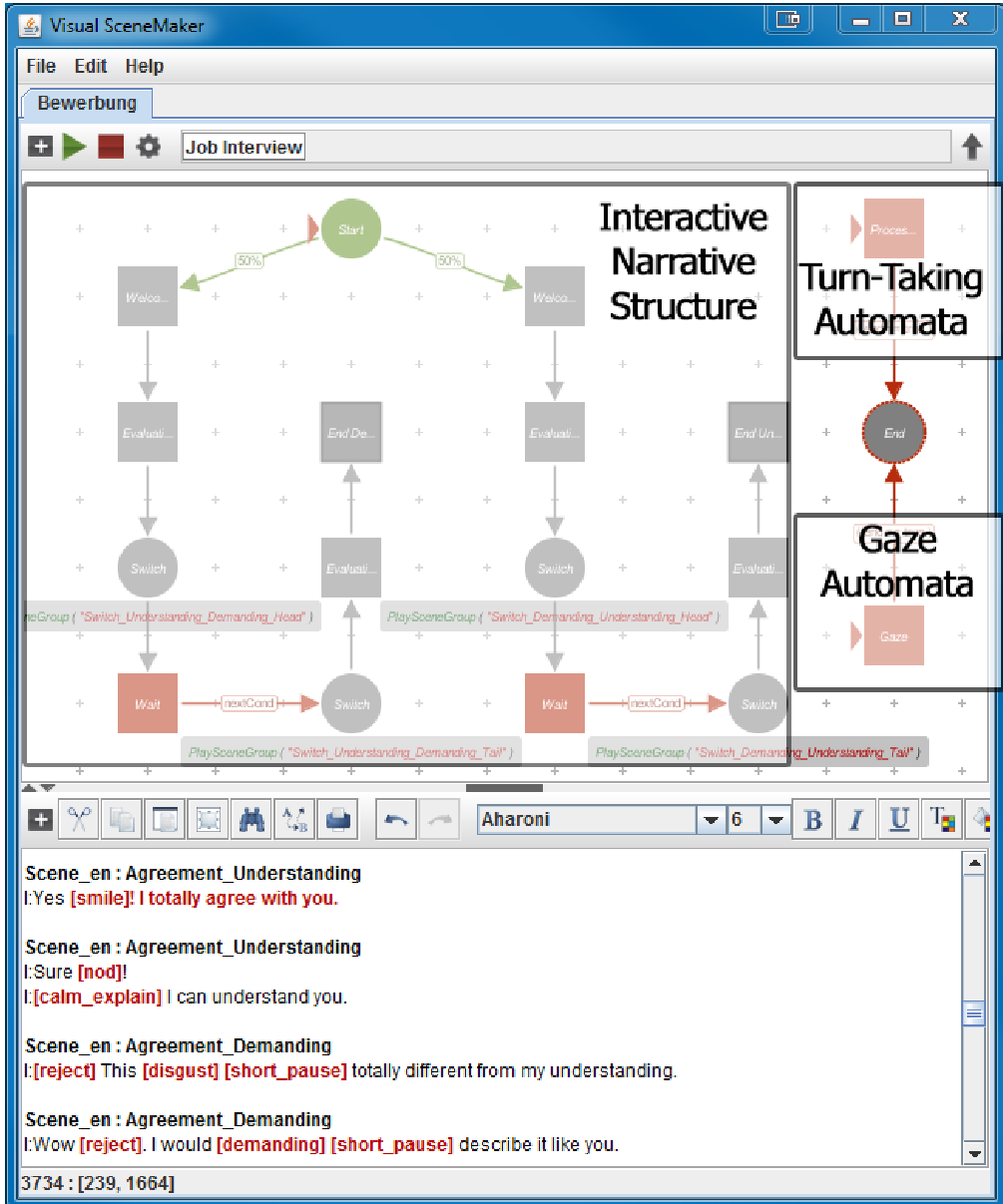 Figure 1: The HFSM structure separating dialogue plot from lower-level gaze and turn-taking behaviors.
Experiments & Results: Quantifying the "Stress Gap"
The study involved 24 participants in a within-subjects design, where they faced both recruiters. The results were stark and statistically significant across multiple dimensions.
- Perceived Stress: Users felt significantly higher stress and found the Demanding recruiter much more challenging, despite the actual question difficulty being similar.
- Speech Patterns: In the "Understanding" condition, users had more breathing pauses, indicating comfort. In the "Demanding" condition, they produced longer, continuous speech chunks—a sign of being "on the defensive."
- Movement Energy: Analysis showed a trend toward higher movement energy in the demanding condition, correlating with the physical manifestation of stress.
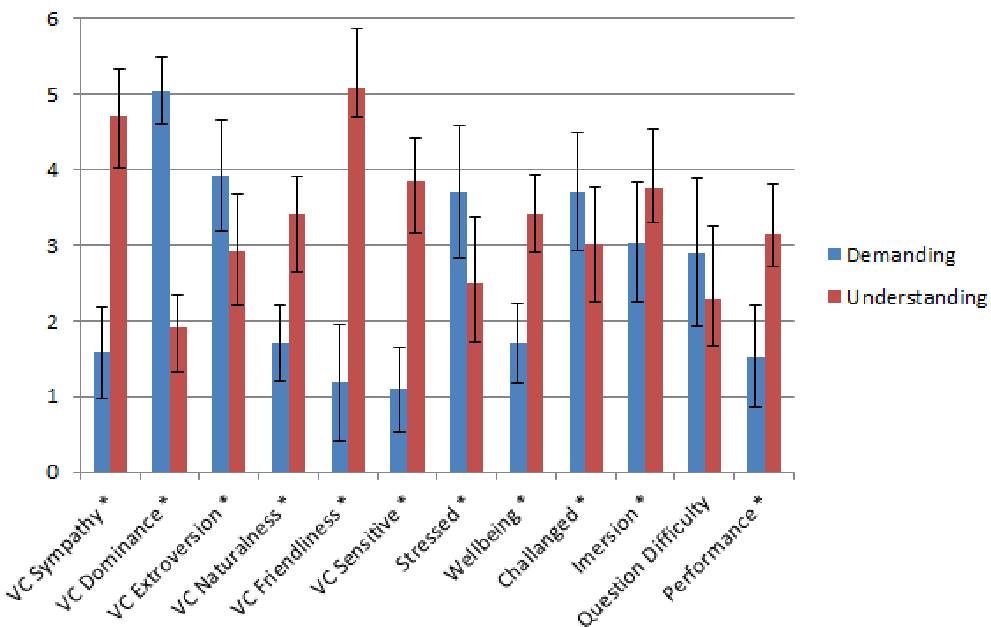 Figure 2: Significant differences (p < 0.05) in user perception of the two characters.
Critical Analysis & Conclusion
Takeaways
The paper successfully proves that social atmosphere is a programmable variable. By manipulating gaze, gesture size, and linguistic politeness, AI developers can tune the "difficulty" of a social interaction just like a video game developer tunes an enemy's health points.
Limitations
- The "Naturalness" Trade-off: The "Demanding" character was perceived as less natural. This suggests that "coldness" in virtual agents can sometimes trigger the Uncanny Valley or be interpreted as system error rather than intentional personality.
- Sample Demographic: The average age was 28.7, which is slightly older than the typical "young NEET" demographic.
Future Perspective
As we move toward LLM-driven agents, this research provides the necessary Control Logic. Future systems could use these HFSM structures as "guardrails" or "system prompts" to ensure an AI recruiter maintains a consistent level of pressure, allowing users to practice their "soft skills" in the toughest possible virtual arena.