
Accelerating Service Emulation: Mining Interaction Traces for Instant System Responses
Interaction Traces Mining for Efficient System Responses Generation
The paper introduces a clustering-based trace mining technique to accelerate service emulation for enterprise systems. By pre-processing large-scale interaction traces using BEA and VAT algorithms, the method enables efficient response generation, achieving 99% faster inference than prior exhaustive search methods.
TL;DR
Service emulation is vital for DevOps and QA, yet searching massive interaction traces for the "perfect match" at runtime is a performance nightmare. This paper presents a clustering-based approach that pre-processes traces using bio-informatics-inspired sequence alignment, reducing response generation time by a staggering 99% while maintaining high protocol conformance.
Background & Motivation: The Scalability Wall
In large-scale enterprise environments, testing a system that depends on third-party services (like banking APIs or LDAP directories) is often impossible or expensive. Developers use Service Emulation to mimic these dependencies.
The state-of-the-art involves recording "traces" (request-response pairs) and replaying them. However, when you have millions of recorded interactions, the "Matching Function"—which finds the most similar request to an incoming one—becomes a bottleneck. The authors identified that exhaustive search across the entire library is simply not viable for high-performance testing environments.
Methodology: From Bio-informatics to Trace Clustering
The core insight is that network protocols have repetitive structures. Instead of searching everything, why not group similar interactions together?
1. The Distance Function
The authors treat network messages as strings and use the Needleman-Wunsch algorithm, typically used for DNA sequence alignment, to calculate a "distance" between messages. This captures both structural similarity and payload overlap.
2. The Pre-processing Pipeline
The framework moves the heavy lifting to an offline stage:
- Translation: Convert traffic (PCAP) to text.
- Distance Matrix: Calculate pairwise distances for all interactions.
- Clustering: Use BEA (Bond Energy Algorithm) or VAT (Visual Assessment of Tendency) to group these interactions without pre-defining the number of clusters.
- Center Selection: Identify a "representative" request for each group.
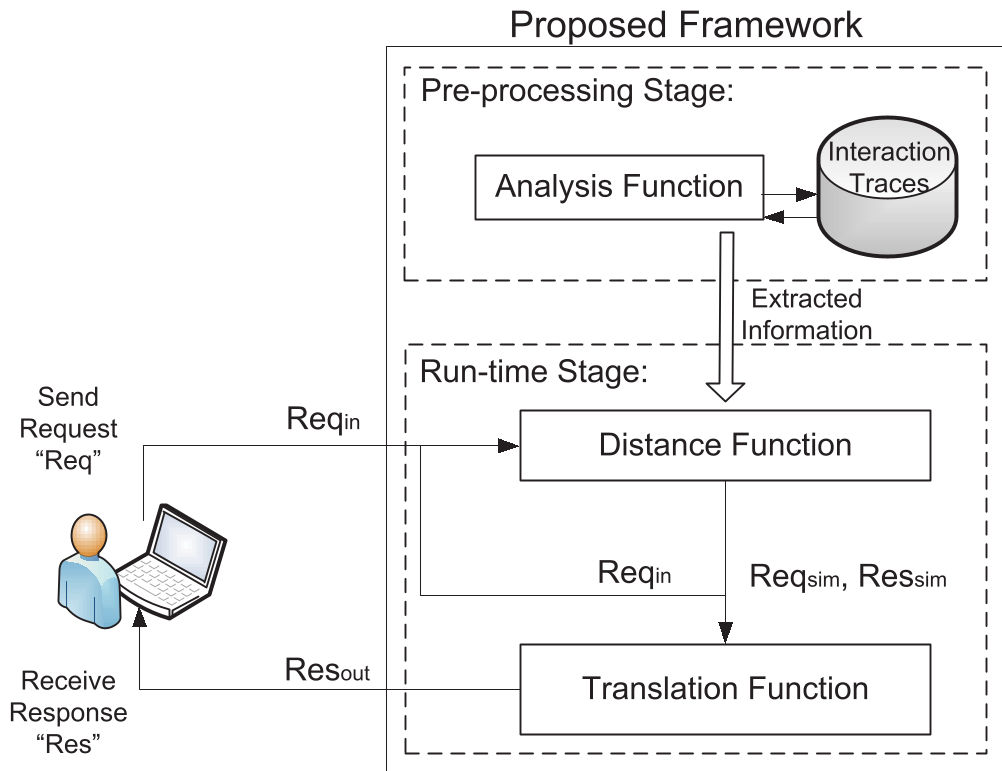
Runtime: Two Paths to a Response
When a live request hits the emulator, it only compares itself to the Cluster Centers. Two strategies are proposed:
- Centre Only: Match against the center and generate a response immediately. Super fast, but slightly lower accuracy.
- Whole Cluster: Find the right cluster first, then do a refined search within that small subset. A balance of speed and precision.
Experimental Showdown: SOAP vs. LDAP
The authors tested their prototype against two heavyweights: SOAP (structured XML) and LDAP (binary-encoded directory protocol).
Performance Boost
For SOAP, the "Centre Only" method reduced response time from 128.6ms per request to just 0.9ms. That is a 140x speedup.
The Accuracy Catch
- SOAP: Achieved 100% valid responses because XML structure is highly predictable.
- LDAP: Accuracy dropped to 75.1%. The authors noted an interesting nuance: in LDAP, different operations (like Search vs. Add) might share very similar payloads, leading the algorithm to pick the wrong "type" of response.

Critical Insight & Conclusion
This work demonstrates that "mining" interaction data is the key to moving service emulation from lab experiments to production-grade DevOps. While clustering provides massive speed gains, the drop in LDAP accuracy highlights that sequence alignment is sometimes "structure-blind."
Future Outlook: The next generation of emulators will likely need to incorporate hierarchical clustering or "protocol-aware" distance functions that weigh the "Operation Name" more heavily than the data payload to avoid types of mismatches seen in LDAP.
Takeaway for Architects
If you are building test-beds for massive distributed systems, don't just "replay" traces. Cluster them. The cost of pre-processing is paid once, but the dividend is an emulator that responds in sub-millisecond time, regardless of how many million traces you've collected.