
EventAction: Turning Historical Clickstreams into Prescriptive Marketing Blueprints
Interactive Campaign Planning for Marketing Analysts
EventAction is a prescriptive visual analytics tool designed for marketing analysts to transform event sequence data into actionable campaign plans. It leverages historical records to identify similar customer journeys, explore potential outcomes, and interactively recommend personalized marketing interventions with estimated success probabilities.
TL;DR
Marketing analysts often struggle to bridge the gap between "knowing what happened" and "knowing what to do next." EventAction is a specialized visual analytics tool that moves from descriptive to prescriptive modeling. By finding "look-alike" historical customer journeys, it allows analysts to simulate future interventions—like an email send or a web ad—and immediately see how those actions might shift the probability of a conversion.
Back to the Future: The Motivation for Interactive Planning
Most AI-driven recommenders are black boxes. They tell a marketer "Send an email," but they don't explain why or show the historical precedent. In high-stakes environments like enterprise marketing, analysts are reluctant to trust a system they can't interrogate.
The authors argue that for important decisions, users want engagement and justification. EventAction solves this by moving away from "The Machine Says So" toward "The Data Shows This."
Methodology: The Architecture of a Recommendation
The core of EventAction is its multi-view coordinated interface designed to handle the "messiness" of temporal event sequences.
1. Defining Similarity Beyond Static Attributes
In marketing, two customers might look the same (e.g., both 30-year-old males in the US), but their behavioral timing is different. EventAction allows analysts to set Similarity Criteria based on temporal patterns. For example: "Find me customers who opened an email in week 1 but didn't click anything for the next three weeks."
2. The Pseudo A/B Testing Loop
The most innovative feature is the interactive action plan. Analysts can drag-and-drop future events onto a timeline. The system then re-calculates the predicted outcome based on how past customers reacted to similar event sequences.
 Figure 1: The seven coordinated views, including the seed record timeline (a) where the "future" is planned, and the outcome distribution (g) showing real-time probability shifts.
Case Studies: Real-World Evidence
The paper validates the tool through two specific marketing scenarios:
- Customer Onboarding: Analysts identified that sending a specific "Tutorial" email exactly 3 days after a previous interaction increased the likelihood of engagement by 11%. Previously, this was a "gut feeling"; now it's data-backed evidence.
- Channel Attribution: Analysts used the tool to see when "Paid Search Ads" were most effective relative to "Email Sents," discovering that timing (the when) was as important as the channel (the what).
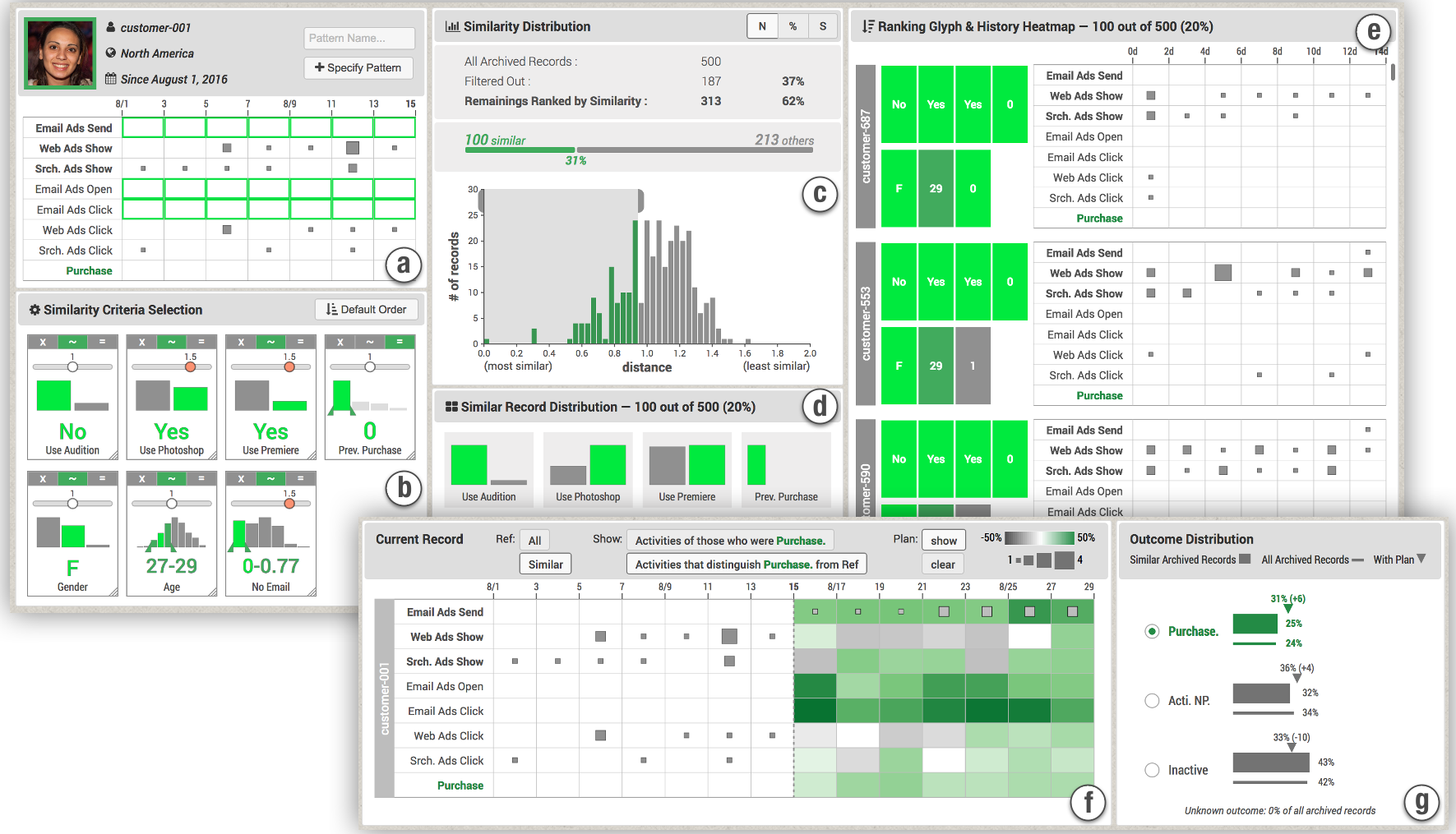 Figure 2: The Activity Summary View showing "Hotspots" (darker squares) where specific interventions lead to higher success rates.
Overcoming the "Messy Data" Challenge
The authors highlight four major technical hurdles in marketing analytics:
- Attribute Scarcity: Marketing data is often anonymous. Solution: Use temporal patterns as a "proxy" for persona.
- Visual Overlap: Too many events at once. Solution: Power-scale visual mapping and categorical grouping.
- Scalability: Millions of records make real-time similarity search hard. Solution: Peer-group indexing.
- The Cost of Failure: Real A/B tests are expensive. Solution: Use "Pseudo A/B Testing" to prune bad ideas before they go live.
Critical Insight: The Human-in-the-Loop
EventAction proves that the future of AI in the enterprise isn't full automation, but augmented intelligence. By allowing analysts to "play" with the timeline and see immediate probabilistic feedback, the tool transforms a static dataset into a dynamic laboratory for strategy.
Future Outlook: As generative AI (like LLMs) becomes more integrated into marketing, the "Interactive Action Plan" pioneered here could evolve from manual drag-and-drop to natural language prompting: "Show me what happens if I delay the discount code by two days."