
Interactive Language: Breaking the Real-Time Barrier in Robotics
Interactive language: Talking to robots in real time
The paper introduces Interactive Language, a framework for training real-world robots to follow open-vocabulary natural language instructions in real-time. By utilizing a transformer-based architecture called LAVA and a massive dataset of ~600,000 trajectories, the system achieves a 93.5% success rate across 87,000 unique commands and enables real-time human-in-the-loop guidance for complex long-horizon tasks.
TL;DR
Researchers from Google Trinity have unveiled a framework that allows humans to talk to robots in real-time to solve complex tasks. By combining a new 600k-trajectory dataset (Language-Table) with a transformer architecture named LAVA, they have enabled robots to understand 87,000 unique commands and respond to live human corrections. The result? A jump from 25% to 85% success on complex "smiley face" block rearrangements through human-in-the-loop guidance.
The "Instruction" Bottleneck
In the quest for general-purpose robots, language has always been the holy grail of interfaces. However, most SOTA systems are "deaf" once they start moving. They take an instruction (e.g., "pick up the red block"), plan a trajectory, and execute it in a blocking fashion. If the block slips or the human changes their mind, the robot is stuck.
The authors identify three missing pillars in current robotics:
- Direct Real-World Presence: Moving beyond simulation to contact-rich manipulation.
- Breadth of Skill: Handling thousands of diverse commands, not just a dozen.
- Real-Time Interactivity: The ability to process new language inputs at 5Hz during execution.
Methodology: Scaling "Play" and Attention
The core of the paper isn't a complex new loss function, but a masterclass in data engineering and architectural intuition.
1. Data: Beyond Random Windows
The team collected 2,700 hours of "play" data—teleoperators just moving blocks around without specific goals. To make this useful, they used Event-Selectable Hindsight Relabeling. Unlike previous methods that picked random clips, they let humans pick meaningful segments and label them. This resulted in the Language-Table dataset, which is an order of magnitude larger than any predecessor.
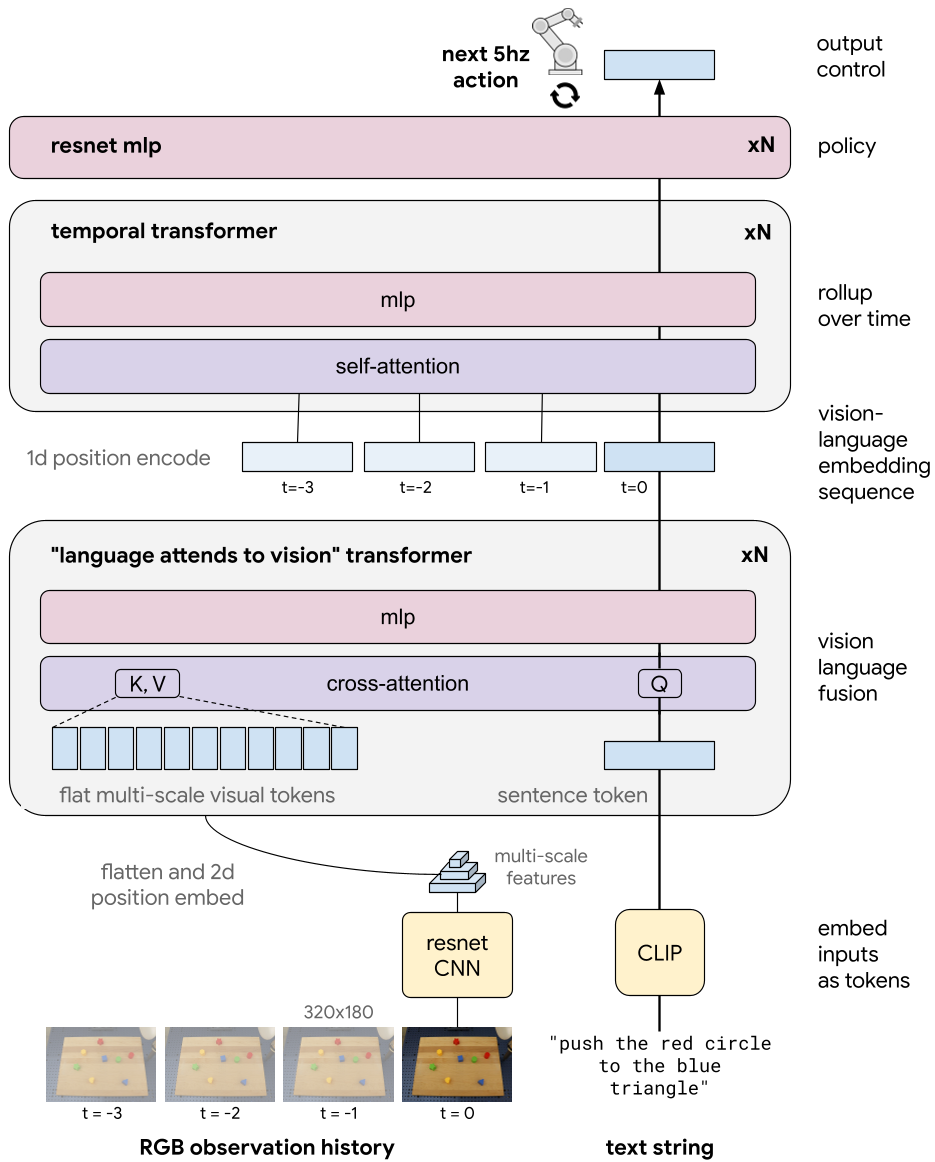
2. LAVA: Language Attends to Vision to Act
The policy architecture moves away from simple global conditioning.
- Perception: Uses a ResNet-based feature pyramid to capture both fine details and global context.
- Fusion: A transformer block where the Language is the Query and Visual Tokens are the Keys/Values. This allows the robot to dynamically "search" the image for objects mentioned in the command.
- Temporal Logic: A second transformer processes the last 4 frames of history to maintain fluid motion.
Experimental Breakthroughs
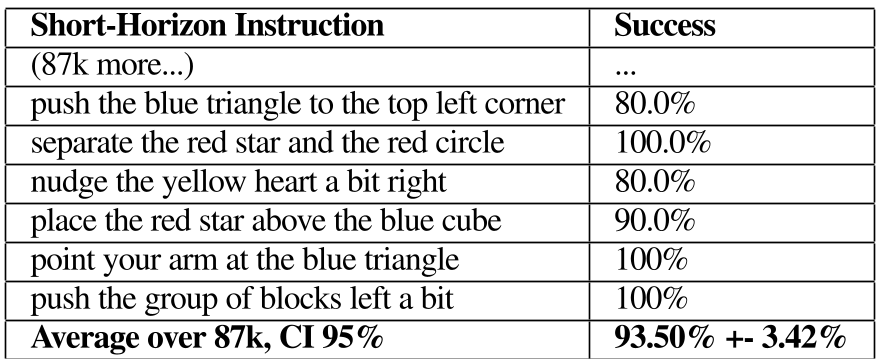
The team tested the system against a staggering 87,000 unique natural language strings. They found that the robot doesn't just recognize nouns, but understands spatial relationships (e.g., "top right of the yellow hexagon") and abstract modifiers ("nudge it a bit left").
The Power of "Wait, No!"
The most striking result came from long-horizon tasks, like arranging blocks into a specific pattern.
- Open-Loop (Fixed Plan): 25% success.
- Real-Time Guidance: 85% success.
In the real-time setting, humans could provide corrections like "slide the triangle slowly left" or "move it away from the edge" to fix errors on the fly. This synergy effectively allows the human to act as the "Global Planner" while the robot handles the "Local Visuomotor Control."
Deep Insight: Multi-Robot Orchestration
Because the robot is responsive and semi-autonomous for short durations, a single human can actually control four robots simultaneously. The operator can give a command to Robot A, and while it executes, give a correction to Robot B. This suggests that low-level language competency is the key to scaling human-supervised robot fleets.
Critical Analysis & Conclusion
While highly successful, the system is currently limited to 2D tabletop manipulation. The "Event-Selectable" labeling, while effective, still requires heavy human labor (64 annotators).
The true value of this work is the open-sourcing of Language-Table. By providing 600,000 labeled trajectories, the authors have given the community the "ImageNet moment" for language-conditioned robotics. The path forward is clear: combining this robust low-level reactivity with more sophisticated high-level reasoning from LLMs.
Takeaway: Interactive Language proves that real-time feedback is the ultimate "safety net" for imitation learning, turning fragile policies into robust, collaborative partners.