
Empowering Digital Immigrants: A Fast Visual Search Platform for Musical and Local Culture
Designing an Interactive Map of Musical Culture and a Digital Humanity App
The paper introduces an interactive mobile visual search platform tailored for the historical Dadaocheng district in Taiwan. By integrating a Client-Server Content-Based Image Retrieval (CBIR) system using SIFT descriptors, the app allows tourists to identify local shops and cultural sites by photographing customized signboards, achieving a 1-second response time.
TL;DR
Researchers have developed a highly efficient mobile visual search platform specifically for the Dadaocheng district in Taiwan. By leveraging a Client-Server CBIR architecture and SIFT descriptors, the system allows users to photograph shop signboards to instantly retrieve cultural and historical information. The system achieves an 88% accuracy rate with a sub-one-second latency, specifically designed to bridge the gap between "Digital Natives" and "Digital Immigrants."
Background: Beyond the Search Bar
When touring historical sites, the friction of typing search queries into a phone often disconnects the traveler from the physical environment. This paper identifies a specific social gap: while younger generations (Digital Natives) navigate complex apps easily, older travelers (Digital Immigrants) require more intuitive interfaces. The authors propose that Visual Search is the most natural bridge for this divide.
Methodology: The Core Engine
The researchers chose a Client-Server architecture to solve the dual problem of mobile processing power and battery consumption.
1. The Recognition Pipeline
- Feature Extraction: The system uses SIFT (Scale-Invariant Feature Transform) to create unique descriptors for shop signboards. SIFT was chosen for its robustness against scaling and rotation—common issues when tourists take photos at awkward angles.
- IPC Optimization: To handle multiple concurrent users, the server uses Named Pipes for Inter-Process Communication, which according to the authors' analysis, outperforms shared memory or socket functions in mobile internet scenarios.
- Data Augmentation: To prepare the system for the "messiness" of real life, the team didn't just use clean photos. They generated blur and brightness variations (8,487 samples for 207 shops) to train the engine for night-time or shaky-hand photography.
 Figure 1: The conceptual framework connecting Digital Natives (designers) to Digital Immigrants (users).
Experimental Validation
The evaluation focused on two key metrics: Speed and Accuracy.
- Latency: By normalizing query images to a 200x200 resolution before transmission, the system minimizes bandwidth usage, allowing the entire loop to finish in < 1 second.
- Precision: Out of 100 random real-world queries, 88 were matched perfectly. The failures typically occurred in cases of extreme occlusion or massive overexposure—challenges that still plague most modern computer vision systems.
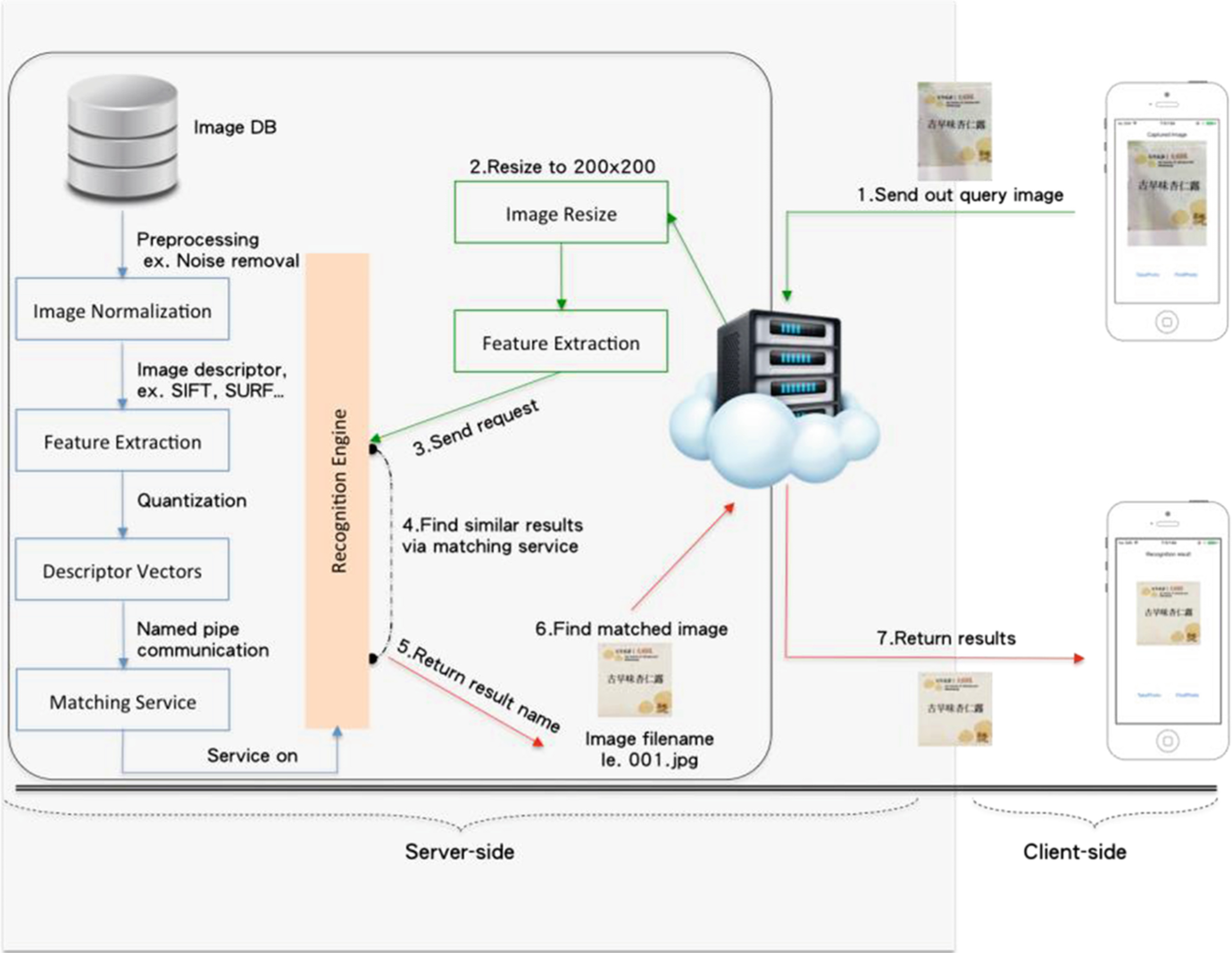 Figure 2: The mobile application interface demonstrating the visual query of a local shop.
Critical Insight: UI as a Solution for Algorithmic Limits
An interesting takeaway from this study is the authors' suggestion for "Future Work." They note that rather than just making the algorithm more complex (which increases cost and latency), one can improve accuracy through UX design. By adding "visual hints" or "overlays" on the camera UI, the app can guide the user to take better photos at the point of capture, effectively "cleaning" the input data before it ever reaches the server.
Conclusion
This research is more than a technical implementation; it is a social intervention. By focusing on a specific locality (Dadaocheng) and a specific demographic (Digital Immigrants), it proves that SIFT-based visual search remains a viable, low-latency alternative to heavy Deep Learning models for localized, high-speed LBS (Location-Based Service) applications.
Future Directions:
- Integration of Augmented Reality (AR) for interactive storytelling.
- Expanding the database to include Atmospheric/Environmental sensors for a richer context.
- Transitioning monitoring logs into a robust database for long-term urban management.