
Beyond Batch: Re-architecting Social Media Abuse Detection for Sub-Second Response
Interactive querying and data visualization for abuse detection in social network sites
The paper introduces a low-latency architecture for abuse detection on social networks, comparing a Distributed SQL Engine (Apache Drill) against a Stateful Stream Processing approach (Kappa Architecture). The proposed streaming method utilizes Apache Spark and Kafka to generate materialized views, achieving sub-150ms interactive querying speeds on a 269GB Reddit dataset.
TL;DR
To protect users from cyber-bullying and self-harm, social platforms need to detect threats as they happen. This paper explores why traditional Big Data SQL engines fail this mission and proves that a Stateful Stream Processing approach (Kappa Architecture) can reduce query latency from hours to just 33 milliseconds.
Background: The Latency Life-or-Death Gap
In the context of the AMiCA project, researchers are tasked with identifying threatening behaviors like cyber-bullying and suicidality. In these scenarios, the "Insights-to-Action" loop must be near-instant. However, standard Big Data stacks are typically built for throughput, not latency, leaving a dangerous gap where a threat is detected only after the harm has occurred.
The Collision of Two Philosophies
The authors pit two architectural philosophies against each other using a 269GB Reddit dataset:
- Distributed SQL (Ad-hoc): Utilizing Apache Drill, this approach allows users to ask any question at any time. It's flexible but slow because it must scan data and execute functions (like sentiment analysis) upon request.
- Stateful Streaming (Pre-computed): Following the Kappa Architecture, this method treats data as a continuous stream. It cleans, analyzes, and saves results into "Materialized Views" (in MongoDB) before the user even asks the question.
Methodology: The Streamlined Pipeline
The core innovation lies in the transition from ad-hoc processing to a continuous stateful pipeline.
Architecture Decomposition
The authors moved away from the complex "Batch + Speed" layers of Lambda architectures, opting for a unified streaming path:
- Ingestion: StreamSets cleanses the raw JSON Reddit data.
- Log Storage: Apache Kafka acts as the "source of truth."
- Computation: Apache Spark Streaming executes UDFs for sentiment polarity (VADER lexicon) and term-frequency analysis.
- Serving: Materialized views in MongoDB allow for O(1) or O(log n) lookups.
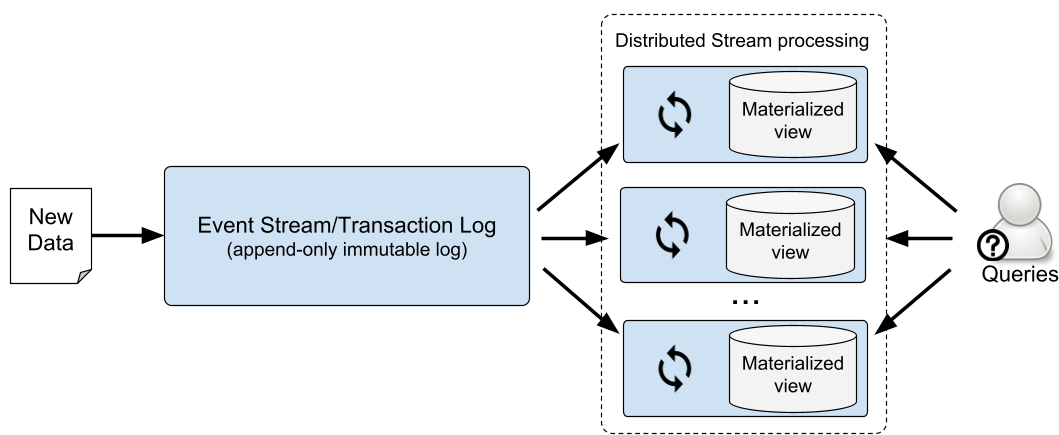 Fig 1: The stateful stream processing approach, decoupling ingestion from querying.
Experimental Showdown
The results were polarized.
- Apache Drill struggled with the complexity of text analysis. On the full dataset, a query involving sentiment analysis took over 2 hours.
- The Streaming Approach delivered results in 33.56ms, maintaining a consistent performance regardless of total historical data size, because the work was already done incrementally.
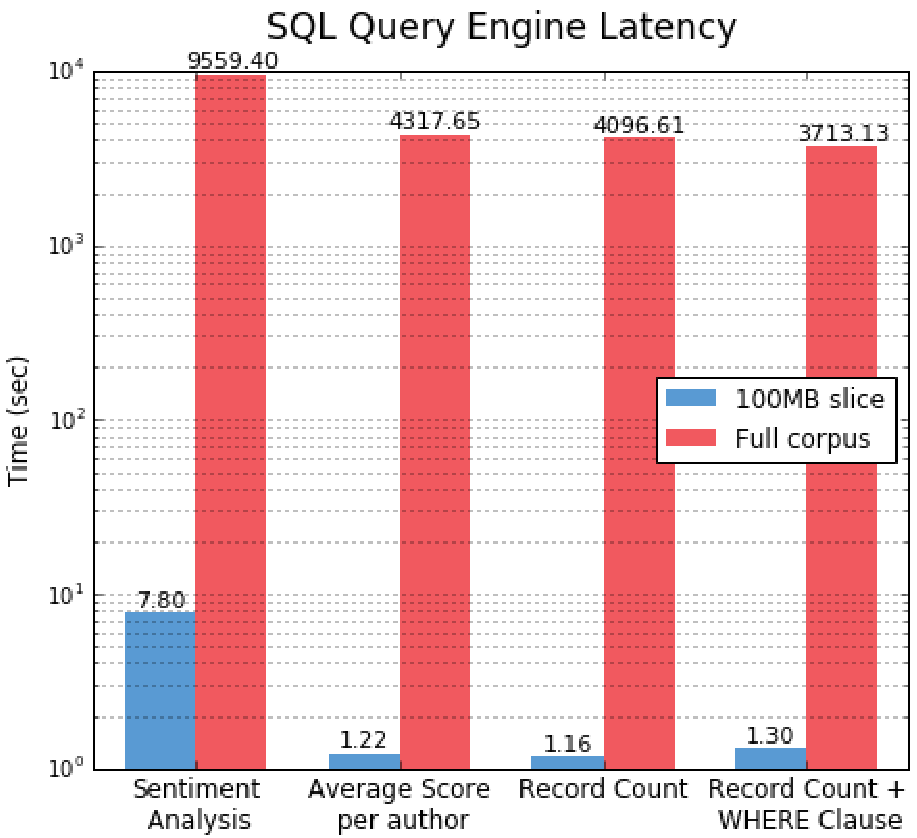 Fig 2: Latency of the SQL engine implementation showing the "Batch Wall" hit by ad-hoc queries.
Critical Insight: The "Preprocessing Tax"
The paper acknowledges a trade-off: The streaming approach is less flexible. If you want to ask a new type of question not covered by your materialized views, you must re-process the stream. However, for specific use cases like abuse detection, where the metrics (sentiment, threat keywords) are well-defined, the trade-off is clearly worth the massive gain in speed.
Conclusion
This work demonstrates that "Interactive" Big Data isn't just about faster databases; it's about changing when we do the math. By moving computation to the ingestion phase, we can achieve the sub-150ms response times necessary for human-in-the-loop monitoring systems that actually save lives.
Takeaway for Engineers: If your dashboard takes more than 1 second to load, consider moving from an "Ad-hoc SQL" mindset to a "Materialized Stream" architecture.