
Interactive Refinement of Linked Data: Turning Casual Users into Ontology Engineers
Interactive Refinement of Linked Data: Toward a Crowdsourcing Approach
This paper introduces an interactive framework for refining Linked Data ontologies using a crowdsourcing-inspired approach. Focused on a multilingual rental apartment FAQ system, it enables non-expert users to correct misclassified data links through text interaction and image uploads.
TL;DR
Maintaining the accuracy of Linked Data ontologies is notoriously labor-intensive. This paper presents a solution that democratizes this process by allowing "casual users" (non-experts) to interactively refine data links within a rental apartment FAQ system. By combining text-based feedback, majority-voting mechanisms, and image-based identification, the system transforms user errors into opportunities for data enrichment.
Context & Positioning
In the hierarchy of the Semantic Web, Linked Data relies on the Resource Description Framework (RDF) to create meaningful connections between disparate data points. However, when these links are generated via automated inference, errors are inevitable. This work positions itself as a bridge between Ontology Learning (automated but imperfect) and Crowdsourcing (human-powered and scalable), specifically targeting the "last mile" of data accuracy in multilingual contexts.
The Pain Point: The Expert Bottleneck
Previous iterations of RDF systems required domain experts to manually audit and fix incorrect links—an approach that is neither scalable nor cost-effective. For instance, if a user queries "Shower is broken" and the system mistakenly maps this to the "Kitchen" floor plan due to a faulty inference rule, a casual user has no way to correct it. This creates a "static error" trap that degrades the utility of the FAQ system over time.
Methodology: The Interactive Refinement Loop
The authors introduce a refinement protocol that triggers whenever a system output fails to satisfy a user. The core logic follows a three-scenario path:
- New Keyword Discovery: If a user inputs a term unknown to the ontology, they are prompted to categorize it (e.g., associating "Toilet flush" with the "Bathroom" plan).
- Disambiguation: If keywords exist but point to the wrong location, the system shows the "reasoning" and allows the user to vote for a more relevant link.
- Conflict Resolution: Uses a "Voting" mechanism in a temporary ontology. A change is only committed to the real ontology if it reaches a majority threshold.
Architectural Flow
The interaction between the user and the RDF database (managed via Apache Jena Fuseki) is structured to prioritize user intuition over complex logic.
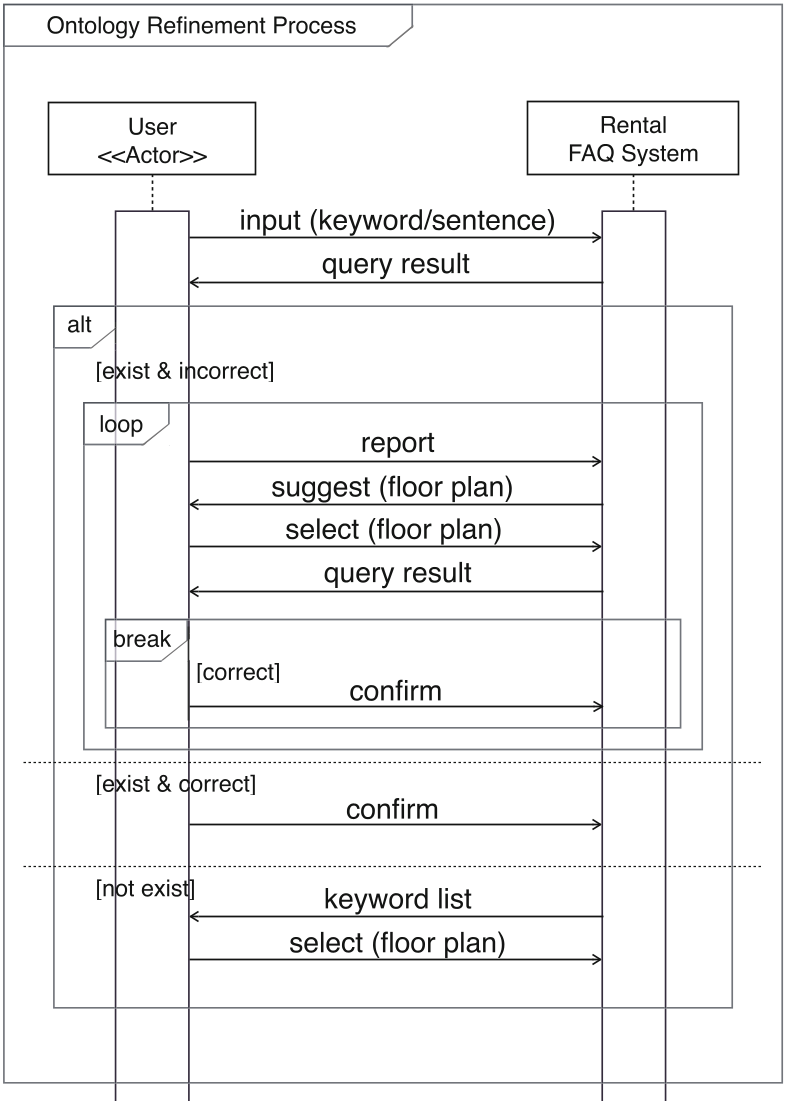 Figure 1: UML diagram illustrating the interactive refinement protocol between the user and the system.
Breaking the Language Barrier with Pictures
A standout feature of this research is the Picture Function. Recognising that international students might not know the Japanese or English technical name for a broken apartment component, the system allows them to upload a photo.
- The photo is shared with the "crowd."
- Other users label the photo.
- The system links the new label to the ontology and the image.
This multi-modal approach ensures that the "Semantic" part of the Semantic Web isn't limited by a user's vocabulary.
Experimental Data Strategy: How to Store the "Votes"?
Crowdsourcing introduces a technical challenge: how do you store transient "votes" in a strict RDF format? The authors evaluate three approaches:
- Reification: Creating "statements about statements." While standard, it triples the number of required triples.
- External SQL Tables: Fast and efficient, but breaks the "Pure RDF" paradigm, requiring dual-query (SPARQL + SQL) logic.
- Direct RDF Recording: Storing individual user sessions as separate RDF entries and aggregating them during query time.
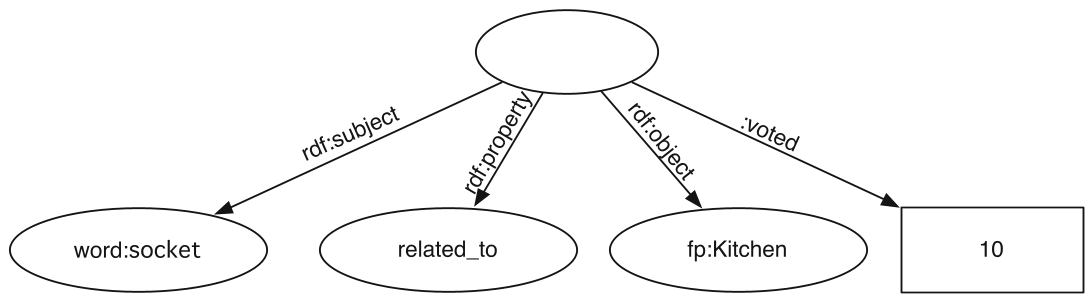 Figure 2: Example of RDF Reification used to attach user "votes" to a specific data link.
Critical Insight & Future Outlook
The brilliance of this work lies in its Inductive Bias toward simplicity. By assuming that the "crowd" is generally correct, it circumvents the need for complex logic validation.
Limitations: The paper currently lacks a robust defense against "malicious users" or "trolls" who might intentionally mislabel data. Future Work: The authors aim to introduce Gamification (Games-with-a-purpose), turning the tedious task of ontology cleaning into a rewarding experience for users.
Summary Takeaway
This research moves us closer to a Self-Healing Web of Data. By treating every user interaction as a potential "Micro-Task," we can maintain high-quality ontologies without the high-quality price tag of domain experts.