
Integrated Modeling of Agri-Environmental Measures: Beyond the "One-Size-Fits-Of" Policy
An interdisciplinary modelling approach assessing the cost-effectiveness of agri-environmental measures on reducing nutrient concentration to WFD thresholds under climate change: the case of the Louros catchment
This paper presents an interdisciplinary modeling framework to evaluate the cost-effectiveness of Agri-Environmental Measures (AEMs) in the Louros catchment, Greece. It integrates the INtegrated CAtchment (INCA) nitrogen and phosphorus models with socio-economic analysis to meet EU Water Framework Directive (WFD) thresholds under climate and land-use change scenarios.
TL;DR
This research challenges the blanket application of expensive agri-environmental programs. By combining the INCA-N/P hydrochemical models with socio-economic cost assessments in Greece's Louros catchment, the authors demonstrate that while significant nutrient reduction is technically possible (up to 54%), it may not be economically justified if current water quality already meets thresholds—unless climate change projections suggest a future risk of "wash-out" events.
Problem & Motivation: The Efficiency Gap in Green Policies
EU Common Agricultural Policy (CAP) allocates billions of Euros to Agri-Environmental Measures (AEMs). However, policy design often lacks a link between physical effectiveness (how much nitrogen actually leaves the soil) and economic efficiency (is this the cheapest way to reach a water quality target?).
The authors identify a critical "Type I error": spending public funds on measures that are either not needed or don't work under future climate shifts. In the Louros catchment, a complex karstic system, the interaction between agriculture, hydroelectric dams, and Natura 2000 habitats makes traditional "top-down" regulation risky and potentially wasteful.
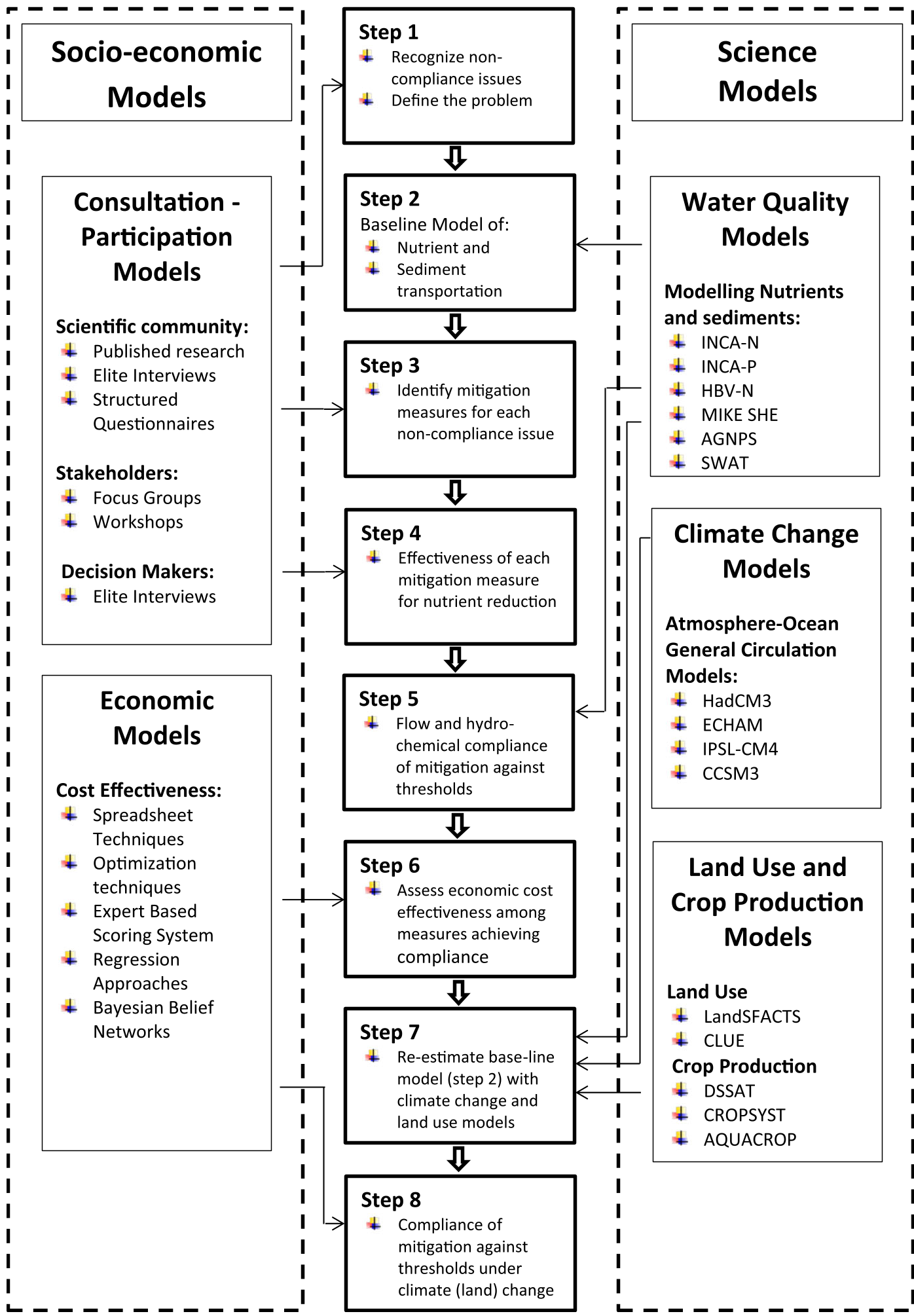
Methodology: The 8-Step Integration Framework
The core of this paper is a structured workflow that bridges the gap between soil science and farm economics.
1. Structural Logic
The methodology proceeds from identifying non-compliance to calibrating the INCA (INtegrated CAtchment) model, then evaluating mitigation options (like crop rotation or buffer strips) through the lens of both nutrient transport and farmer income loss (Standard Gross Margin).
2. The INCA Model (The Technical Engine)
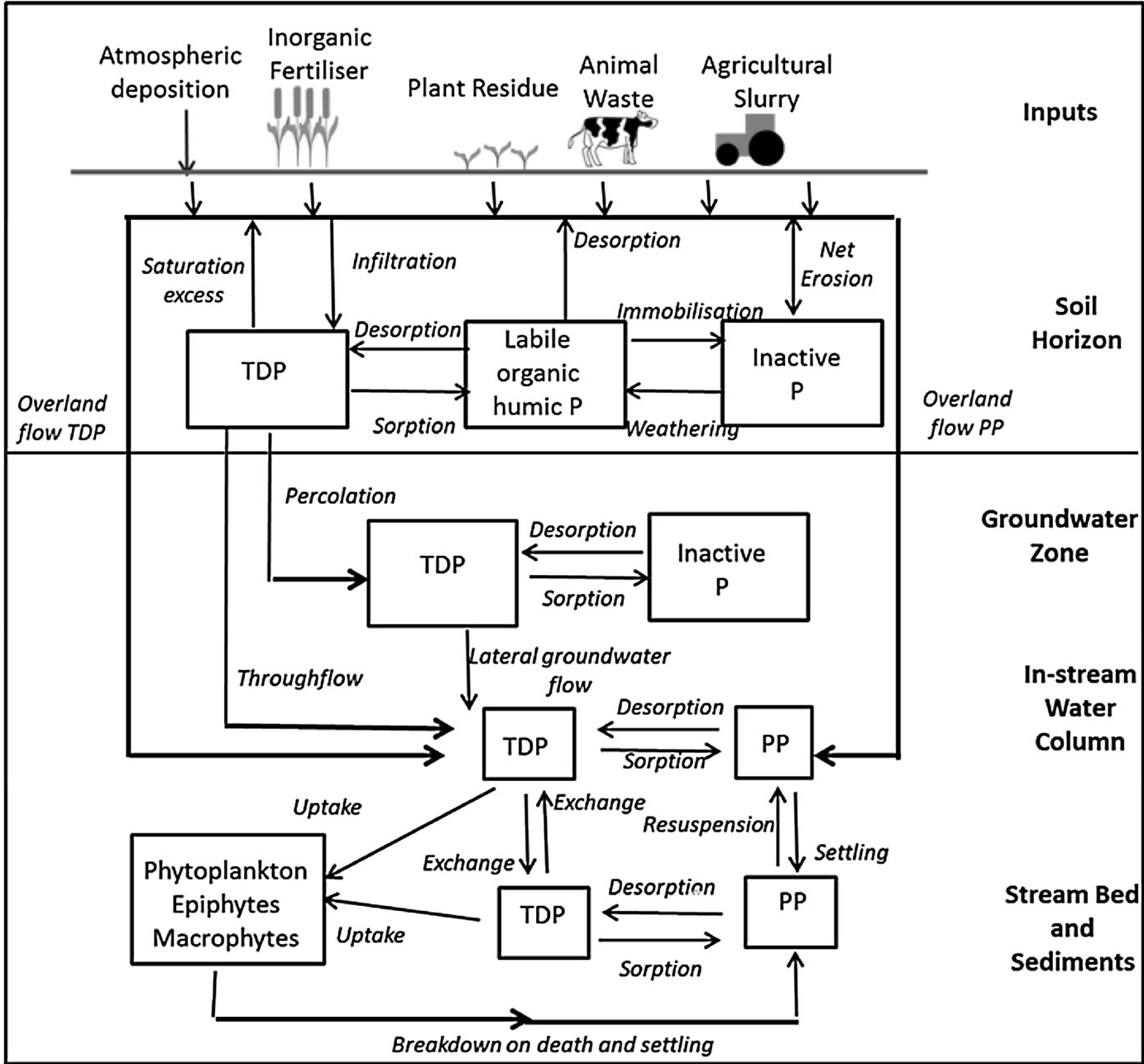
The INCA-P model simulates the phosphorus cycle in soils, groundwater, and streams. It accounts for spatial variations in land use and hydrology, allowing researchers to "track" how a reduction in fertilizer at the farm gate translates to a concentration change at a specific river monitoring point.
Experiments & Results: A Reality Check for Regulators
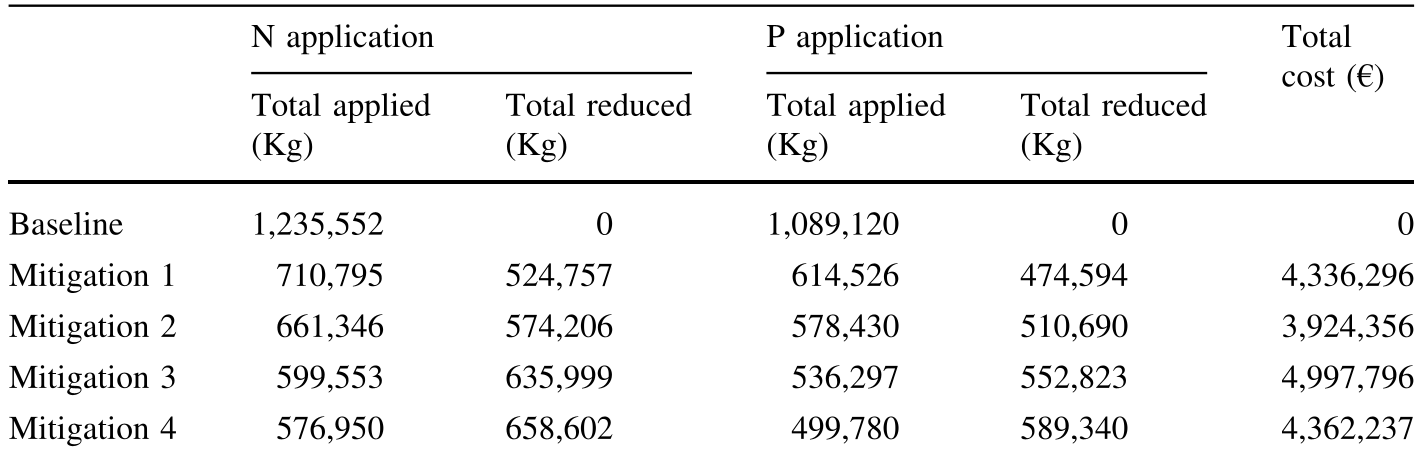
The study analyzed four mitigation schemes involving 25-30% set-asides and the use of nitrogen-trapping legumes.
- Cost vs. Benefit: The abatement cost was calculated at approximately €6.6 to €8.26 per kg of Nitrogen.
- Baseline Reality: Surprisingly, the Louros river is currently "cleaner" than expected. The baseline model showed Nitrogen levels consistently below the 1.5 mg/L threshold.
- The Phosphorus "Wash-out" Risk: While Phosphorus (P) isn't a major issue now due to dry summers (where P stays in the soil), climate models suggest that wetter future summers could trigger a sudden flushing of accumulated phosphorus into the Amvrakikos Gulf.
Critical Analysis & Conclusion: Prevention vs. Cure
The paper’s most significant contribution is the argument for Resilience over Mitigation.
Takeaway
If a catchment is not in immediate "ecological failure," rather than implementing high-cost Pillar 2 AEMs that reduce agricultural productivity, policy should focus on Pillar 1 cross-compliance. This includes institutionalizing "early involvement" resilience actions—such as alternative fertilization techniques—that prevent environmental issues from emerging as the climate shifts.
Limitations
A notable limitation is the reliance on SRES climate scenarios (which are now being succeeded by RCP/SSP models) and the assumption that land-use change follows productivity changes linearly. Furthermore, the specialized karstic geology of the Louros catchment means these exact results might not translate directly to non-karstic regions without local recalibration.
Future Outlook
This work sets a precedent for "evidence-based greening" of the CAP. As European water bodies reach their 2027 WFD goals, the use of integrated models like INCA will be essential to justify the allocation of thinning rural development budgets.