
IASLP: Mimicking Human Social Intelligence for Efficient P2P Content Discovery
Interest-Aware Content Discovery in Peer-to-Peer Social Networks
The paper introduces IASLP (Interest-Aware Social-Like Peer-to-Peer), a decentralized model for content discovery in Online Social Networks (OSNs). By mimicking ten social theories—such as community formation based on homophily—the model enables autonomous nodes to self-organize into interest-based clusters, significantly improving search efficiency in unstructured P2P environments.
TL;DR
The IASLP (Interest-Aware Social-Like Peer-to-Peer) model revolutionizes how we find content in decentralized social networks. By mimicking human social behaviors—such as forming "interest communities" and prioritizing "knowledgeable acquaintances"—it achieves a 20% higher recall than previous SOTA methods like SESD, while simultaneously lowering network traffic by 10%.
The "Small World" Search Problem
As users migrate away from centralized platforms (like Facebook or X) due to privacy concerns, decentralized Peer-to-Peer (P2P) social networks have emerged as a viable alternative. However, these networks face a fundamental "discovery" challenge: How do you find a specific file among millions of nodes without a central directory?
Traditional flooding methods clog the network, while Distributed Hash Tables (DHTs) are brittle under high "churn" (nodes constantly joining and leaving). The authors of this paper realized that the answer lies in Social Wisdom. Just as you ask a "techie" friend for a software recommendation, P2P nodes should "remember" who holds what type of information.
Methodology: The Social Brain of a Node
The core of IASLP lies in its Social Knowledge Index, which bifurcates a node's memory into two distinct areas based on social ties:
1. The Dual-Index Architecture
- Interest Index (Strong Ties): Stores information about peers who share the node's core interests. This spontaneously forms "Content Communities."
- Knowledge Index (Weak Ties): Stores "incidental" knowledge—information about peers who held content for past queries unrelated to the node's main interests.
2. Adaptive Forwarding & The "Olfactory" Intuition
Unlike standard algorithms that treat all neighbors equally, IASLP uses an Adaptive Node Selection Algorithm.
- Physical Intuition: The authors use the concept of olfactory fatigue. If a neighbor has a high "concentration" of relevant documents, the "scent" is stronger, and the node is more likely to forward the query there.
- Mathematical Edge: The forwarding degree is calculated using a power-law adjustment factor , ensuring that "expert" nodes receive the bulk of the traffic, while still allowing for occasional random exploration to find new "social worlds."
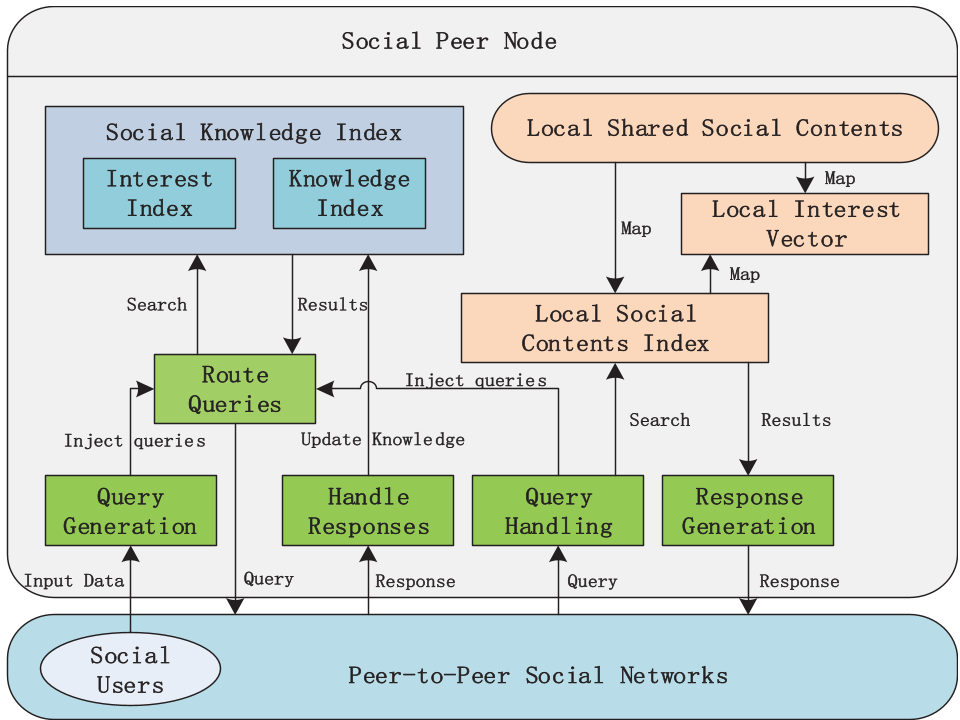 Figure 1: The overall architecture of the IASLP node and its interaction with social content.
Experimental Showdown: Surpassing the SOTA
The researchers tested IASLP against three heavyweights: RBFS (Random Breadth-First-Search), NeuroGrid, and SESD.
Key Findings:
- High Recall: Even in a mature network with thousands of nodes and high churn, IASLP consistently found more documents than SESD.
- Efficiency: IASLP achieved the highest "Recall per Query Message." This means it finds more content while sending fewer packets across the wire.
- Robustness: When the relevance of content to a user's interest decreases (simulating erratic user behavior), IASLP's performance remained stable compared to its peers.
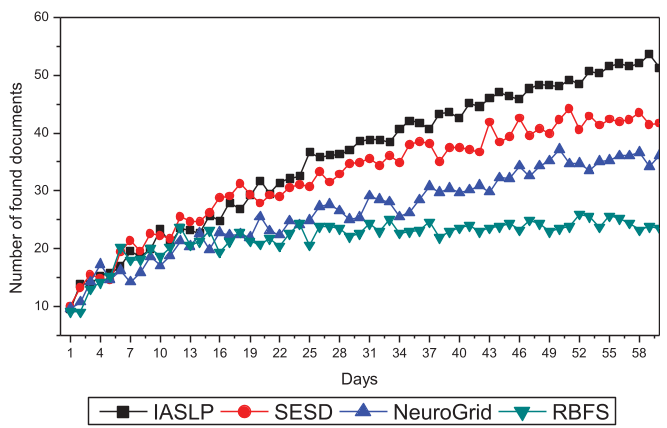 Figure 2: Average Recall comparison between IASLP, SESD, NeuroGrid, and RBFS.
Deep Insight: Why it Works
The secret sauce is Self-Organization. IASLP doesn't use extra "control messages" to build communities. Instead, it "learns" the network topology during the search process itself. By combining declared interests with historical search results, each node builds a personalized map of the "Social Small World."
Critical Analysis & Future Outlook
Takeaway: This work proves that unstructured P2P networks don't have to be inefficient. By embedding "Social Strategies" into the protocol layer, we can create decentralized systems that are as fast as centralized ones but far more private.
Limitations: The current study assumes a relatively honest environment. In a real-world OSN, "Interest Spoofing" (nodes lying about their interests to attract traffic) could be a threat. Future research should integrate Trust and Reputation models into the IASLP framework to mitigate adversarial behavior.
Conclusion
IASLP is a masterclass in applying sociopsychological principles to hard engineering problems. It moves us one step closer to a decentralized web that is both scalable and deeply attuned to human interest patterns.