
Interest-Aware Next POI Recommendation: Bridging Latent Interests and Contextual Logic
Interest-Aware Next POI Recommendation for Mobile Social Networks
This paper introduces an interest-aware next POI (Point-of-Interest) recommendation framework for mobile social networks. It leverages a spatial-temporal LDA topic model and spectral clustering to capture personalized user preferences, achieving superior performance on the Gowalla dataset compared to traditional Markov Chain and FPMC baselines.
TL;DR
Predicting where a user will go next is a cornerstone of Personalized Location-Based Services (LBS). This paper presents a framework that extracts "latent interests" using a spatial-temporal topic model and combines them with social and temporal context. By using Spectral Clustering to group similar users and Random Forest for final prediction, the approach achieves a higher F1-score than traditional Markov Chain-based models on real-world Gowalla data.
Problem & Motivation: Beyond Simple Transitions
Why is next POI recommendation so difficult?
- Data Sparsity: Most users only check in at a handful of locations, making it hard to build a robust profile for any single individual.
- Contextual Complexity: A "library" visit at 10 AM on a Tuesday (likely work/study) means something entirely different than a visit at 10 PM on a Friday (potentially social or specific event).
- Interpretability Gap: Modern RecSys often defaults to Deep Learning (RNNs/LSTMs), which are powerful but provide little insight into why a location was suggested.
The authors’ core insight is that user interest is a latent distribution over spatial-temporal "words." By grouping users who share these distributions, we can "borrow" data from similar users to solve the sparsity problem.
Methodology: The Core Framework
The proposed solution follows a rigorous four-step pipeline:
1. Spatial-Temporal Topic Modeling (LDA)
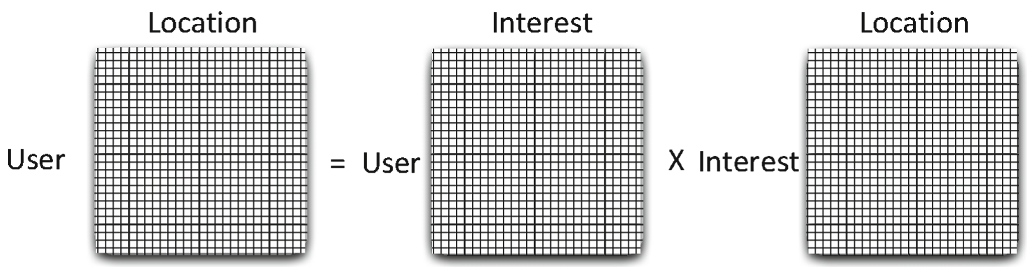
The researchers redefined the "words" in a document. Instead of text, a "word" is a tuple: (LocationID, Is_Weekday, Hour_of_Day). A user’s check-in history becomes a "document." By applying Latent Dirichlet Allocation (LDA), they map every user to a distribution across interest topics.
2. Spectral Clustering for User Groups
To handle the "Cold Start" or sparse data problem, the authors use Spectral Clustering. Unlike K-Means, spectral clustering is highly effective for finding clusters in sparse, high-dimensional interest spaces. This groups users into "interest tribes," allowing the model to use the collective wisdom of the tribe for predictions.
3. Comprehensive Feature Extraction
The model doesn't just look at the last location. it extracts:
- Interest Features: The most likely next POIs based on the user's cluster.
- Contextual Features: Transitions filtered by time (hour/day) and social links (friends' preferences).
- Global Trends: The general Markov transition matrix for all users.
4. Supervised Learning via Random Forest
The final "decision maker" is a Random Forest classifier. It takes the candidate POIs suggested by each individual feature and learns which feature to trust under specific circumstances.
Experiments & Results
The model was validated using the Gowalla dataset, specifically focusing on San Francisco check-ins.
SOTA Comparison
The Interest-Aware model was compared against FPMC (Factorizing Personalized Markov Chains) and standard MC (Markov Chains).
| Method | Recall | Precision | F1-score |
|---|---|---|---|
| Interest-aware | 0.1017 | 0.1925 | 0.1251 |
| FPMC | 0.0878 | 0.2874 | 0.1229 |
| Markov Chain | 0.0883 | 0.2114 | 0.1167 |
While FPMC shows high precision, the Interest-aware model provides a much better balance (F1-score), largely due to its superior Recall. This suggests that considering the "interest tribe" of a user helps find relevant locations that simple transition models miss.
Key Insight: The "N" Factor
The number of clusters () is critical. As seen in the ablation studies, the model's performance peaks at .
- If is too small, recommendations are too "generic."
- If is too large, the clusters become too small to overcome data sparsity.
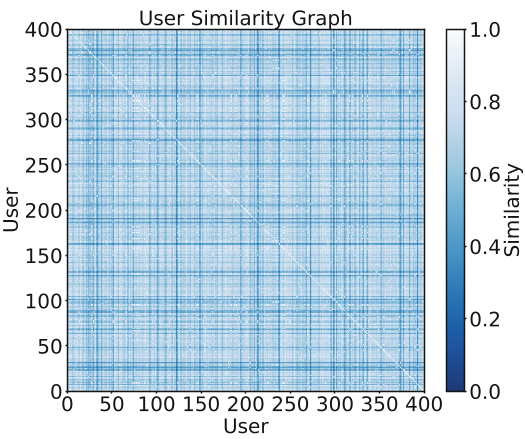 Visual evidence showing how Spectral Clustering successfully groups users with similar interest distributions (right) compared to the raw shuffled data (left).
Critical Analysis & Conclusion
Takeaway
The strength of this work lies in its feature engineering. By transforming "check-ins" into "spatial-temporal words," the authors successfully applied NLP techniques (LDA) to geographic data. The bridge between unsupervised clustering and supervised classification creates a pipeline that is both high-performing and easier to debug than an end-to-end neural network.
Limitations
- Static Interests: The model assumes user interests are relatively static across the dataset period. In reality, interests evolve.
- Computational Cost: Spectral clustering and LDA on massive datasets (millions of users) can be computationally expensive to retrain frequently.
Future Prospect
Future iterations could replace the LDA/Random Forest combo with Graph Embedding techniques (like Node2Vec or GraphSAGE) to better capture the social network topology while maintaining the interest-aware philosophy established here.