
SocialTube: Harmonizing Social Networks and P2P for the Next Generation of Short-Video Sharing
An Interest-Based Per-Community P2P Hierarchical Structure for Short Video Sharing in the YouTube Social Network
The paper introduces SocialTube, a hierarchical P2P short-video sharing architecture designed specifically for YouTube's ecosystem. It leverages actual social subscription data to build a two-level overlay (per-channel and per-interest) that achieves SOTA performance in reducing server bandwidth and startup latency.
TL;DR
The explosion of short-video platforms like YouTube has created a massive bandwidth bottleneck for centralized servers. While Peer-to-Peer (P2P) solutions exist, they typically fail for short videos due to high churn and overhead. SocialTube solves this by shifting the P2P logic from "who is watching this video" to "who is subscribed to this channel," creating a stable, hierarchical structure that slashes server load and kills startup latency.
Background: The Scalability Crisis of Short Videos
As of 2011, YouTube was seeing 2 billion views per day. Unlike Netflix or traditional VoD where users watch a 2-hour movie and stay in an overlay, YouTube users jump between 3-minute clips.
- The Problem with "Per-Video" Overlays: If you build a network for every single video (like NetTube or PA-VoD), the "maintenance overhead" explodes. A user watching 10 videos in a session would have to join and leave 10 different overlays, creating massive signaling traffic.
- The Problem with Availability: Since the videos are short, by the time you find a peer, they might have already finished the video and left.
The Core Insight: Interest-Based Stability
The authors of SocialTube realized that while video views are transient, social subscriptions are persistent.
- Subscribers are a Community: If you subscribe to a channel, you are highly likely to watch most videos that channel uploads.
- Interests are Predictable: Most users have a narrow set of interests (Gaming, Tech, etc.), which allows for clustering not just by channel, but by category.
Methodology: The Two-Level Hierarchy
SocialTube organizes peers into a two-level structure to ensure high "Peer Availability" with low "Redundancy."
1. The Per-Channel Overlay (Lower Level)
Subscribers of the same channel are grouped. Since they share a common interest in the creator's content, they effectively act as a permanent cache for each other.
2. The Interest-Based Cluster (Higher Level)
Users interested in "Technology" but following different channels are linked at a higher level. This allows a user to find a rare video from a peer in a related channel before resorting to the expensive central server.
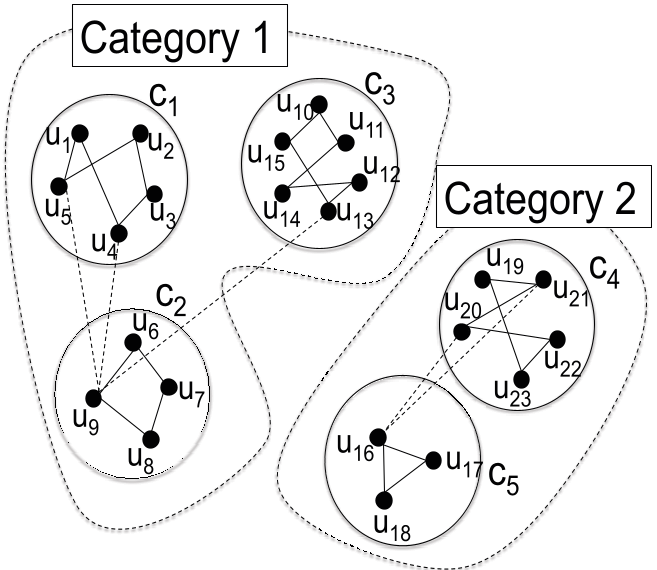 Figure 1: The hierarchical architecture showing inner-links (intra-channel) and inter-links (cross-channel/interest-based).
3. Smart Prefetching
Instead of randomly prefetching related videos, SocialTube uses the Zipf distribution of channel views. It identifies the most popular videos in a user's subscribed channels and prefetches the first few chunks, achieving a prefetch accuracy of over 50%.
Experiments & Results
The researchers validated SocialTube using both PeerSim (10,000 nodes) and PlanetLab (a real-world global testbed).
- Maintenance Overhead: This is the "killer app" of SocialTube. While NetTube's overhead grows linearly as a user watches more videos, SocialTube's overhead remains flat. By the end of a session, a NetTube user might be managing 50+ links, while a SocialTube user stays at a constant 15.
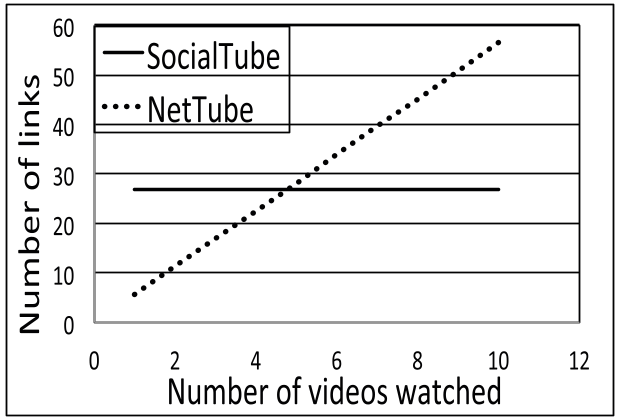 Figure 2: Overlay maintenance overhead over time. SocialTube's stability is key to its scalability.
- Server Relief: SocialTube successfully offloads the majority of the traffic to peers. For 50% of the nodes, more than 63% of the data comes from peers, significantly higher than previous SOTA methods like PA-VoD.
Critical Insight & Conclusion
SocialTube proves that Social Logic > Network Logic. By aligning the P2P overlay with the way humans actually consume content (via subscriptions and interests), the system achieves a level of stability that previous "technical-only" solutions could not.
Limitations: The system relies on the YouTube server to periodically update video popularity lists for prefetching. In a fully decentralized world, this "centralized helper" would need to be replaced by a distributed consensus or gossip protocol.
Future Outlook: As we move toward 4K/8K short-form content (TikTok, Reels), the bandwidth pressure will only grow. SocialTube’s hierarchical community approach remains a blueprint for offloading central clouds to the "network edge" via social bonds.