
Beyond "Who You Know": Mining Interest Communities via Weak Association Rules
The interest community mining method of social network based on the weak association rules
This paper introduces a novel interest community mining method based on "Weak Association Rules" for social networks. By relaxing the constraints of traditional association rule mining, the authors successfully group users into cohesive interest-based communities using tag co-occurrence data from platforms like Sina Weibo.
TL;DR
In the evolving landscape of Web 2.0, our social circles are increasingly defined by "what we like" (Interest Graphs) rather than "who we know" (Social Graphs). This paper addresses the limitations of traditional community detection by proposing Weak Association Rules. By focusing on tag co-occurrence thresholds rather than rigid set intersections, the authors provide a scalable way to cluster users into meaningful interest groups even when explicit social links are missing.
Background: The Shift from Social to Interest Graphs
Most classic community detection algorithms (e.g., the GN algorithm or modularity-based spectral analysis) rely on the Social Graph—the "we know each other" network. However, modern platforms like Twitter or Sina Weibo operate heavily on the Interest Graph.
The challenge? In an interest graph, two people might both be obsessed with "Distributed Systems" but never follow each other. Traditional data mining, specifically standard Association Rule Mining (like the famous "Beer and Diapers" example), is too strict for this. It requires an all-or-nothing presence of tags, which fails because users often choose different but related tags (e.g., one user tags "Big Data" while another tags "Hadoop").
Methodology: The Power of "Weak" Association
The core innovation is the Weak Association Rule. Instead of requiring a Frequent Item Set (FIS) where all elements must appear together in a transaction, the authors define a Frequent Tag Set (FTS) based on pairwise co-occurrence rates.
The Core Intuition
If the co-occurrence rate meets a threshold , those tags are linked. The problem of finding an interest community effectively becomes a graph problem: finding the maximum complete subgraphs (cliques) where every tag in the set is sufficiently related to every other tag.
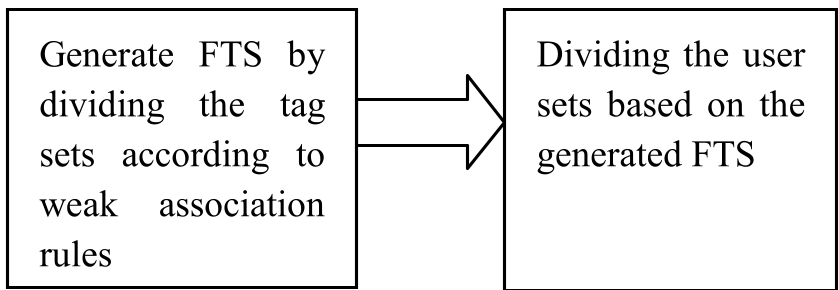 Figure 1: The recursive tree-based flow to generate Frequent Tag Sets (FTS).
The Algorithm Workflow
- Preprocessing: Filter out infrequent tags that don't meet the baseline usage threshold.
- Pairwise Calculation: Calculate the co-occurrence rate for all pairs of tags (K2S).
- Recursive Tree Building: Starting with a root tag, the algorithm builds a tree and prunes branches where the new tag does not maintain the "weak association" with all existing tags in the current path.
- User Mapping: Once FTSs (the communities) are identified, users are assigned to them based on which FTS contains the most of their personal tags.
Experimental Insights
The authors tested this on 1000 users from Sina Weibo. Using a co-occurrence threshold of 0.2, the system successfully extracted logical clusters.
| FTSID | Interest Community (FTS) |
|---|---|
| 1 | {Travel, photography, fashion, music, art} |
| 2 | {Hadoop, cloud computing, distributed} |
| 3 | {Product managers, user experience, interaction design, PM} |
Experimental Result Table: Note how the weak association allows "Hadoop" and "Cloud Computing" to cluster together even if not every "Cloud" user uses the "Hadoop" tag.
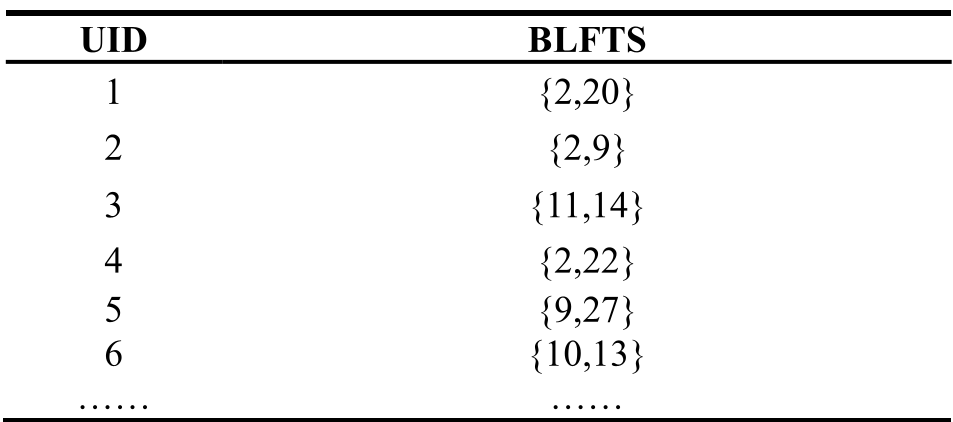 The mapping of Users (UID) to their respective Interest Communities (BLFTS).
Critical Analysis & Conclusion
The beauty of this approach lies in its Inductive Bias: it assumes that human interest is "fuzzy." By moving away from the rigid requirements of traditional Association Rules, the method becomes far more resilient to the "capricious" nature of how people tag themselves.
Limitations:
- Computational Complexity: The exhaustive search for complete subgraphs is NP-hard. For millions of nodes, this would require heuristic optimization or distributed graph processing (like Pregel or Spark GraphX).
- Static Nature: The current model doesn't account for how interests drift over time.
Future Outlook: Integrating this with NLP-based tag expansion (using Word2Vec or LLM embeddings) could solve the synonym problem (e.g., realizing "AI" and "Machine Learning" are effectively the same in certain contexts) before the weak association rules are even applied. This work paves the way for more precise advertising and academic collaborator matching by looking at the content of our personas rather than just the links in our network.