
ICB: Bridging Content Semantics and Network Topology in Mobile Social Networks
Interest- and Content-Based Data Dissemination in Mobile Social Networks
The paper introduces ICB (Interest- and Content-Based dissemination), a routing scheme for Mobile Social Networks (MSNs) that integrates message content analysis with evolving network topology. The core method leverages Singular Value Decomposition (SVD) for content profiling and PageRank for dynamic relay selection, achieving superior delivery performance over SANE and BinarySW.
TL;DR
Information dissemination in Mobile Social Networks (MSNs) has long relied on either "flooding" or simple user-interest matching. The ICB (Interest- and Content-Based) scheme changes the game by using Latent Semantic Analysis (SVD) to understand what a message is actually about and PageRank to identify who the most influential carriers are. The result? A 25% boost in delivery performance with significantly lower costs than traditional flooding.
The Missing Link: Data Content
In the world of MSNs—think smartphones communicating via Bluetooth or Wi-Fi in a crowded conference—the network is constantly changing. Previous SOTA methods like SANE or Bubble Rap solved half of the puzzle. They looked at who you are (Interests) or where you are in the crowd (Centrality).
However, they ignored the Message Content itself. A message isn't just a packet; it's a collection of topics. Without understanding the specific content profile of the data being moved, relay nodes are chosen blindly, leading to wasted battery and missed connections.
Methodology: The ICB Framework
The ICB scheme operates on two pillars: Semantic Similarity and Structural Importance.
1. SVD-Powered Content Analysis
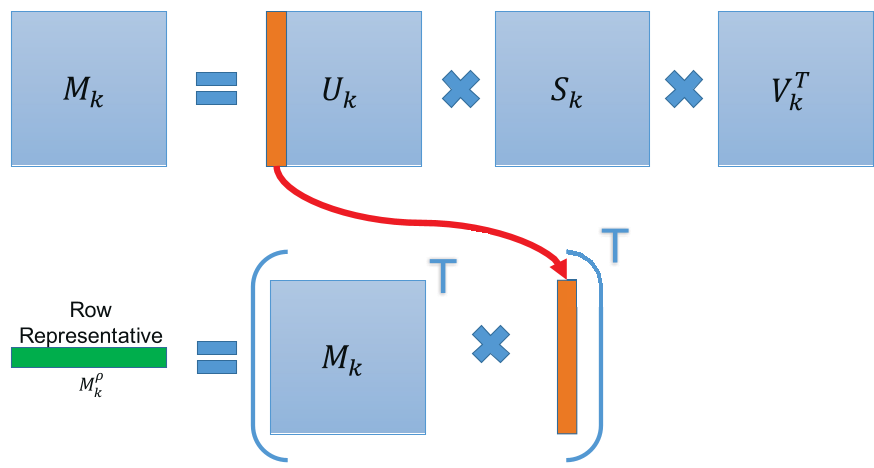
A single message might contain multiple items (e.g., different news clips). ICB represents these as a matrix and applies Singular Value Decomposition (SVD) to extract the "First Singular Vector." This vector represents the latent essence of the message, which is then compared against a user's Interest Profile using cosine similarity.
2. Dynamic Centrality via PageRank
Because these networks are "Delay Tolerant" (nodes come and go), ICB treats the MSN as a series of time-sliced graphs. It calculates a PageRank score for each node at every interval. If a node is a "hub"—meaning it meets many other people frequently—it is assigned a higher probability of being a relay, even if its personal interest in the message is low.
3. The Utility Score
The final decision to forward a message to a neighbor is governed by a weighted formula: This ensures that messages are carried by people who either care about the content or are positioned perfectly to pass it to others.
Performance: Winning in Constraints
The researchers tested ICB against the Epidemic (flooding) and SANE (interest-based) protocols using the INFOCOM06 dataset.
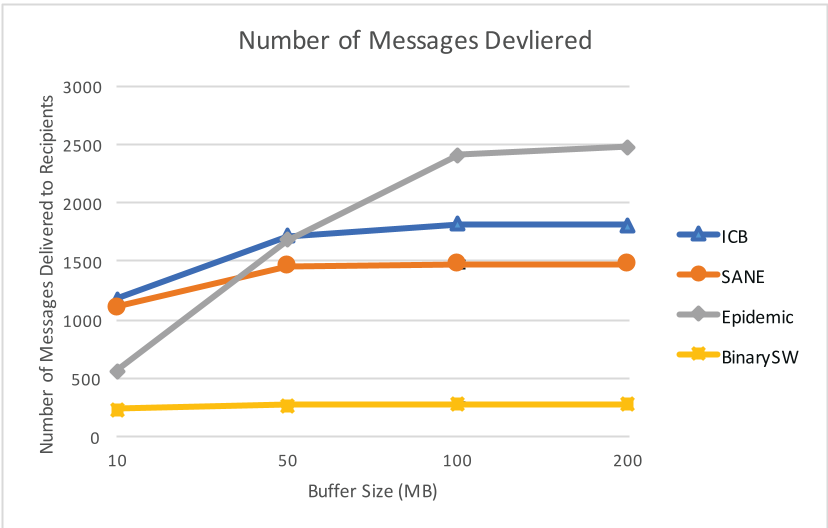
- Efficiency under Pressure: While Epidemic routing is usually the "gold standard" for delivery ratio, it collapses when device buffers are small (e.g., 10MB) because it overflows the network with junk. ICB outperforms Epidemic in these realistic, resource-constrained environments.
- Delivery Success: ICB consistently achieved a 25% higher delivery rate to interested users compared to interest-only methods like SANE.
Critical Insight
The brilliance of ICB lies in its Inductive Bias: the assumption that a good relay isn't just someone who likes the data, but someone who is "structurally significant" to the network. By weighting PageRank higher than simple similarity ( vs ), the authors prioritize the network's transport capacity without losing the specificity of content-based targeting.
Conclusion
ICB proves that "Content is King," but "Context is Queen." By merging SVD-based semantic extraction with PageRank-based topology analysis, we can build mobile networks that are both smarter and leaner. This has massive implications for future Ad-Hoc networks and local data sharing in smart cities.