
InterestSpread: Harmonizing Throughput and Social Willingness in Mobile Social Networks
InterestSpread: An Efficient Method for Content Transmission in Mobile Social Networks
The paper introduces InterestSpread, a novel two-stage routing algorithm for Mobile Social Networks (MSNs) that optimizes large-scale content transmission. By integrating contact probability, social features, and bandwidth constraints, it achieves high network throughput while minimizing the resource drain on nodes not interested in the content.
TL;DR
In the era of high-definition User-Generated Content (UGC), Mobile Social Networks (MSNs) struggle to balance network speed with device battery life. InterestSpread is a two-stage routing framework that uses social features and bandwidth estimation to select "interested" relays, maximizing throughput via Max-flow while sparing the resources of uninterested users.
Problem & Motivation: The Conflict of Interest
Mobile Social Networks operate on a "Store-Carry-Forward" basis. However, current algorithms encounter two major roadblocks:
- The Bandwidth Bottleneck: High-resolution videos outpace the brief contact windows between mobile users. A single encounter isn't enough; content must be split and sent via multiple paths.
- The Energy Drain: Why should a stranger's phone drain its battery to relay your video? Most users are "uninterested" and reluctant to help, yet "interested" nodes (friends, classmates) are often willing to serve as relays regardless of resource cost.
The authors identify a critical research gap: existing SOTA methods rarely combine physical bandwidth constraints with social willingness.
Methodology: The Two-Stage Strategy
InterestSpread moves away from "blind" multi-path routing. Instead, it builds a specialized transmission graph.
Stage 1: Relay Candidate Set Selection
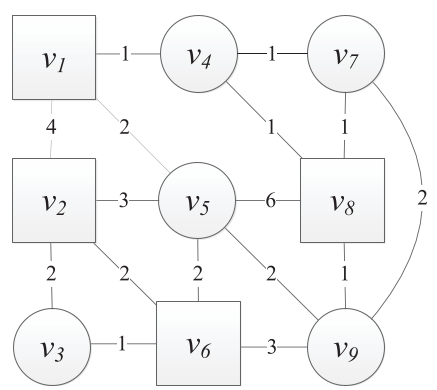
The algorithm identifies a Connected Dominating Set (CDS)—a backbone of the network that ensures connectivity.
- Priority Rule: Interested nodes are given higher priority in the CDS.
- Pruning & Adjustment: The set is refined using a threshold . Nodes that contribute little to the "Expected Throughput" are pruned, while high-capacity interested nodes are added.
Stage 2: Max-Flow Optimization
Once the relay set is narrowed down to willing and capable nodes, the problem is treated as a classic Max-flow bottleneck. By calculating (Relative Bandwidth), the system finds the most efficient way to split and spray packets through the social graph.
Experiments & Results
The researchers tested the algorithm against real-world human mobility data (Infocom2006 trace) and synthetic environments.
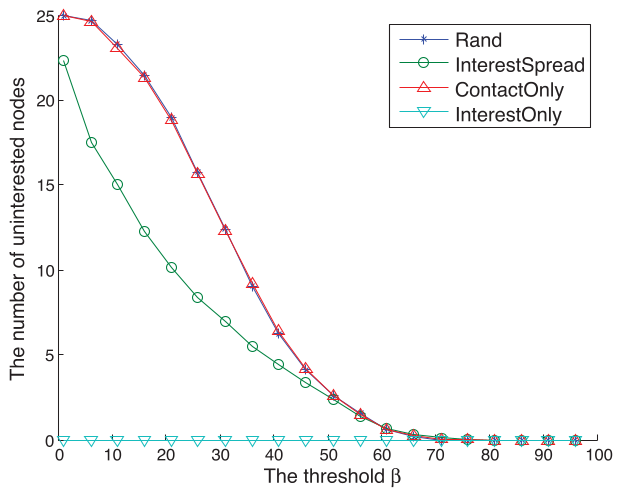
- Throughput vs. Efficiency: InterestSpread consistently outperformed "ContactOnly" and "Random" approaches.
- Resource Conservation: Across all tests, InterestSpread maintained high delivery rates while using 40% fewer uninterested nodes. As the threshold increases, the algorithm intelligently sheds the most "expensive" (reluctant) relay nodes without a catastrophic drop in throughput.
Critical Analysis & Conclusion
The genius of InterestSpread lies in its Inductive Bias: social similarity is a proxy for routing participation. By mathematically formalizing "interest," the authors bridge the gap between social psychology and graph theory.
Takeaway: Future MSN protocols cannot rely on purely opportunistic encounters. They must account for the incentive of the node. Limitations: The current model assumes storage is "cheap and infinite," which may not hold true for massive 8K video streams or in highly congested IoT environments where buffer management becomes a second-order bottleneck.
Future Outlook: Integrating multi-source and multi-destination scenarios will be the next frontier for InterestSpread, potentially leading to a more cooperative and sustainable mobile internet.