
SIPF: Decoding Urban "Interestingness" by Uncoupling Social Echoes
On Interesting Place Finding in Social Sensing: An Emerging Smart City Application Paradigm
This paper introduces SIPF (Social-aware Interesting Place Finding), a maximum likelihood estimation (MLE) framework designed to identify points of interest in smart cities using social sensing data. By jointly modeling user travel experience and social dependencies, it achieves SOTA performance on LBSN datasets like Brightkite and Gowalla.
TL;DR
In the era of smart cities, identifying truly interesting places—parks, hidden trails, or historic sites—is often clouded by the "noise" of daily routines and social bubbles. The SIPF (Social-aware Interesting Place Finding) framework moves beyond simple visit-counting. By applying a rigorous Maximum Likelihood Estimation (MLE) approach that accounts for user travel experience and friendship-driven visit correlations, SIPF boosts identification precision by up to 36% over traditional methods.
The "Office Building" Trap: Why Current Systems Fail
Most recommendation systems rely on a simple logic: "If many people go there, it must be interesting." However, this fails in two scenarios:
- Low-Frequency Gems: Truly interesting places (like a quiet scenic trail) are not visited daily.
- Social Dependency: A group of 50 colleagues checking into the same nondescript office building every day creates a false signal of "interestingness."
Prior works often treated every user as an independent data point or assumed travel expertise is a simple linear function of the number of check-ins. SIPF challenges this by asking: How much of this visit is due to the place's inherent value, and how much is due to the user's social network?
Methodology: The SIPF Framework
The core of the paper is a probabilistic model that treats "interestingness" as a latent variable (). Using the Expectation-Maximization (EM) algorithm, the system iteratively estimates two things simultaneously:
- : The probability that a place is actually interesting.
- : The reliability (travel experience) of a user.
Breaking the Social Correlation
The authors introduce a User-Dependency Matrix (). If two users are friends, their visits to the same location are no longer treated as two independent votes. Instead, the model calculates Dependent Travel Experience, which adjusts the weight of a check-in based on whether a user's friends also visited that location.
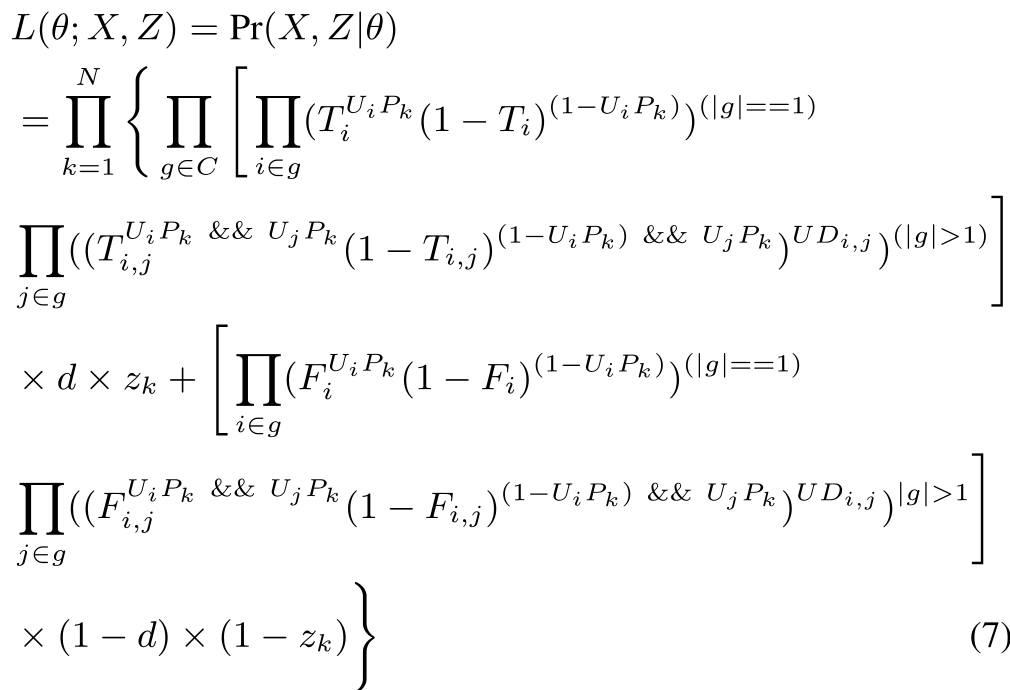 The Likelihood Function (Eq 7) elegantly segregates independent users () from social groups () to prevent over-counting correlated observations.
Experimental Validation
The researchers tested SIPF against three major benchmarks: Voting, Sums and Hubs, and Regular-EM, using data from San Francisco (Brightkite and Gowalla datasets).
Performance Gains
- Precision: SIPF showed a massive 36% improvement in precision on Brightkite.
- Recall: A 20% improvement on Gowalla, proving that the model can find "hidden gems" that other systems miss.
- Ranking: Using NDCG (Normalized Discounted Cumulative Gain), the authors proved that the top-10 list generated by SIPF aligns much more closely with ground truth from travel experts (TripAdvisor, etc.) than any other method.
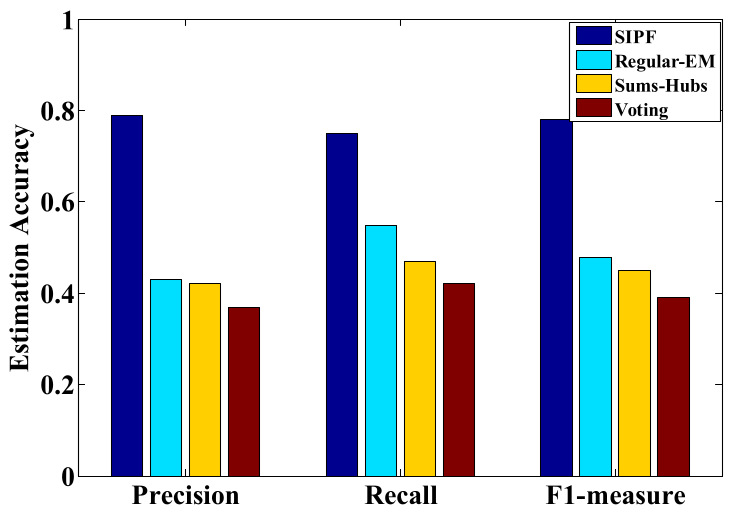 Figure 1: Comparison of F1-measure and Precision. SIPF consistently dominates across both datasets.
Future Outlook and Critical Insights
The true value of this work lies in its Inductive Bias. It recognizes that human social behavior is not "i.i.d." (independent and identically distributed). By mathematically "de-noising" the social influence, we get a clearer picture of the physical world.
Limitations: The current binary model (interesting vs. not interesting) could be refined into a continuous scale. Additionally, while the model accounts for social connections, it doesn't yet account for temporal patterns (e.g., a place might only be "interesting" during a weekend festival).
Conclusion
SIPF is a significant step toward making smart city applications more "socially-intelligent." By treating users as nuanced sensors with varying experience levels and social baggage, we can build navigation and recommendation engines that finally understand why we travel where we do.