
[FAIR/Meta] Interleaved Head Attention: Shattering the Linear Bottleneck of Multi-Head Attention
Interleaved Head Attention
The paper introduces Interleaved Head Attention (IHA), a novel attention mechanism that enables cross-head communication by constructing pseudo-heads as linear combinations of original heads. This architecture allows a single head to represent up to attention patterns, significantly outperforming standard Multi-Head Attention (MHA) in multi-step reasoning and long-context retrieval tasks.
TL;DR
Researchers from Meta, MIT, and UT Austin have proposed Interleaved Head Attention (IHA), a drop-in replacement for standard Multi-Head Attention (MHA). By allowing heads to "talk" to each other before the attention step through the creation of pseudo-heads, IHA achieves quadratic scaling in relational patterns. It delivers a massive 112% improvement in long-context retrieval and significantly boosts reasoning scores on GSM8K and MATH benchmarks.
The Problem: The "Head Isolation" Tax
In the standard Transformer architecture (Vaswani et al., 2017), Multi-Head Attention follows a strict rule: what happens in Head A stays in Head A. Each of the heads computes its own attention matrix independently.
While this parallelization is efficient, it creates a "linear scaling bottleneck." If a complex reasoning task requires the model to compose different relational steps (e.g., "The Hobbit" J.R.R. Tolkien South Africa), a standard MHA layer typically needs heads or increased depth to track these dependencies. This makes MHA fundamentally inefficient for high-order logic and long-context evidence aggregation.
Methodology: The Power of Pseudo-Heads
Interleaved Head Attention (IHA) introduces a "mixing" stage before the actual attention computation.
How it Works:
- Pseudo-Head Generation: Instead of heads, IHA uses learned linear combinations () to project the original heads into pseudo-heads.
- Interleaving: These pseudo-tokens are interleaved into the sequence, expanding the effective sequence length from to .
- Quadratic Interaction: When these pseudo-queries attend to pseudo-keys, they can induce up to distinct attention patterns per head.
- Compatibility: Because Step 4 is still a standard dot-product attention, it remains fully compatible with FlashAttention, ensuring high throughput on modern GPUs.
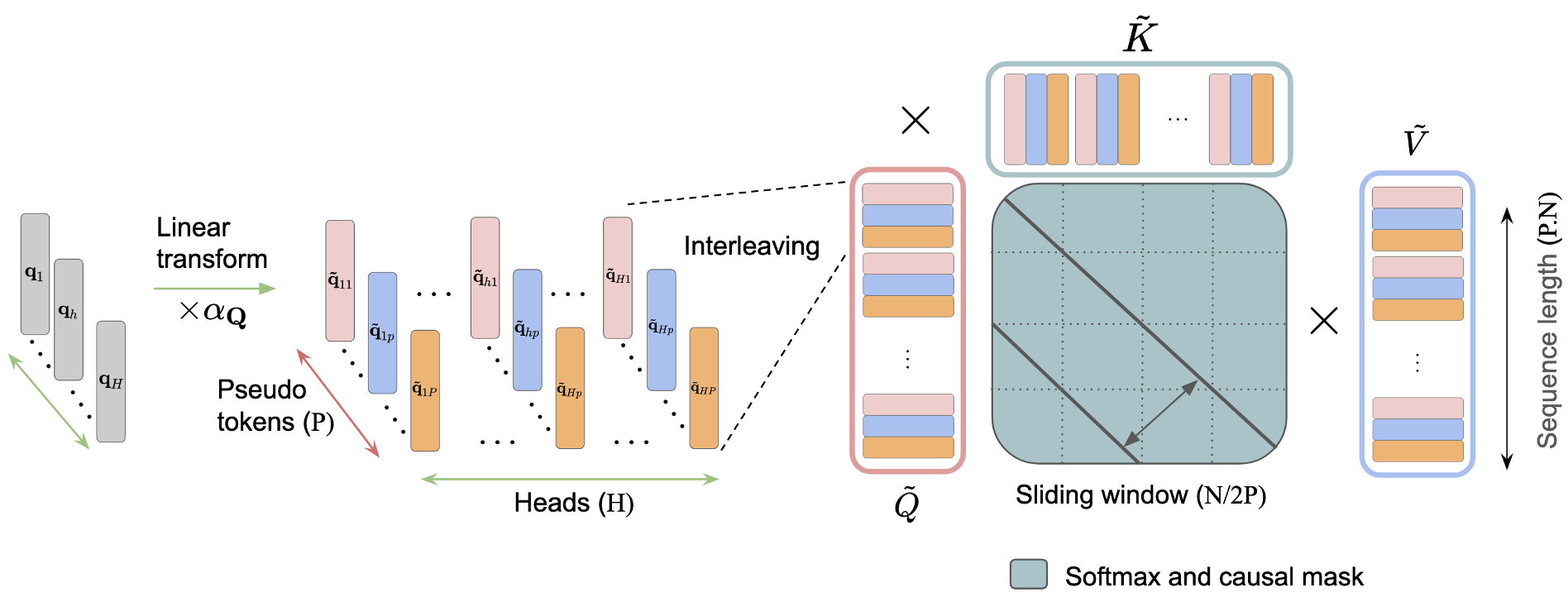 Figure 1: IHA Workflow—Mixing across the head axis (green) followed by interleaving and sequence-based attention.
Mathematical Intuition & Theory
The authors prove that IHA is a strict superset of MHA. Any function MHA can represent, IHA can too—but the reverse is not true.
On synthetic tasks like Polynomial Filters (a proxy for -hop reasoning), IHA demonstrates a "Square Root" efficiency gain. Where MHA requires heads to represent hops, IHA only needs heads.
| Task | MHA Complexity | IHA Complexity |
|---|---|---|
| Polynomial (Parameters) | ||
| CPM-3 (Heads) |
Experimental Results: Large-Scale Impact
The researchers didn't just stop at theory; they trained a 2.4B parameter decoder-only Transformer to test IHA in the wild.
1. Long Context (RULER Benchmark)
IHA dominates long-context retrieval. When fine-tuned at 64k context, IHA showed a 112% relative improvement in Multi-Key retrieval at 16k lengths compared to standard global attention.
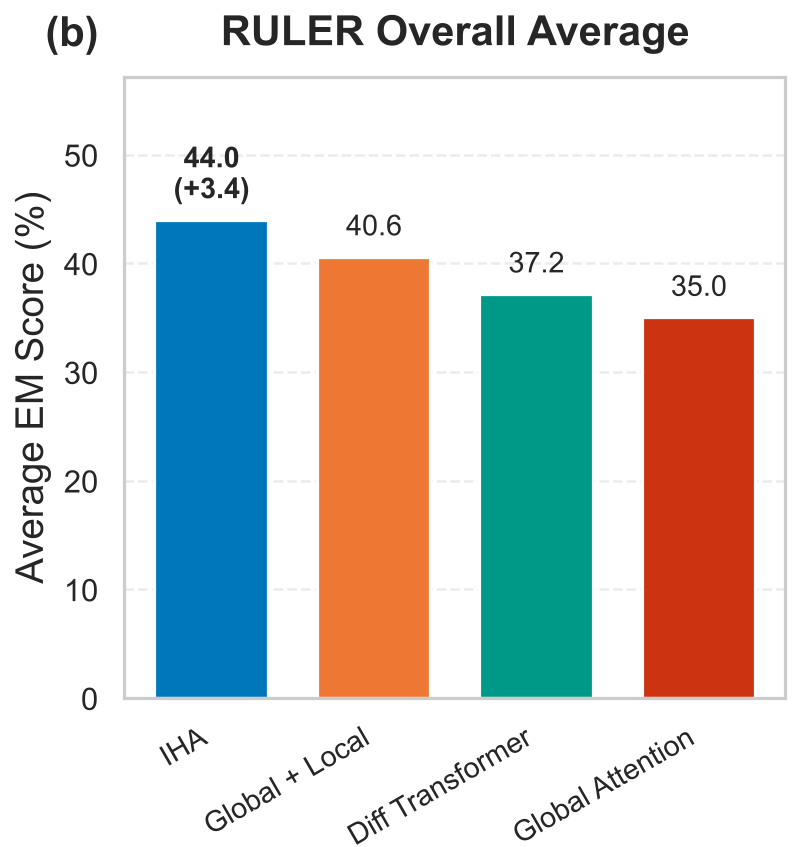 Figure 2: Performance on RULER. IHA is clearly more robust as context length increases.
2. Mathematical Reasoning (SFT on OpenThoughts)
After Supervised Fine-Tuning (SFT) on the OpenThoughts dataset, IHA outperformed all baselines, including powerful variants like Talking-Heads and Diff Transformer.
- GSM8K: +5.8% improvement (Majority @16)
- MATH-500: +2.8% improvement (Majority @16)
Critical Insight: Why Does This Matter?
The industry has spent years trying to make attention sparse or linear to save memory (e.g., FlashAttention, GQA). IHA focuses on making attention more expressive per parameter.
By decoupling the number of attention patterns from the number of physical heads, IHA allows smaller models to punch far above their weight class in reasoning tasks. The slight increase in FLOPs for the global IHA layer is mitigated by a hybrid local-global schedule, making it a practical choice for next-generation LLM architectures.
Conclusion & Future Work
Interleaved Head Attention proves that "head isolation" is a vestigial constraint of the original 2017 Transformer. By allowing pre-attention mixing, we unlock quadratic expressivity. Future research remains to see how IHA scales to 70B+ parameter models and whether adaptive pseudo-head allocation can further optimize the compute-to-reasoning ratio.