
Organized Adaptation: Converging Social Networks and Multi-Agent Systems for Decentralized Control
Interleaving multi-agent systems and social networks for organized adaptation
This paper introduces a framework for organized adaptation in decentralized open systems by interleaving norm-governed multi-agent systems (MAS), opinion formation in social networks, and computational social choice (voting). It demonstrates a prototype system where gossip-based opinion exchange informs collective voting to dynamically reconfigure institutional rules and roles in ad hoc networks.
TL;DR
The paper proposes a novel framework for Organized Adaptation in open systems. By combining the logical specification of Norms (what agents are allowed to do), the dynamics of Opinion Formation (how agents influence each other), and Computational Social Choice (how groups reach decisions), the authors enable decentralized networks to autonomously rewrite their own rules.
Background Positioning: This work bridges the gap between low-level emergent systems (like swarm robotics) and high-level social governance, providing a "socially-inspired" mechanism for self-regulation in environments like MANETs and virtual organizations.
Problem & Motivation: Beyond "Hard-Wired" Emergence
Traditional decentralized systems often rely on "swarm intelligence"—simple local rules that lead to complex global behavior. However, ad hoc networks (MANETs, sensor nets, VOs) are Open Systems. Components may be heterogeneous, self-interested, or even malicious.
The authors argue that these systems need Social Intelligence. Static rules fail when environmental conditions (e.g., battery levels or threat levels) change. The core challenge is: How can a network without a central controller collectively decide to change its own governance structure?
Methodology: The Three Pillars of Social Intelligence
The framework rests on three formal models that work in an interleaved loop:
1. Rules of Social Order (The "Law")
Using Event Calculus (EC), the authors define the system's "constitution." It distinguishes between:
- Physical Capability: What an agent can do.
- Institutional Power: The ability of an agent (e.g., a "Clusterhead") to create "institutional facts" (like declaring a winner).
- Permissions/Obligations: What an agent should do.
2. Rules of Social Exchange (The "Gossip")
Before voting, agents "gossip." This is modeled via mathematical opinion dynamics where each agent maintains a Confidence Matrix.
- Confidence (): How much agent trusts agent .
- Affinity (): How much 's expressed opinion aligns with 's internal mindset. Through repeated rounds, agents influence one another, potentially leading to consensus or polarization.
3. Rules of Social Choice (The "Decision")
Once opinions are formed, the system triggers a Transition Protocol. Agents cast votes, and the "Clusterhead" (empowered agent) uses a winner-determination algorithm (e.g., Plurality, Borda, or Runoff) to change system parameters.
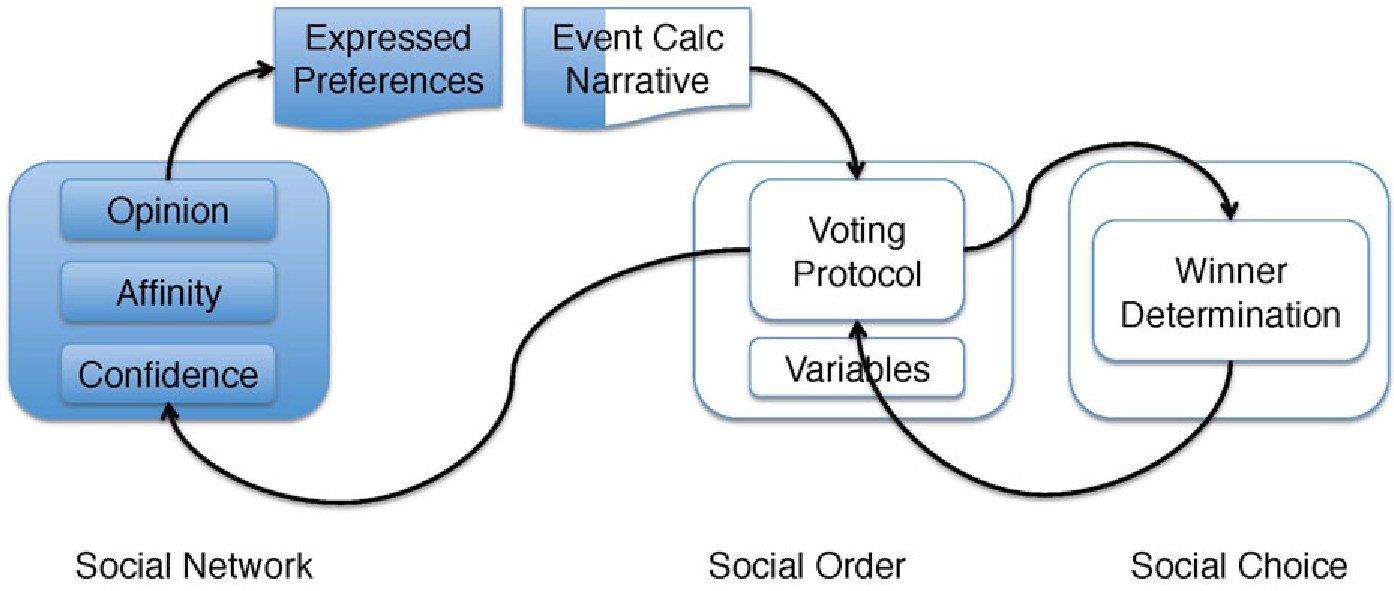 Figure 1: The interleaving process showing how gossip informs voting, which in turn modifies institutional variables and updates agent affinities.
Experimental Insight: Adapting Network Security
The authors tested this in a MANET scenario where agents must decide on an encryption level (Plaintext, AES, or RSA).
- The Conflict: RSA is secure but power-hungry; Plaintext is fast but risky.
- The Adaptive Loop: Agents monitor "Brute Facts" (battery levels). They gossip about the "Fitness" of the current security rule. They then vote not only on the security level but also on which voting rule to use (Meta-level adaptation).
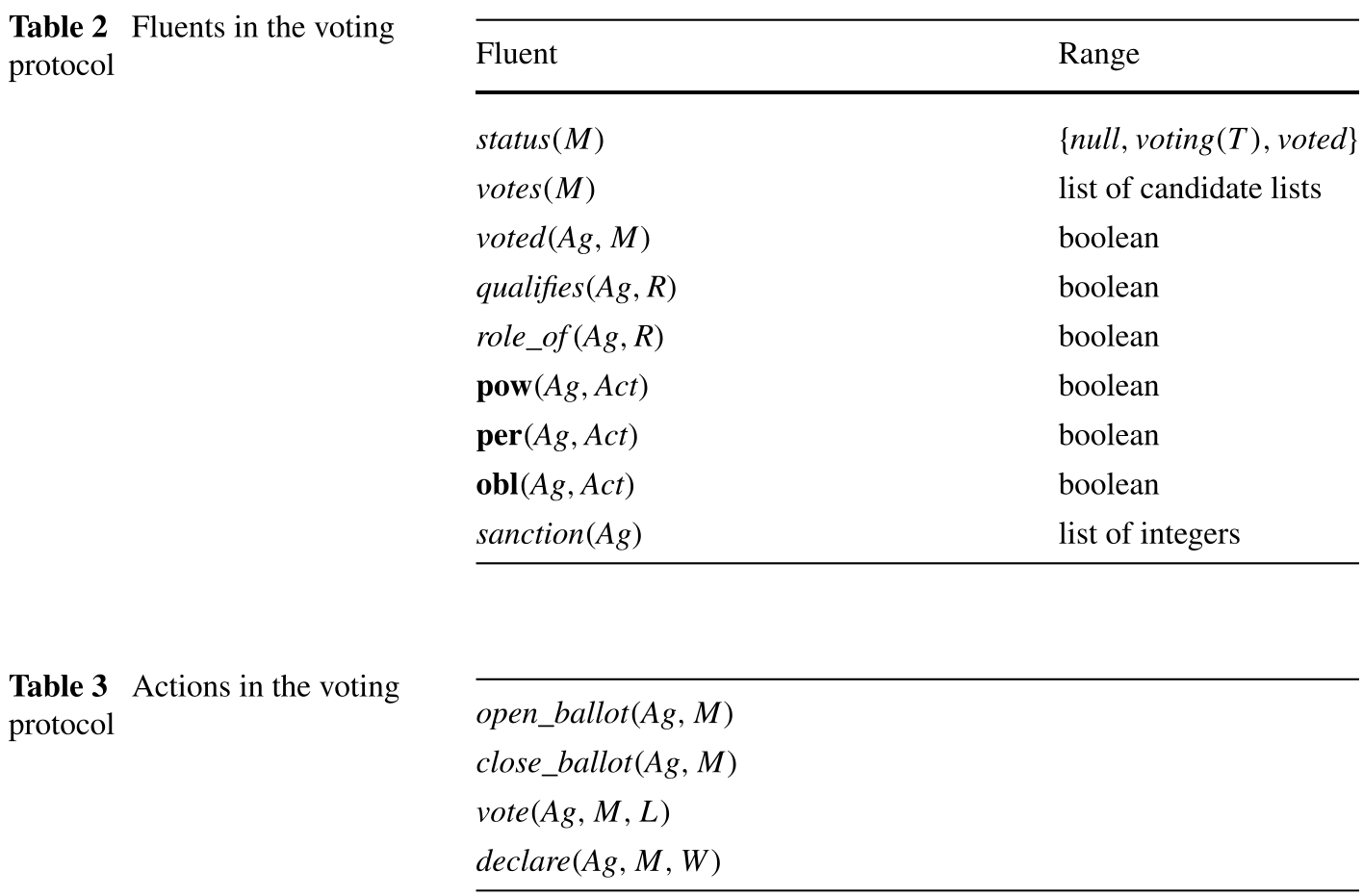 Figure 2: An Event Calculus trace showing the "Social State"—how powers and obligations shift as an agent opens a ballot, votes are cast, and a result is declared.
Key Finding: The choice of the Social Choice rule (the voting algorithm) is critical. The paper demonstrates that given the exact same set of preferences, different algorithms (Borda vs. Plurality) yield different winners. In the simulation, the system "decided" to switch to a Borda count, which then led to the selection of RSA encryption to counter a perceived threat, despite the power cost.
Critical Analysis & Conclusion
Takeaway
This research provides a rigorous logical and mathematical foundation for self-governing commons. It moves away from rigid protocols and towards "Soft-Wired" local computations that consider both physical constraints and conventional (social) rules.
Limitations
- Scalability: The computational cost of Meta-level protocols (voting on the rules of voting) could lead to an infinite regress (Meta-Meta-protocols).
- Strategic Manipulation: While the authors discuss NP-hard manipulation in voting, the impact of "lying" during the gossip phase (dishonest opinion exchange) needs more exploration.
Future Outlook
The marriage of Social Network Theory and Deontic Logic (via Event Calculus) opens the door for autonomous systems that are not just "smart," but "civil"—capable of resolving conflicts through institutionalized discourse rather than just simple optimization.