
Beyond the Treetops: Benchmarking the 3-D Future of Individual Tree Detection
International Benchmarking of the Individual Tree Detection Methods for Modeling 3-D Canopy Structure for Silviculture and Forest Ecology Using Airborne Laser Scanning
This paper presents an international benchmarking study of five Individual Tree Detection (ITD) methods—raster-based, hybrid, and point-based—using Airborne Laser Scanning (ALS) data. The state-of-the-art FGI-P point-based method demonstrates superior performance in depicting 3-D canopy structures, particularly for subordinate trees, across diverse forest stands.
TL;DR
This landmark benchmarking study evaluates five international ALS-based Individual Tree Detection (ITD) methods, revealing that while we are excellent at spotting dominant trees (90%+ accuracy), the real challenge lies in the "shadows"—the intermediate and suppressed trees. The study demonstrates that point-based methods (like the new FGI-P) are essential for 3-D canopy modeling, and that point density is the secret sauce for unlocking vertical forest structure.
The "Raster Ceiling" in Forest Remote Sensing
For decades, forestry professionals have relied on Crown Height Models (CHM)—essentially 2-D "heat maps" of forest height. While efficient, the CHM acts as a "raster ceiling": once the laser pulse hits the highest canopy, the data points beneath it are often discarded or ignored by algorithms.
The problem is that a forest isn't a surface; it's a volume. By ignoring suppressed and intermediate trees (subordinate trees), we miss critical data on forest regeneration, biodiversity, and biomass. This paper argues that to understand the 3-D ecology, we must stop looking at forests as pictures and start treating them as 3-D point clouds.
Methodology: The Shift to Vox-Cloud Analysis
The core innovation discussed is the FGI-P method, a point-based approach that sidesteps the limitations of rasters.
- Voxelization: The raw ALS data is transformed into a "vox-cloud." This makes searching for neighboring points significantly faster than raw KD-tree searches.
- Morphological Detectors: Instead of just looking for local maxima (peaks), the method uses ten different Structure Elements (SE). These act as 3-D "filters" that check for open space above a point and a "crown-like" cluster below it.
- Bottom-Up Extraction: Unlike traditional methods that start with the biggest trees, FGI-P processes trees from the bottom up. This ensures that smaller trees aren't "absorbed" into the clusters of their larger neighbors.
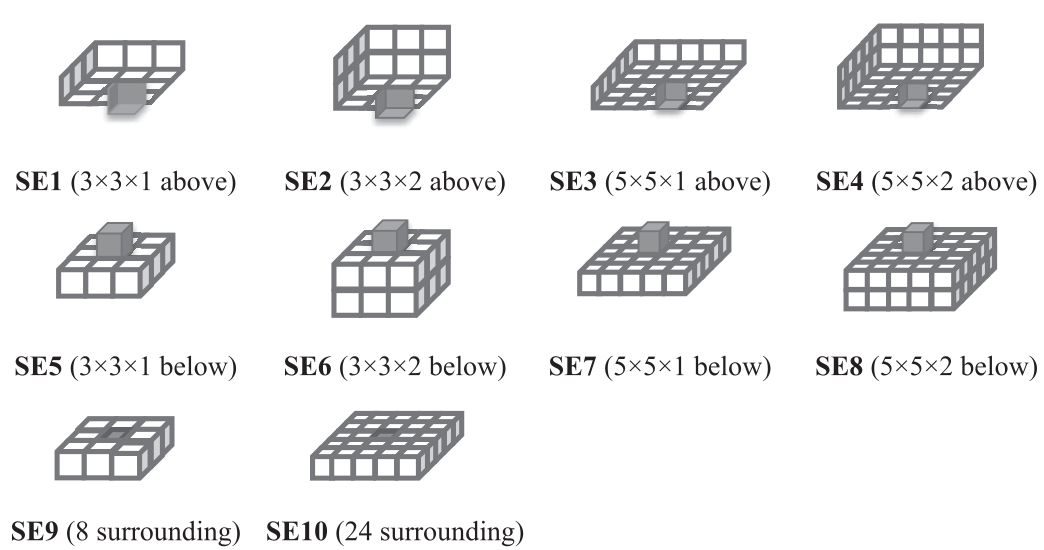 Figure 1: The structural elements (SE) used by FGI-P to detect treetops in 3-D space.
Experimental Showdown: Crown Class Sensitivity
The researchers didn't just ask "how many trees?" They asked "which trees?" by classifying the forest into four Kraft classes: Dominant, Codominant, Intermediate, and Suppressed.
Key Findings:
- Raster-based methods (like IGN-R and SLU-R) were virtually blind to suppressed trees, as these trees don't form "peaks" in a CHM.
- Hybrid and Point-based methods (FGI-P, UZH-H) are the only ones capable of penetrating the canopy to find the understory.
- Point Density Matters: A critical discovery was that for point-based methods, increasing density from 2 to 8 pts/m² significantly improved the detection of intermediate and suppressed trees. This contradicts earlier benchmarks that suggested density had "limited influence"—a conclusion now revealed to be a byproduct of old raster-based thinking.
 Figure 2: Visualization of individual tree crowns extracted from a complex mixed stand.
The Match-Commission Tradeoff
One of the most profound insights from the study is the Commission Cost. Detecting suppressed trees is hard because large branches and crown-overlaps create "phantom trees" (Commission errors).
- The Findings: Any attempt to increase the detection of intermediate trees naturally increases false positives from large branches.
- The Solution: Point-based methods manage this tradeoff better because they can verify if a cluster has the "depth" and "shape" of a real tree, rather than just being a flat branch.
Deep Insight: Is ALS Enough?
The study also conducted the first quantitative evaluation of ALS "detectability." They found that at 8 pts/m², only 34% of suppressed trees actually had enough laser returns (at least 5 points) to be detectable by any algorithm.
- The Takeaway: The bottleneck for 3-D forest modeling is no longer just the algorithm—it's the hardware's ability to penetrate dense leaves.
Conclusion & Future Outlook
The benchmarking makes it clear: The era of CHM-based forestry is nearing its end. To model the complex silviculture of the future, we must embrace:
- Point-based ITD to capture the vertical story.
- High-density ALS (and potentially multi-wavelength/Titan systems) to overcome occlusion.
- Voxel-based processing to handle the massive data volumes of modern 3-D scans.
This paper serves as both a scorecard for current tech and a roadmap for the next generation of ecological modeling.