
Decoding Global Social Media: Why Mobile Operators Can't Use the Same Facebook Strategy Everywhere
International Differences in Social Media Interactions Between Mobile Network Operators and Consumers
This study investigates international differences in social media interactions between Mobile Network Operators (MNOs) and consumers across various countries using a mixed-methods approach. By analyzing 163 MNO brand pages on Facebook, the authors identify distinct patterns in content strategy and user engagement that reflect local cultural and market characteristics.
TL;DR
A study presented at CHI 2020 reveals that global Mobile Network Operators (MNOs) face wildly different consumer behaviors on Facebook depending on the country. From India’s complaint-heavy comment sections to Japan’s preference for photographic content over video, the research proves that localization isn't just about language—it's about understanding the unique "interaction DNA" of each market.
Context & Positioning
In an era where branding is global but the "User Experience" is intensely local, this paper serves as a strategic manual for international enterprises. By focusing on MNOs—a sector characterized by high competition and universal utility—the authors provide a roadmap for using cluster analysis and qualitative coding to optimize social media presence.
The Problem: The Localization Gap
Most global enterprises open localized brand pages, but they often treat them as mere translation exercises. The authors argue that this is a missed opportunity. Why do some countries engage more with videos? Why do consumers in some regions use Facebook for customer support while others use it for community engagement? Without understanding these nuances, brands risk wasting marketing spend on content that ignores the local "social contract."
Methodology: From Big Data to Deep Insights
The research followed a rigorous three-step process:
- Macro Analysis: Data extraction from 163 MNOs across 59 countries.
- Clustering: Using "Clustering Analysis" to group countries with similar activity levels (posts per year vs. engagement per post).
- Micro Analysis: Qualitative coding of 1,200 entities (posts and comments) to categorize the intent of the communication.
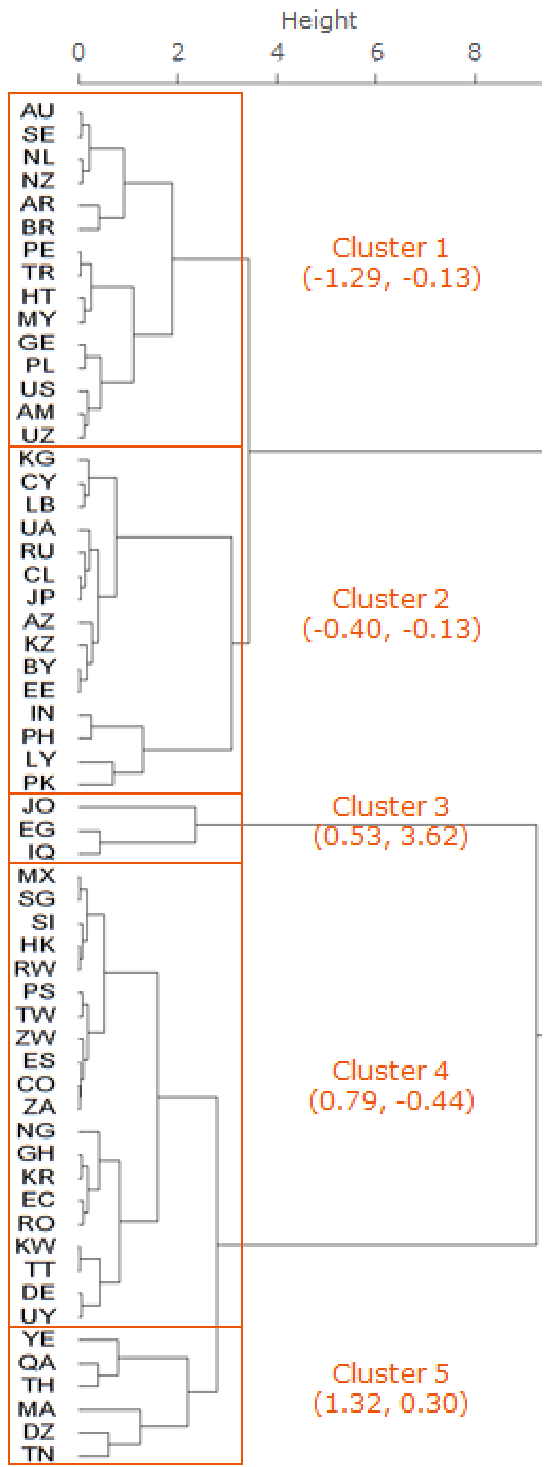 Figure 1: Hierarchical clustering showing how countries group by engagement and posting frequency. Cluster 3 (including India) shows particularly high user engagement.
Key Findings: The "Country Signature"
The qualitative results revealed striking contrasts in how operators and consumers interact:
1. The Strategy of the Post
Operators in Singapore (SG) were found to be highly pragmatic, with nearly 90% of their posts dedicated to "Attractive Introduction" and "Promotion." In contrast, operators in Nigeria (NG) frequently utilized "Calls for Action" (30%), such as opinion collection and quizzes, to drive engagement.
2. Media Type Preferences
A fascinating discovery was the discrepancy in media usage. While Western markets like the US and Australia lean heavily into video (>57%), Japan and Nigeria remain dominated by photos (>70%). The authors suggest this might be linked to local data costs and charging systems; in markets where data is expensive, consumers may avoid data-heavy video content.
3. The Voice of the Consumer
The "Comment" sections showed the most diverse range of behaviors:
- India (IN): A hub for "Criticisms" (59%). Consumers use Facebook as a primary channel to complain about network throughput.
- Japan (JP): High "Involvement" (54%) despite the fact that Japanese MNOs almost never reply to comments. The page serves as a fan touchpoint rather than a service desk.
- Singapore (SG): Users are focused on "Questions" (32%), treating the page as an information hub.
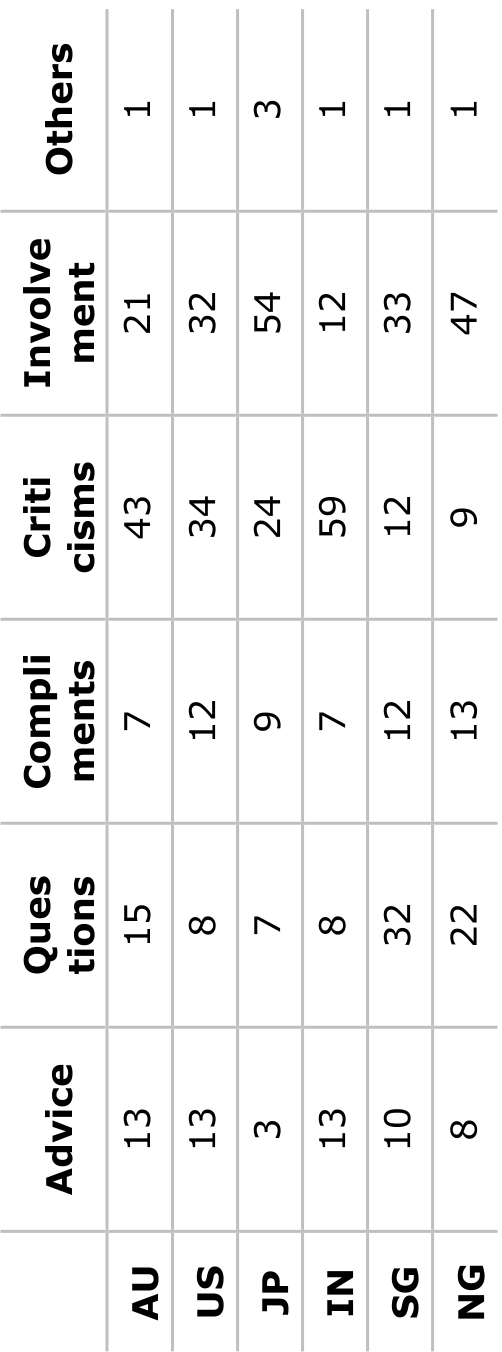 Table 4: Distribution of consumer comment categories. Note the high criticism in India and high involvement in Japan.
Critical Analysis & Conclusion
The study’s core takeaway is that engagement metrics alone are deceptive. High engagement in India (Cluster 3) is driven by dissatisfaction, whereas high engagement in other regions might be driven by brand loyalty or entertainment.
Limitations
The study's qualitative phase was limited to 18 MNOs due to language constraints of the coders. Furthermore, it focuses solely on Facebook, which—while dominant in 2020—competes with visual-first platforms like Instagram and TikTok today.
Future Outlook
This methodology—clustering by activity followed by qualitative intent coding—should be a standard part of any global CMO's toolkit. As AI-driven sentiment analysis becomes more robust, we can expect these insights to be generated in real-time, allowing brands to pivot their local strategies dynamically.