
Digital Mirrors: How Google+ Reveals the Global Gender Gap
International Gender Differences and Gaps in Online Social Networks
This study utilizes large-scale Google+ network data from 73 countries to quantify global gender differences and gaps. It maps online behavioral indicators—such as reciprocity, status metrics, and assortativity—to the World Economic Forum's offline Global Gender Gap Index, achieving a strong correlation of up to 0.8.
TL;DR
Can a user's number of followers or their tendency to follow their own gender tell us something about a country's socioeconomic equality? By analyzing Google+ data across 73 countries, researchers Gabriel Magno and Ingmar Weber found that online network structures are powerful proxies for offline gender inequality. While the "Online Gender Gap" aligns closely with global indices (r=0.8), it also reveals a paradox: in highly unequal societies, women online often hold higher "status" than men—a phenomenon dubbed the Jackie Robinson Effect.
Problem & Motivation
Tracking gender equality is traditionally the domain of the United Nations or the World Economic Forum, relying on "hard data" like female-to-male income ratios or political representation. While precise, these metrics are slow to update and expensive to aggregate.
The researchers sought to answer a fundamental question: Does our digital behavior reflect the structural inequalities of our physical world? By moving beyond content analysis (which is plagued by language barriers and cultural subjectivity) to "hard" network metrics, they aimed to create a real-time, automated system for tracking global development.
Methodology: The Core
The study analyzed over 60 million nodes and 1 billion edges from Google+ (collected in 2012). The authors calculated several key metrics for each country-gender group:
- In-degree/PageRank: Indicators of popularity and relative importance.
- Reciprocity: The fraction of social links that are mutual.
- Differential Assortativity: The "lift" showing how much more likely users are to follow their own gender compared to random chance.
Architecture of Inquiry
The researchers didn't just look at totals; they calculated Gender Ratios (Female/Male) for every metric, mirroring the methodology of the Global Gender Gap Report.
 Figure 1: Correlating online gender ratios with offline Global Gender Gap scores.
The "Jackie Robinson Effect" and Other Insights
The results provided several counter-intuitive breakthroughs:
- The Status Paradox: In countries with high inequality (e.g., Pakistan, Egypt), women actually had a higher average number of followers and PageRank than men. The researchers hypothesize this is the "Jackie Robinson Effect": in environments where women face barriers to entry, only the most influential, high-status, or tech-savvy women successfully establish an online presence.
- Cliqueness and Reciprocity: Globally, women were found to be more "tightly cliqued," with higher clustering coefficients and a significantly higher fraction of reciprocated social links than men.
- Segregation vs. Equality: Surprisingly, countries with less gender inequality (like Norway or Finland) showed higher assortativity—meaning men and women in "equal" societies were more likely to follow their own gender than expected.
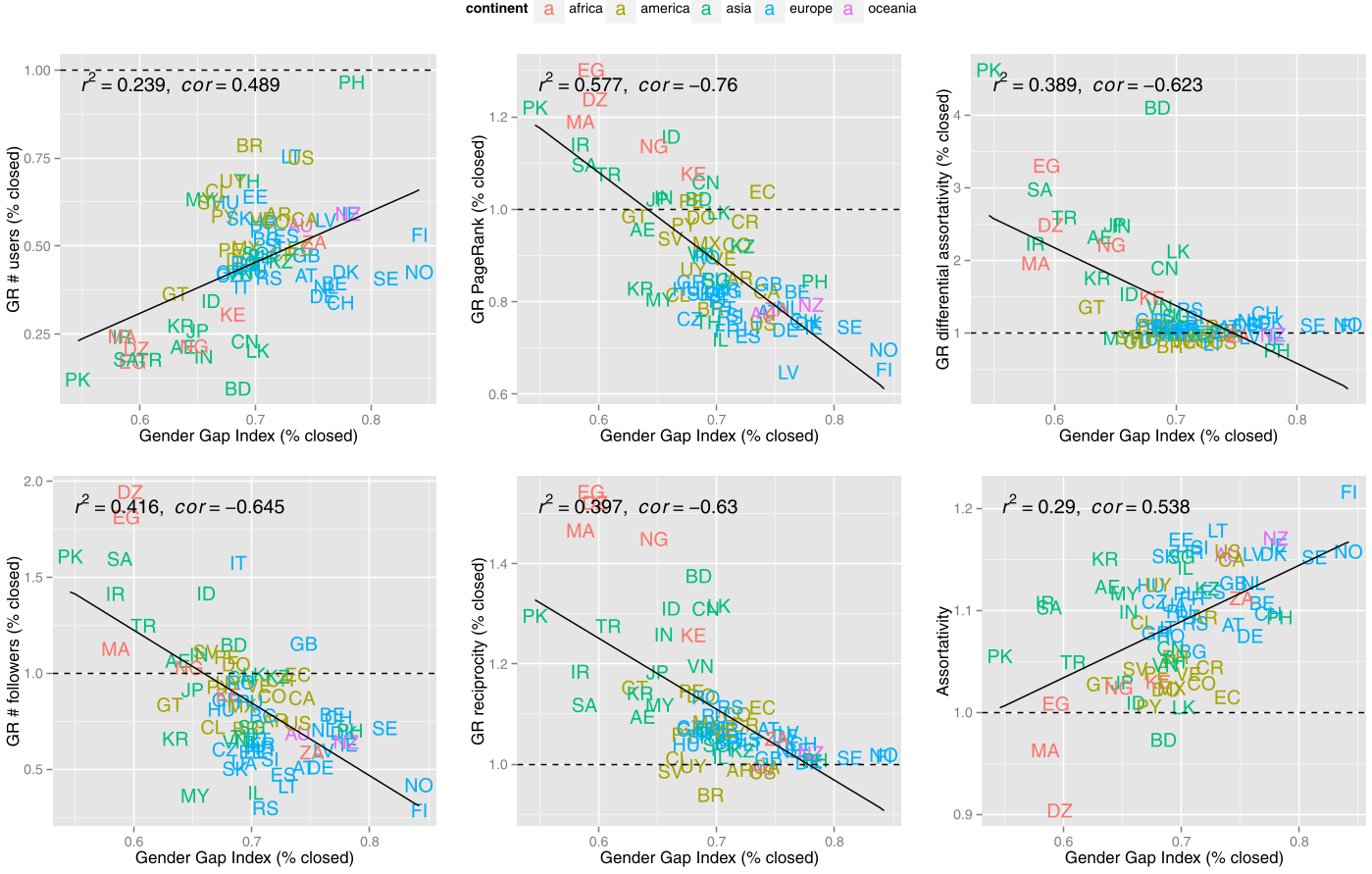 Figure 2: The correlation matrix showing the strong negative/positive links between online and offline metrics.
Critical Analysis & Conclusion
Takeaway
The study demonstrates that network structure alone—devoid of text or sentiment—can predict a country's development status with remarkable accuracy. This validates the use of "Data for Development" (D4D) as a legitimate tool for international policy.
Limitations
- Selection Bias: Google+ users are not representative of the total population; they tend to be of higher social status and more tech-inclined.
- Static Snapshot: The data is a snapshot. Truly revolutionary tracking would require longitudinal data to see how networks change as laws (like suffrage or education reforms) change.
Future Outlook
The "Jackie Robinson Effect" offers a profound insight into digital representation. As we move toward AI-driven social monitoring, understanding these nuances—where "high performance" by a minority group might actually signal "high barriers to entry"—is critical for accurate social science.
Source Analysis: Magno, G., & Weber, I. International Gender Differences and Gaps in Online Social Networks.