
Beyond the Tap: How Hand Gestures Sculpt the Psychology of Mobile Gaming Enjoyment
International Journal of Human - Computer Studies
This paper investigates how mobile hand gestures (surface vs. motion) influence consumer enjoyment in gamified marketing. It identifies two critical interaction effects: surface gestures align with real product images to boost enjoyment via mental simulation, while motion gestures align with reward uncertainty to enhance enjoyment via perceived control.
Executive Summary
In the hyper-competitive landscape of mobile marketing, brands often treat "shaking" or "swiping" as mere gimmicks. This research reveals that hand gestures are, in fact, powerful psychological levers. By mapping the interaction between surface gestures and visual aesthetics, and between motion gestures and reward mechanics, this study provides a blueprint for creating truly "flow-inducing" gamified experiences. The takeaway is clear: physical interaction must be congruent with mental imagery to maximize consumer enjoyment.
The Problem: The Disconnect Between Body and Interface
Traditional gamification research focuses on points, badges, and leaderboards. However, it ignores the physicality of the mobile device. In many marketing games, the gesture feels arbitrary—why am I shaking my phone to buy a sneaker? Why am I swiping to win a random coupon? When the body's action contradicts the mind's expectation (Inductive Bias), enjoyment plummets.
Methodology: The Dual-Path of Embodied Cognition
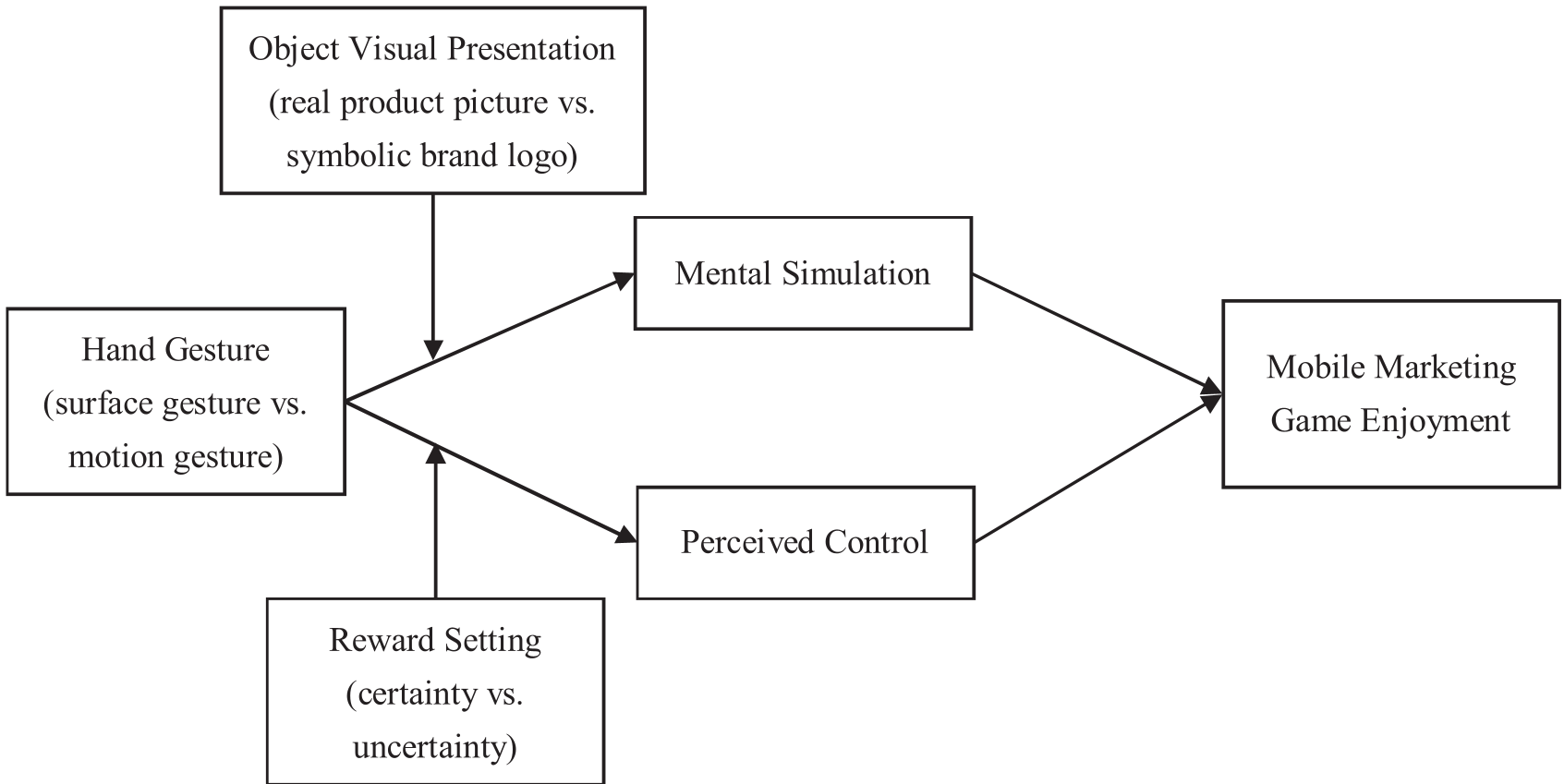
The researchers proposed a model where the "style" of manipulation dictates the psychological outcome:
- Direct Manipulation (Surface Gestures): These involve direct finger-to-object contact. Because they mimic how we touch objects in the real world, they facilitate Mental Simulation—the brain's ability to "feel" the product virtually.
- Indirect Manipulation (Motion Gestures): These involve moving the entire device (shaking/tilting). This requires higher Body Involvement, which metaphorically maps to effort and "holding on" to a situation.
Core Insight 1: Touch for Imagery (Surface + Real Pictures)
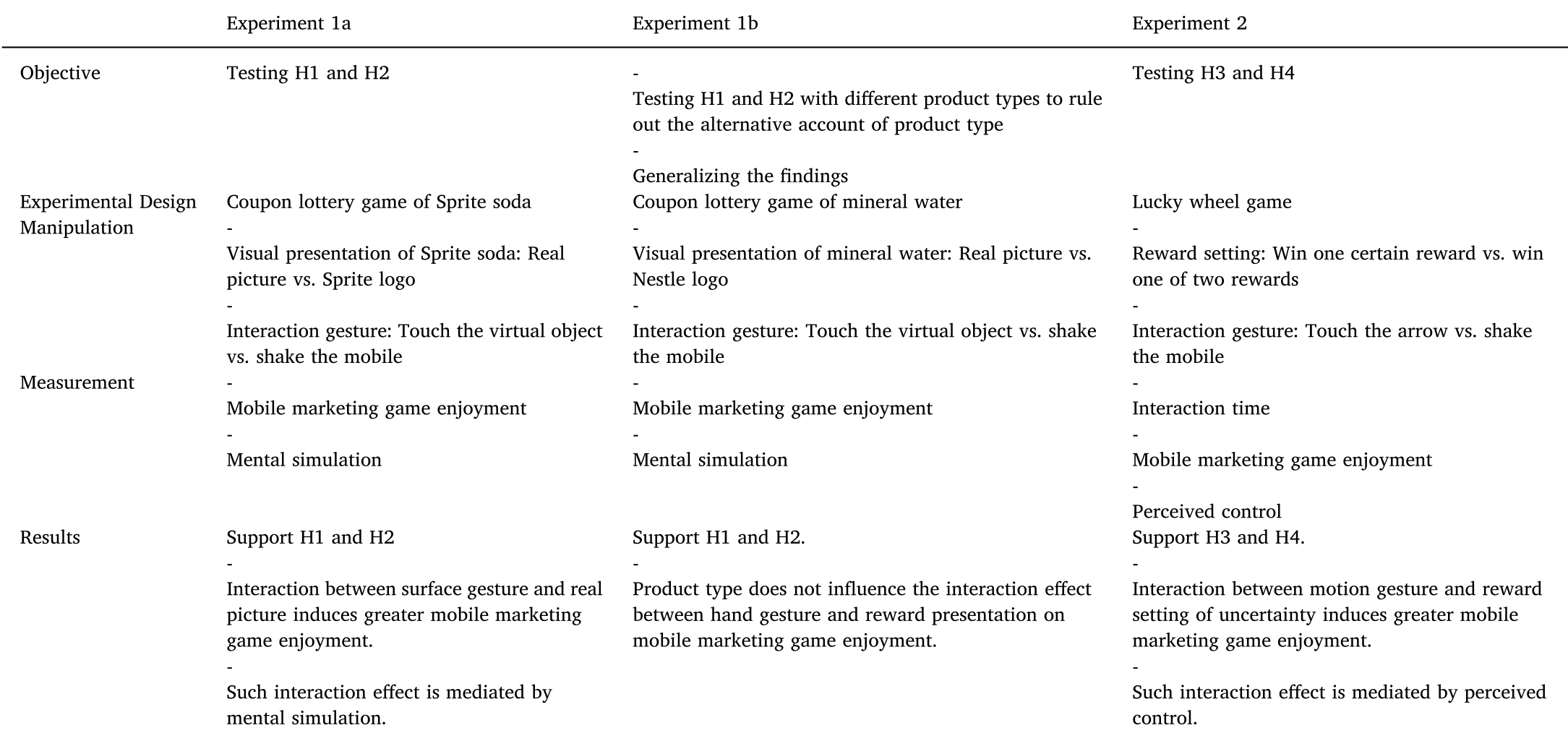
Experiments 1a and 1b discovered that when users see a real product picture (like a can of Sprite), using a surface gesture (touching/dragging) creates a synergy. Because the eye sees a tangible object and the finger "touches" it, the brain generates vivid haptic imagery.
- The SOTA Gap: If you use a brand logo instead of a real picture, the effect vanishes because logos are abstract and don't trigger "grasping" simulations.
Core Insight 2: Shaking for Control (Motion + Uncertain Rewards)
Experiment 2 tackled the "Lucky Wheel" scenario. When a reward is uncertain, humans naturally feel a loss of control. The study found that motion gestures (shaking the phone) act as a compensatory mechanism.
- The Physics of Effort: High-involvement shaking makes users feel they are "putting more soul" into the game. This effort translates into an illusory sense of control, making the random outcome feel earned and the process more enjoyable.
Critical Analysis & Conclusion
This work demonstrates that "Flow" in mobile games isn't just about difficulty—it's about Natural Mapping.
- Takeaway: Design interactions that match the cognitive load. Use "Touch" to sell the product's physical appeal; use "Motion" to sell the excitement of the "win."
- Limitations: The study used simple HTML5 games. In a high-fidelity 3D environment or VR, these effects might be even more pronounced, but the "effort" of motion gestures might also lead to physical fatigue, which this study did not measure.
- Future Work: As we move toward "in-air" gestures (like those in Apple Vision Pro), understanding the metaphor of "grabbing space" versus "touching glass" will be the next frontier in marketing psychology.
Final Thought: Your phone isn't just a screen; it's a physical extension of the consumer's body. If the gesture doesn't match the goal, you aren't just losing a click—you're losing the "felt" connection to the brand.