
Beyond Labels: A Genetic Approach to Linguistic Semantics in Fuzzy Classifiers
International Journal of Approximate Reasoning
The paper introduces a genetic design method for linguistic terms in Fuzzy Rule-Based Classification Systems (FRBCSs) using Hedge Algebras. By formalizing the semantic-order structure of linguistic variables, the authors develop an evolutionary multiobjective optimization approach that automatically determines optimal fuzzy membership functions and term-sets, achieving superior performance on 17 Machine Learning datasets.
TL;DR
This research moves beyond treating fuzzy labels as mere "placeholders." By leveraging Hedge Algebras, the authors provide a mathematical framework to evolve linguistic terms (like Very Small, Rather Large) alongside their fuzzy membership functions. The result is a Fuzzy Rule-Based Classification System (FRBCS) that is not only more accurate on standard ML benchmarks but also more "readable" to human experts.
Background: The Gap Between Syntax and Semantics
In traditional fuzzy systems, the designer typically pre-defines a partition (e.g., 5 triangular fuzzy sets). The genetic algorithm then "tunes" the corners of these triangles. However, this ignores the Logic of Language: a "Very Large" value should inherently be more specific and shifted further than a "Large" value. Without a formalized structure, the link between the syntax (the words) and the semantics (the math) is broken.
The Core Insight: Hedge Algebras
The authors argue that a linguistic domain is not just a collection of sets, but an ordered algebraic structure.
- Generators: Primary terms like True/False or Slow/Fast.
- Hedges: Operators like Very (V), Extremely (E), or Little (L) that modify the tendency of the generator.
By using Semantically Quantifying Mappings (SQMs), they translate these qualitative relationships into precise numerical intervals. This ensures that the generated fuzzy sets always respect the human-intuitive order of language.
Methodology: The Genetic Design Loop
The paper proposes a two-phase optimization process:
- Linguistic Term Design: A Genetic Simulated Annealing (GSA) algorithm optimizes the "fuzziness parameters" for each feature. Instead of tuning every single triangle corner, it only tunes a few parameters that define the logic of the hedge algebra.
- Rule Selection: Once the terms are "grown" to fit the data distribution, a multi-objective genetic algorithm selects the most compact and accurate rule set.
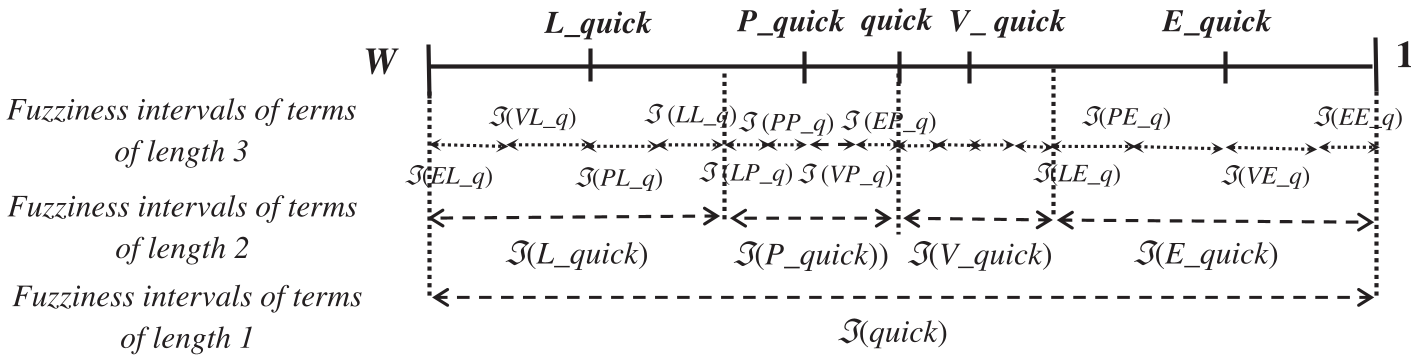 Fig 1: The mapping from linguistic hierarchy to numerical fuzziness intervals.
Experimental Proof: Interpretability vs. Accuracy
The method was tested against 17 complex datasets from the UCI repository.
Key Findings:
- Performance: The proposed method achieved a mean test classification rate of 80.50%, significantly higher than the "All Granularities" baseline (78.10%) and the tuned "Product/1-ALL-TUN" (79.16%).
- Interpretability: Despite having more "granular" terms available (up to 3 levels of hedges), the final rule bases remained sparse. For the Mammographic dataset, only 14 of the 21 possible terms were actually used, keeping the logic simple for doctors to interpret.
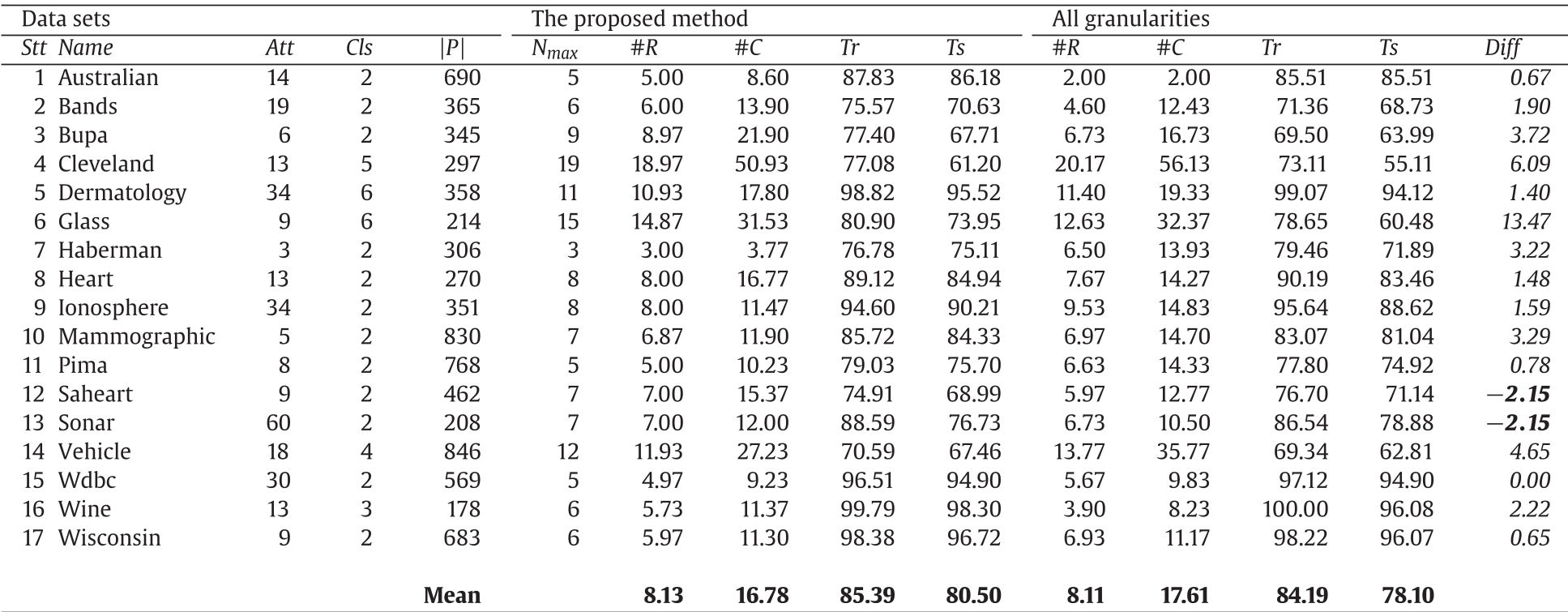 Table 1: Comparative performance across 17 datasets showing clear gains in test accuracy (Ts).
Critical Insight: The "Generality-Specificity" Trade-off
Why does this work better? Traditional systems use uniform partitions. This paper allows the system to discover that some features require specific terms (long strings of hedges) while others work better with general terms. Because the rules are generated directly from data patterns, the complexity doesn't explode even if the vocabulary is large.
Conclusion & Future Outlook
This work represents a shift toward Natural Semantics in AI. By constraining the search space of an optimizer within the boundaries of linguistic logic, we get models that are "right for the right reasons." Future applications could see this combined with Large Language Models (LLMs) to provide a mathematically grounded "fuzzy backbone" for natural language reasoning.
Limitations: The computational cost of the initial rule generation (IFRG) is polynomial but can still be heavy for extremely high-dimensional datasets without pre-processing feature selection.