
Turning Outsiders into Insiders: How Social Grouping Bridges the Trust Gap in Global E-Commerce
International Journal of Information Management
This study investigates how foreign e-commerce firms can build initial trust in collectivistic markets like China by leveraging social grouping strategies. The researchers proposed five strategies based on Social Identity Theory and Trust Transference, finding that common-bond and institutional-identity approaches significantly outperform basic common-identity tactics in establishing credibility.
TL;DR
Why did eBay fail where local players thrived in China? This paper argues it’s an "out-group" problem. By leveraging Social Identity Theory, foreign firms can use social media ties—like showing that your classmates or local cultural icons endorse a brand—to transform from a "foreign intruder" into a "trusted in-group member."
The "Foreigner" Penalty in E-Commerce
When a foreign e-commerce firm enters a new market, it face a steep "trust tax." In collectivistic cultures, consumers naturally categorize entities into In-groups (friends, locals, "people like us") and Out-groups (strangers, foreigners).
The authors point out that traditional localization—merely translating a website into the local language—fails to address the deep-seated psychological distance. To succeed, a firm must achieve "In-grouping": the process of being perceived as part of the consumer's social circle.
Methodology: The Three Levels of Identity
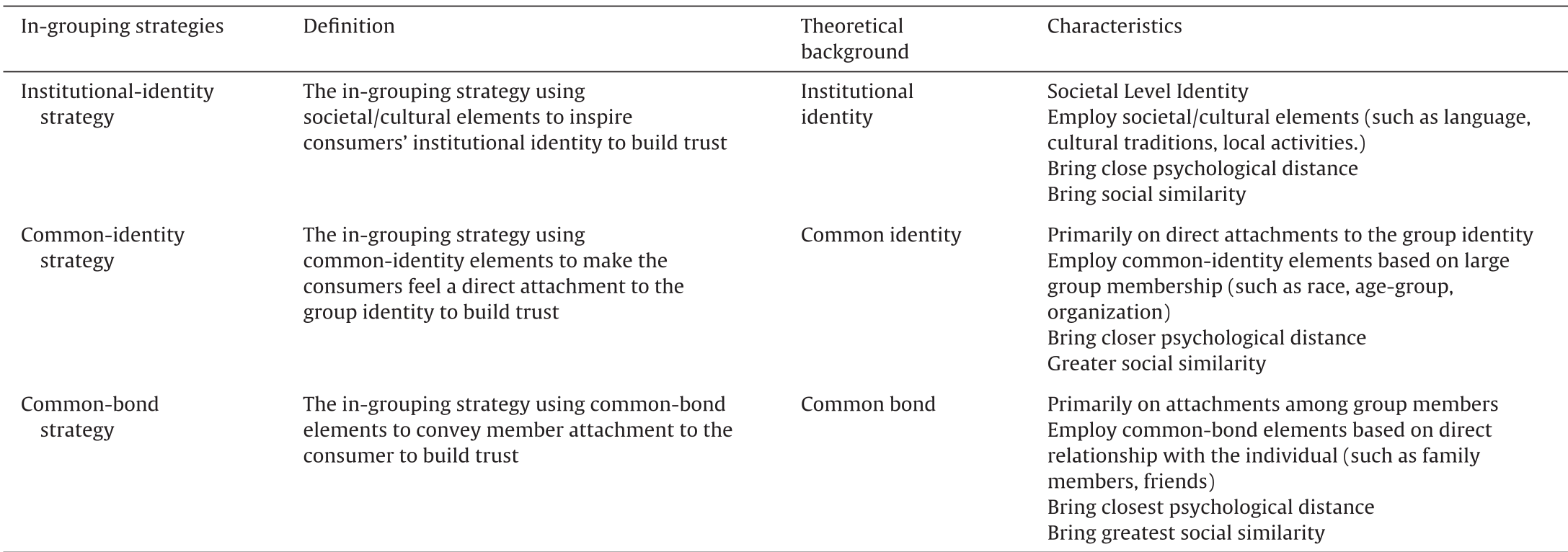
The researchers identified three primary mechanisms to bridge this gap, utilizing the "Facebook of China" (Renren.com) as the delivery vehicle:
- Institutional-Identity: Aligning with the society/culture (e.g., featuring local IMAX film festivals or traditional plays).
- Common-Identity: Aligning with a broad group (e.g., "We are both users of this social network").
- Common-Bond: Aligning with specific personal ties (e.g., "Your classmates from the same university like this store").
Core Insight: Trust Transference
The study relies on Trust Transference Theory. If a consumer trusts their university peers (a known entity), and those peers are associated with a foreign store (an unknown entity), the trust "transfers" across the social tie.
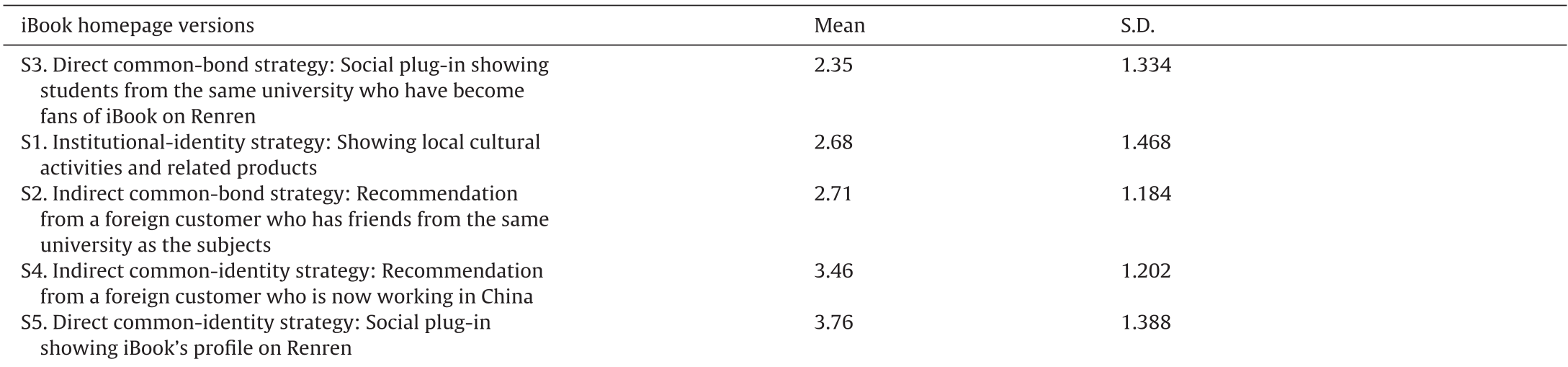
The authors tested five specific homepage versions (S1-S5) to see which strategy triggered this transference most effectively.
Results: The Power of Specific Ties and Local Culture
The ranking results revealed a surprising tie for first place:
- The Winner (Common-Bond): Social plug-ins showing fans from the same university (S3) were highly effective.
- The Surprise (Institutional): Showing local cultural activities (S1) was equally powerful. In China, "Institutional Collectivism" is so strong that aligning with the local culture is just as effective as having a friend recommend the site.
- The Loser (Common-Identity): Simply showing that the brand has a social media profile (S5) was the least effective. It's too generic to build "in-group" status.
Critical Analysis & Takeaways
The brilliance of this work lies in its move away from "What feature should we add?" to "How do we change the user's social perception?"
Key Insights for Practitioners:
- Hyper-Local beats Global: Don't just show "Chinese culture"; show "University of Science and Technology of China culture" if that is your target segment.
- Leverage Invisible Ties: Even a foreign customer's recommendation (usually an out-group signal) can be made effective if you highlight their local ties (e.g., "An American expat who has friends at your university").
- Beyond Localization: Localization is a prerequisite; Social Integration is the competitive advantage.
Limitations
This was an exploratory study focused on perceived trust via rankings. Future research should measure actual conversion rates and purchase behaviors to see if "feeling" like an in-group member truly results in opening the wallet.
Conclusion
For global firms, the "grassroots spirit" isn't about where your headquarters are; it's about whose "Like" button is showing up on the landing page. By utilizing social grouping, the "foreign" label stops being a barrier and becomes a bridge.