
S-Commerce: Why Trust Trumps Discounts in the Age of Social Shopping
International Journal of Information Management
This study investigates the key determinants of consumers' trust in social commerce (s-commerce) and its impact on purchase and word-of-mouth (WOM) intentions. Using an empirical analysis of 371 users, the paper identifies reputation, size, information quality, transaction safety, communication, and WOM referrals as critical drivers of trust, achieving a significant explanation of variance (R² = 78.4% for trust).
TL;DR
Social commerce (s-commerce) is more than just e-commerce with a "share" button; it is a paradigm shift where trust is the ultimate currency. This seminal study by Kim and Park analyzes 371 users to prove that while reputation, site size, and safety are vital, the perceived economic value (discounts) surprisingly does not build trust. Instead, it is the quality of communication and peer referrals that drive consumers to click "Buy."
The Trust Gap in Social Platforms
The transition from traditional e-commerce to s-commerce has been turbulent. In South Korea, the market exploded, yet so did complaints regarding fraud and poor service. The core problem? The low entry barrier for s-commerce firms leads to a "trust deficit." Unlike Amazon or eBay, where institutional trust is established, s-commerce relies on social networks where the line between an ad and a genuine recommendation is blurred.
The authors' research intuition was clear: if s-commerce is built on relationships, then the variables governing those relationships—Communication and Word-of-Mouth—must be the primary drivers of trust, eclipsing the traditional focus on "low prices."
Methodology: Mapping the S-Commerce Ecosystem
The study utilizes a structural equation modeling (SEM) approach to test a model based on the Theory of Reasoned Action (TRA). This framework posits that a consumer's beliefs (trust) lead to intentions, which eventually lead to behaviors (buying and sharing).
The Research Model
The authors identified seven "Characteristics of S-Commerce" as independent variables:
- Reputation & Size: The "Big Player" effect.
- Information Quality & Transaction Safety: The "Technical" hygiene factors.
- Communication & WOM Referrals: The "Social" differentiators.
- Economic Feasibility: The "Price" factor.
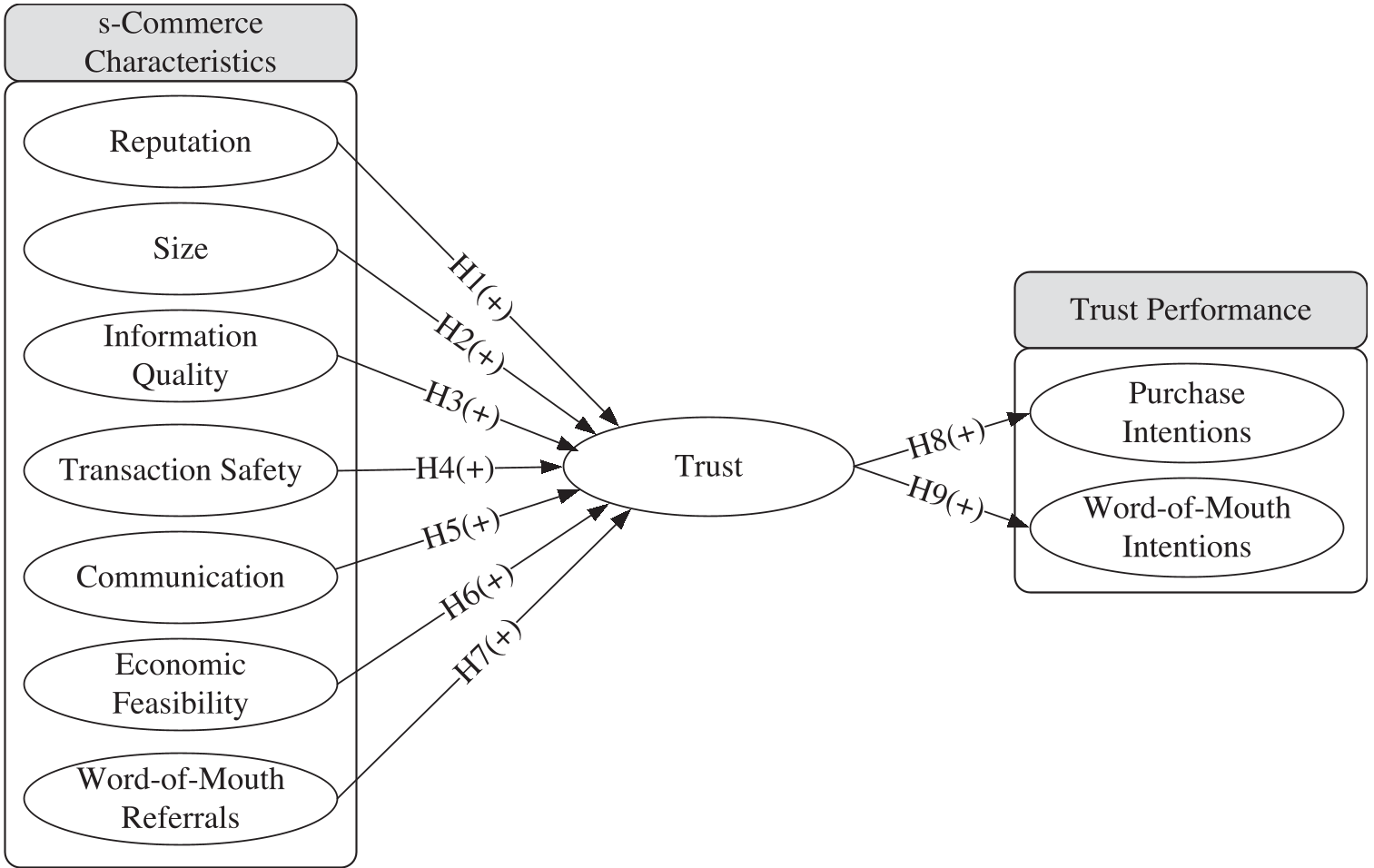 Figure 1: The proposed research model linking s-commerce traits to trust and performance.
Key Findings: The "Price" Paradox
The most striking result of the study is the rejection of Hypothesis 6 (Economic Feasibility → Trust).
- Discounts ≠ Trust: In many Western contexts, a deal is a deal. However, this study suggests that in the s-commerce landscape, an excessively low price can actually trigger suspicion. Consumers may view deep discounts as a "compensation" for high transaction risk.
- The Power of Talk: Communication and WOM referrals were found to be essential. Because s-commerce is "faceless," real-time feedback and peer reviews act as the "social proof" that replaces the physical inspection of goods.
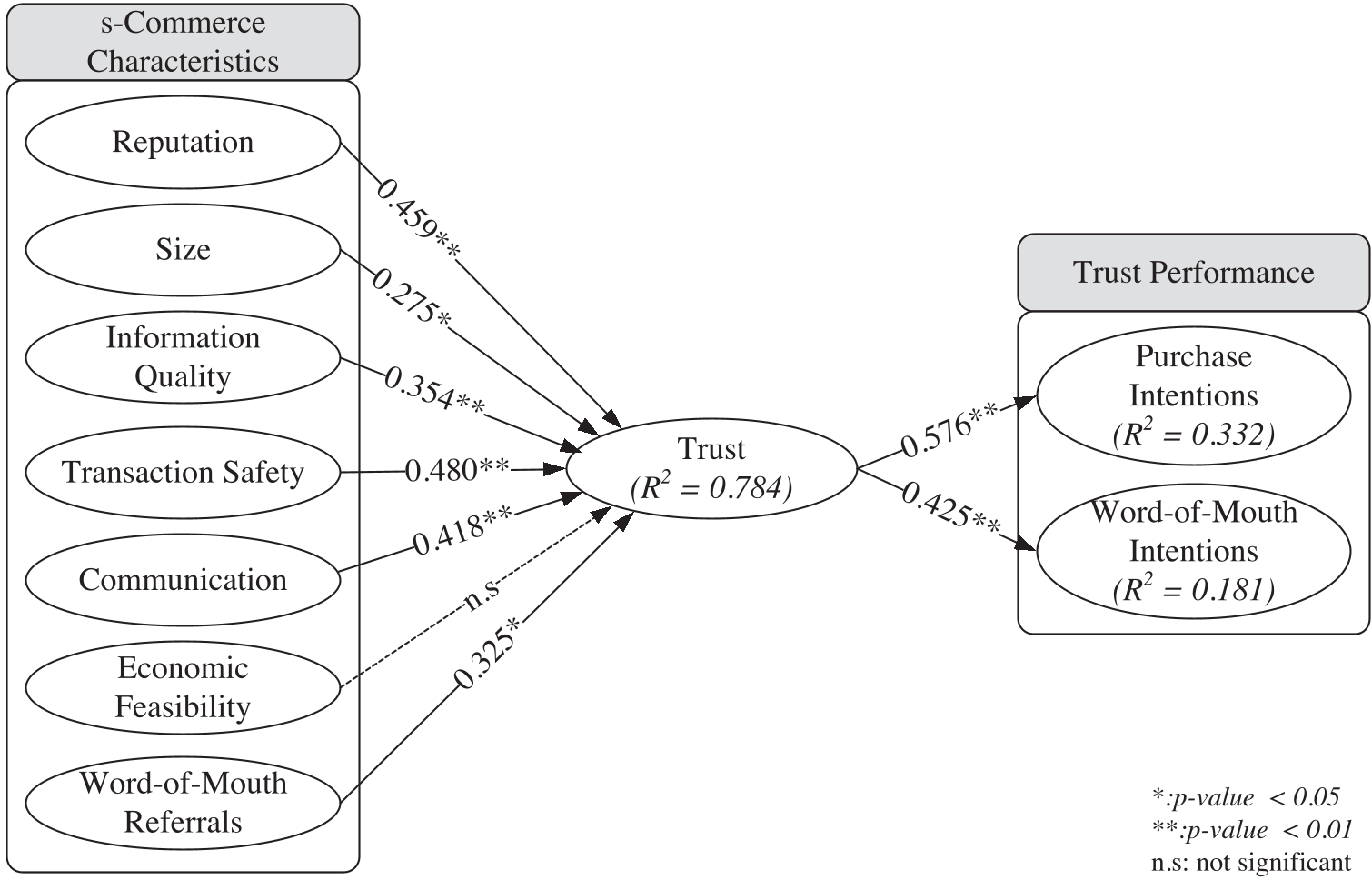 Figure 2: Statistical results showing the significant paths. Note the lack of significance for Economic Feasibility.
Performance Metrics
The study proves that trust has a dual-output:
- Purchase Intentions (33.2% variance explained): Trust turns browsers into buyers.
- WOM Intentions (18.1% variance explained): Trust turns buyers into advocates, creating a self-sustaining marketing loop.
Critical Insight & Practical Application
From an academic standpoint, this paper serves as a vital pivot from "Technical Trust" (security/encryption) to "Relational Trust" (communication/referrals).
For Designers & Marketers:
- Prioritize Interaction: Don't just list products; build robust Q&A boards and real-time support. Communication is a trust-builder, not just a service cost.
- Quality over Hype: Focus on "Information Quality." Accurate, timely, and user-validated information is more effective at securing a sale than a 50% off banner.
- Leverage S-Referrals: Encourage users to share their experiences. In the s-commerce world, a recommendation from a friend is significantly more persuasive than any corporate advertisement.
Conclusion
This research highlights that for s-commerce, the "Social" is just as important as the "Commerce." While reputation and safety are the foundations, it is the active communication and the social validation of the network that ultimately drive business success. As the market continues to evolve toward 2026 and beyond, firms that ignore the relational aspects of trust will likely find that even the deepest discounts cannot save a failing business model.