
Bridging vs. Bonding: How International Students Balance Facebook and Home-Country Social Networks
International students' use of facebook vs. a home country site
This survey study explores how Chinese and Korean international students in the U.S. navigate social capital across Facebook and their home-country social network sites (SNSs) like Renren and Cyworld. By analyzing 335 participants, the research identifies that both bridging and bonding social capital drive engagement on both platforms, defying the simple "local for bonds, global for bridges" dichotomy.
TL;DR
For international students, digital life isn't a zero-sum game between "fitting in" and "staying connected." This study reveals that both Facebook and home-country sites (Renren, Cyworld) are used concurrently to build both bridging and bonding social capital. While Facebook friend counts grow with time spent in the U.S., the home-country site remains a persistent pillar for identity and deep-seated social bonds.
The "Dual-Site" Dilemma: Why One Platform Isn't Enough
When an international student moves to the U.S., they face a unique social challenge: their existing emotional support (Bonding) resides on a native-language SNS, while their future opportunities and local acquaintances (Bridging) reside on Facebook.
Existing research suggests that social networks are vital for adaptation, but it rarely accounts for the time-allocation conflict. Does spending an hour on Renren actively hinder a student's integration into the U.S. culture by poaching time from Facebook? The researchers hypothesized a clean split—Facebook for "reaching out" and home sites for "staying in"—but the reality they found is far more complex.
Methodology: A Tale of Two Countries
The study surveyed 335 students from China and South Korea. These populations were chosen because of their distinct home-grown SNS ecosystems:
- China: Renren (at the time, the dominant "Facebook of China").
- Korea: Cyworld (a pioneer in personalized digital spaces).
The researchers used hierarchical regression to determine what actually drives Intensity of Use and Friend Counts.
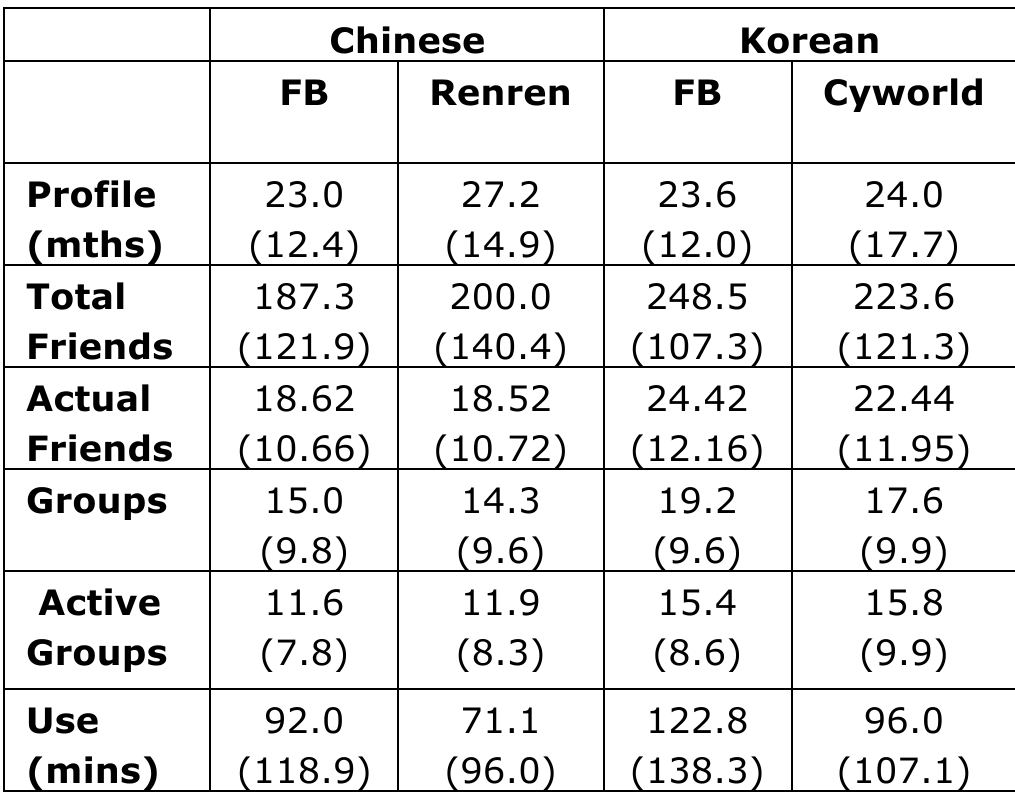 Table 1 illustrates that while international students spend slightly more time on Facebook, the total friend counts and group memberships remain remarkably balanced between the two platforms.
Key Insights: Breaking the Dichotomy
1. The Myth of the "Bridging/Bonding" Split
The authors expected students to use Facebook only for bridging (new acquaintances) and Cyworld/Renren only for bonding (old friends). Instead, the data showed that high desire for both types of capital led to higher intensity on both platforms. If you are a "social seeker," you seek capital everywhere, regardless of the language the interface uses.
2. The Great Firewall Factor
A fascinating finding was the disparity between Korean and Chinese users. Korean students switched to Facebook more intensely as Cyworld's popularity waned. However, for Chinese students, the FB ban in China meant they had to maintain Renren to stay connected with anyone back home, leading to a more rigid separation of social spheres.
3. Time is the Great Facebook Catalyst
Regression analysis confirmed that "Years in the U.S." was a strong predictor for Facebook friend counts. However, it did not significantly decrease activity on home-country sites, suggesting that students add new layers to their social life rather than replacing old ones.
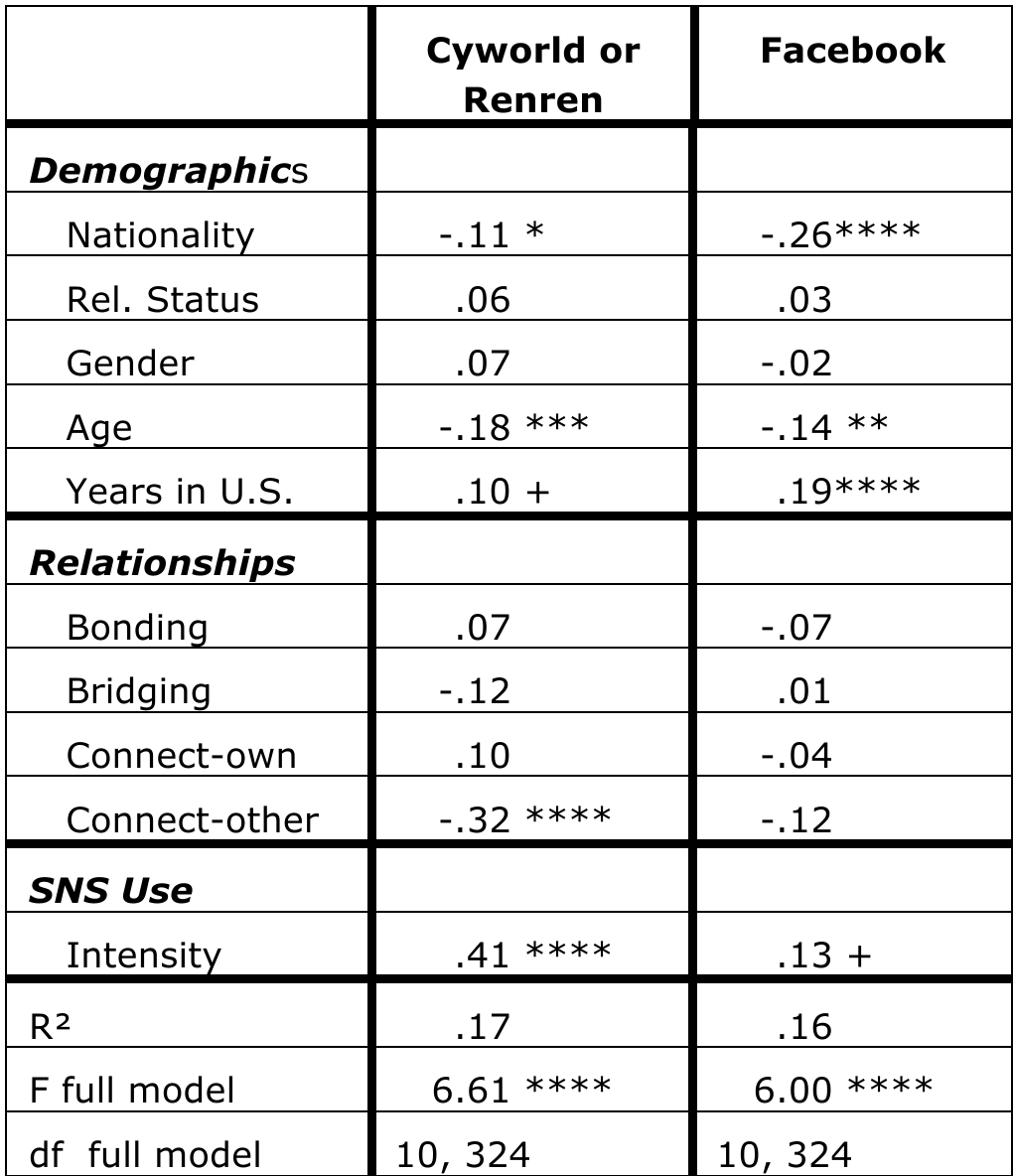 Regression results showing how nationality and years in the U.S. influence social network scale. Notably, interest in 'connecting with other groups' (Connect-other) significantly reduced the number of friends on home-country sites.
Design Implications: Toward "Fluid" Social Media
The study concludes with a powerful call to action for UI/UX designers:
- Cross-Posting Tools: If a student's life is split across two worlds, why should they have to post twice? Tools that bridge these platforms could reduce the cognitive load of "maintenance."
- Smart Newsfeeds: Since attention is divided, newsfeed algorithms should prioritize deep bonding updates on home sites and high-value bridging info on Facebook to maximize the utility of the user's limited time.
Final Takeaway
The digital life of a migrant is fragmented by design. This paper moves the conversation beyond "which site is better" to "how do we manage the synergy of both." For future researchers and developers, the goal should be reducing the friction of living in two digital worlds at once.