
Cross-Platform Monitoring: Deciphering the Pulse of Political Communication in the Web 2.0 Era
International Symposium on Frontiers in Ambient and Mobile Systems (FAMS-2011) Automatic Full Text Analysis in Public Social Media -Adoption of a Software Prototype to Investigate Political Communication
This paper presents a software prototype for automated full-text analysis and monitoring across multiple social networks (Facebook, Twitter, StudiVZ). Focusing on political communication, it tracks temporal evolutions of topics and influence to provide decision-making support for politicians and organizations.
TL;DR
As social networks have evolved into the primary arena for public discourse, the ability to monitor and analyze this data in real-time has become a strategic necessity. This paper introduces a modular software prototype designed to aggregate, index, and analyze full-text data from diverse platforms like Twitter and Facebook. By applying this to a test case of German political actors, the authors demonstrate how dynamic indexing can provide an "early warning system" for emerging public concerns.
Motivation: Beyond the Search Engine
The authors argue that "classic information retrieval" (i.e., traditional search engines) is ill-equipped for the social media age. Why? Because social communication is:
- Fragmented: Users jump between platforms for different purposes.
- Ephemeral: Topics rise and fall within hours.
- Structured yet Messy: While data follows certain API schemas, the actual "meat" of the communication—opinions, typos, and shorthand—requires specialized sanitization.
The core motivation was to move away from "static snapshots" of social networks and toward a continuous, temporal understanding of how information flows.
Methodology: The Anatomy of a Monitoring Server
The prototype's architecture is built on the principle of extreme modularity. This is a pragmatic choice: social media APIs (like Facebook's Graph API or Twitter's API) are notoriously volatile.
1. The Modular Framework
The server core provides only basic services (scheduling and file systems), while "Plug-ins" handle the dirty work of fetching data. This allows the system to pretend to be a web browser when APIs are unavailable or limited.
2. The Data Flow & Processing
A unique feature of this system is its handling of URL Extraction. Since Twitter status updates are limited (historically 140 characters), a module specifically extracts URLs, fetches the linked content, and feeds it back into the Lucene indexer for a more comprehensive textual analysis.
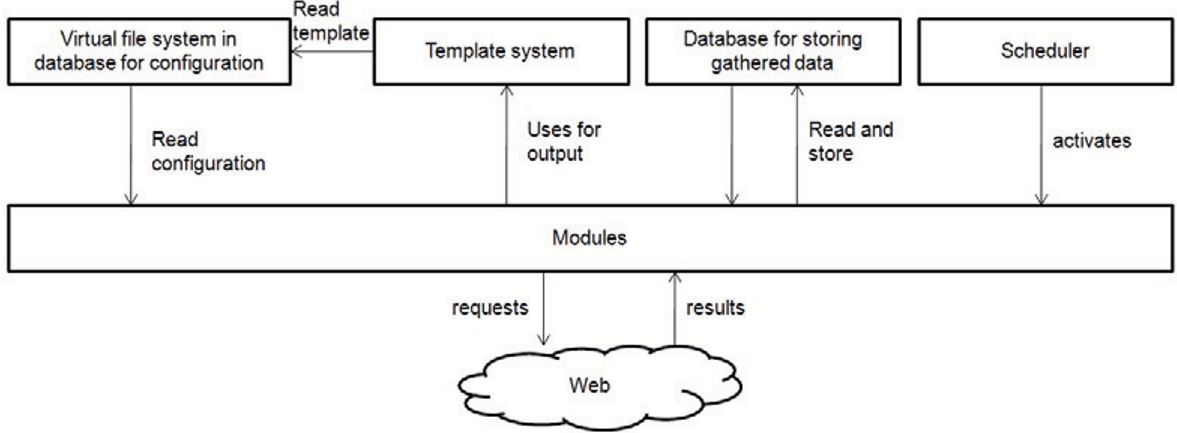 Figure 1: The modular interaction between data gathering, storage via Lucene, and the analysis modules.
Politics 2.0: A Real-World Test Scenario
To validate the system, the authors tracked Sabine Leutheusser-Schnarrenberger, the German Federal Minister of Justice in 2010. They monitored her name (and its various misspellings) alongside major German political parties (CDU/CSU, SPD, FDP, etc.).
Key Findings:
- Dynamic Topic Tracking: The system used "Spark lines" (word-sized trend lines) to visualize the fluctuating relevance of topics over a week.
- Platform Variance: The study noted significant differences in how a person is discussed on "student-centric" platforms like StudiVZ versus "broadcast-centric" platforms like Twitter.
 Table 1: Comparative analysis of mentions across Facebook, Twitter, and StudiVZ.
Critical Insights & Future Outlook
The transition from an academic prototype to a production-ready "Opinion Monitoring" tool faces several hurdles:
- The "API Wall": Since this paper's publication, platforms have significantly restricted data access.
- Semantics vs. Keyword Search: The paper relies heavily on keyword matching (Lucene). Modern approaches would require LLM-based sentiment analysis to distinguish between a mention that is supportive versus one that is critical.
Conclusion
This work serves as a foundational blueprint for Social Software Monitoring. It shifts the focus from "Who knows whom" (graph analysis) to "What is being said" (full-text analysis). For politicians and enterprises alike, the ability to automate the aggregation of cross-platform sentiment is no longer a luxury—it is the bedrock of strategic communication in a hyper-connected world.