
Beyond the 30km Limit: Software Developers and the End of Geographic Homophily
When Internet Really Connects Across Space: Communities of Software Developers in Vkontakte Social Networking Site
This study investigates whether professional online communities genuinely transcend geographic boundaries by analyzing the 25 largest software developer groups on the Russian social network VKontakte (VK). Using Social Network Analysis (SNA), the authors demonstrate that membership and friendship ties are overwhelmingly location-independent, with inter-city links outnumbering intra-city links by an average ratio of 4:1.
TL;DR
Is the internet actually connecting us across the globe, or is it just a digital mirror of our physical neighborhoods? While many studies suggest we mostly talk to people nearby, a deep dive into VKontakte's software developer communities reveals a different story. For IT professionals, geography is irrelevant: friendship and collaboration networks are fundamentally cross-city, driven by a need for specialized expertise rather than local proximity.
The "Local" Trap in Social Media Research
For years, the consensus in digital sociology has been somewhat pessimistic regarding the "Death of Distance." Researchers noted that most social interactions on platforms like Twitter or Facebook tend to cluster within a 30 km radius—essentially the limit of a daily commute.
However, the authors of this paper argue that this "local bias" is a result of what we study. If you look at average users, they use the internet to maintain offline friendships. But if you look at professional communities, specifically software developers, the motivation changes. Developers don't need to know their neighbor; they need to know someone who can debug a C# script.
Methodology: Measuring "Space-Crossing"
The study analyzed the 25 largest developer groups on VK (the "Russian Facebook"), encompassing over 260,000 users. To move beyond simple counts, they utilized the E-I Index (External-Internal).
- EI = (EL - IL) / (EL + IL)
- An index of 1.0 means all links are between different cities (External).
- An index of -1.0 means all links are within the same city (Internal).
The research didn't just look at who is "friends" with whom; it broke down interactions into three distinct layers:
- Friendship Network: Representing identity and group belonging.
- Commenting Network: Functioning as an advice-giving/expert tool.
- Liking Network: Representing casual approval from occasional visitors.
Key Insights: Why Distance is Dead for Devs
The findings were striking. The average E-I index across these groups was 0.67, with a median of 0.83. This indicates a massive prevalence of inter-city ties.
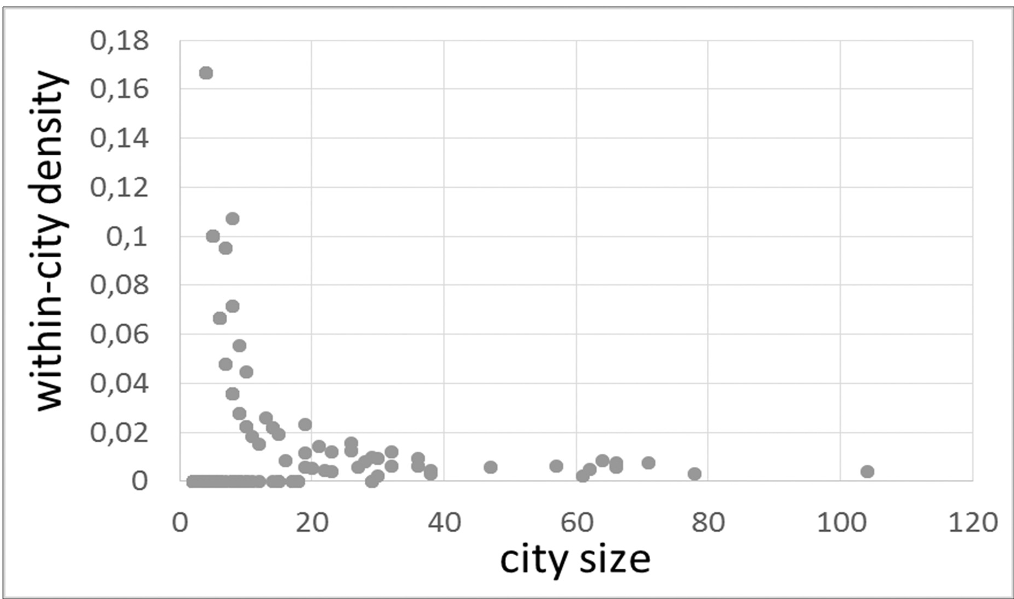 Figure 1: Distribution of in-city vs out-city friendships, showing that most cities connect outward far more than inward.
The C# Group Deep Dive
In a focused study of a C# developer group, the researchers found that:
- Hubs are Geographic-Agnostic: The "hubs" (central users) in commenting and friendship were scattered across Moscow, Saint Petersburg, Kyiv, and Minsk.
- The Advice Economy: Most activity happened on the "wall" (message board). This network behaved like an advice-giving system, where a small set of experts answered questions from visitors regardless of where they lived.
- Functional Independence: Interestingly, being active in comments did not necessarily mean you had many friends in the group. Professional utility (advice) and social capital (friendship) are separate tracks.
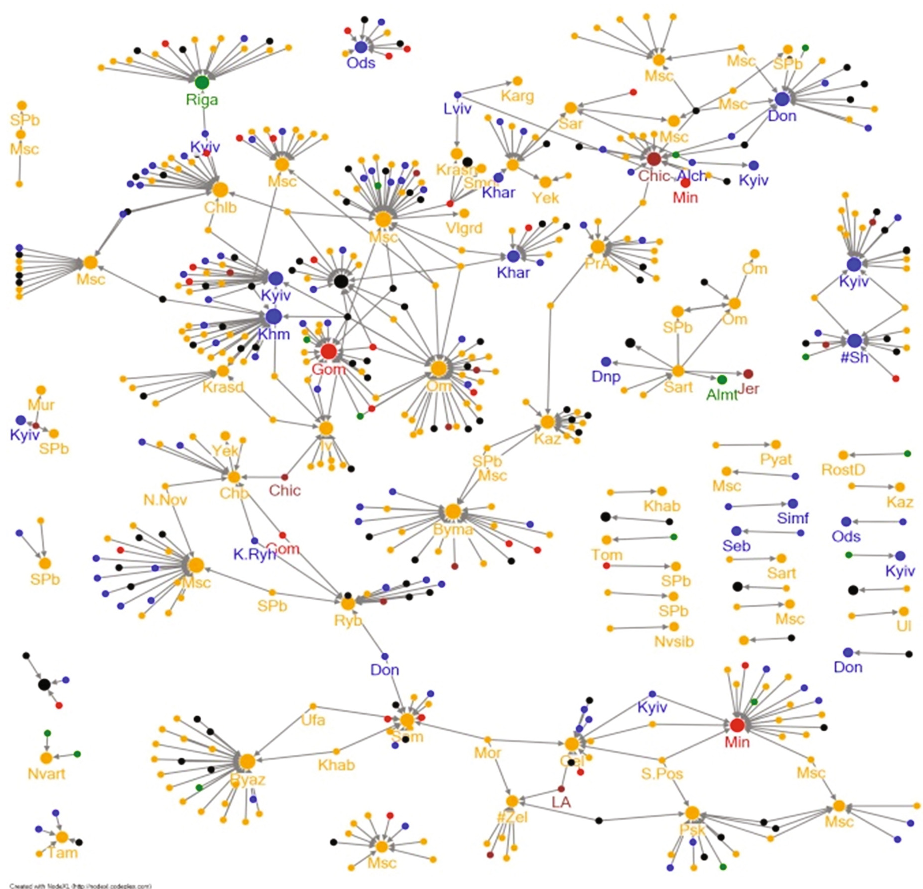 Figure 2: Visualization of the commenting and liking networks, illustrating the star-like structure of "expert" hubs.
Conclusion: An Identity Built on Logic, Not Location
The study proves that for certain "distance-independent" professions, the internet finally fulfills its promise of a global village. Software developers exhibit a strong professional identity that supersedes their geographic one.
Takeaways for the Industry:
- Recruitment: The data supports the validity of globalized remote talent pools; developers are already naturally networking this way.
- Community Design: Professional platforms should focus on "Expert Hubs" and knowledge-retrieval features rather than local discovery.
Limitations: The study focuses on the Russian-speaking segment (Cyrillic web). Future research is needed to see if the same patterns hold in English-centric platforms like StackOverflow or GitHub, where the "cities" are replaced by even broader national boundaries.