
Digital Governance and the Authoritarian Paradox: How Netizens Perceive the Chinese Internet Ecology
The internet ecological perception, political trust and political efficacy of Chinese netizens
This study investigates the impact of Internet ecological perception and political trust on the political efficacy of Chinese netizens. Using survey data from Jiangsu Province (N=1558), it reveals that while online perceptions positively influence external political efficacy and political trust, they have no significant direct effect on internal political efficacy.
TL;DR
Does the Internet empower citizens in an authoritarian state, or does it merely reinforce existing power structures? This study explores how Chinese netizens' perceptions of the "Internet ecology"—including censorship, privacy, and policy—shape their Political Efficacy. The findings suggest a complex reality: while the Internet boosts the belief that the system can respond (External Efficacy) through political trust, heavy usage actually breeds disillusionment.
The Problem: Participation Under "Vague Governance"
In Western democracies, the rules of political engagement are relatively transparent. In China, however, the state employs a strategy of "Vague Governance." There are few hard codifications of what constitutes "forbidden" speech, leading to a "subsequent punishment" mechanism. This forces netizens into a state of Exploratory Political Participation, where they must constantly sense the "ecology" of the web to determine how much influence they truly have.
Prior works often ignored this psychological dimension, focusing instead on simple usage metrics. This paper argues that perception of the environment is more critical than the act of using it.
Methodology: Mapping the Internet Ecology
The researchers identified six pillars that constitute a netizen's perception of the digital environment:
- Policies and Regulations
- Freedom of Speech
- Privacy Protection
- Information Disclosure
- Information Authenticity
- Influence of Online Public Opinion
By surveying 1,558 residents in Jiangsu Province, they mapped these perceptions against Internal Efficacy (self-confidence in one's political ability) and External Efficacy (belief in government responsiveness).
 Note: The study posits that Internet Perception and Political Trust are the primary drivers of efficacy in the digital age.
Key Insights and Results
1. The "Disillusionment" Effect
One of the most striking findings is that Internet use intensity is negatively correlated with political efficacy. Unlike in the US, where more time online often correlates with higher efficacy, the Chinese context reveals a "stalemate." As netizens spend more time online, the initial excitement of social media gives way to the reality of strict regulation and insufficient government response.
2. External vs. Internal Efficacy
The Internet ecology significantly impacts External Efficacy. If a netizen perceives the web as standardized and transparent (high privacy protection and clear regulations), they are more likely to believe the government cares about their opinion. However, it does not significantly increase their Internal Efficacy—their personal confidence in participating in politics remains tied more to traditional factors like education and gender.
3. The Role of Political Trust
The study confirms a unique Chinese phenomenon: Hierarchical Trust. Netizens possess higher trust in the Central Government (idealized as a moral model) than in Local Government (seen as the fallible executor).
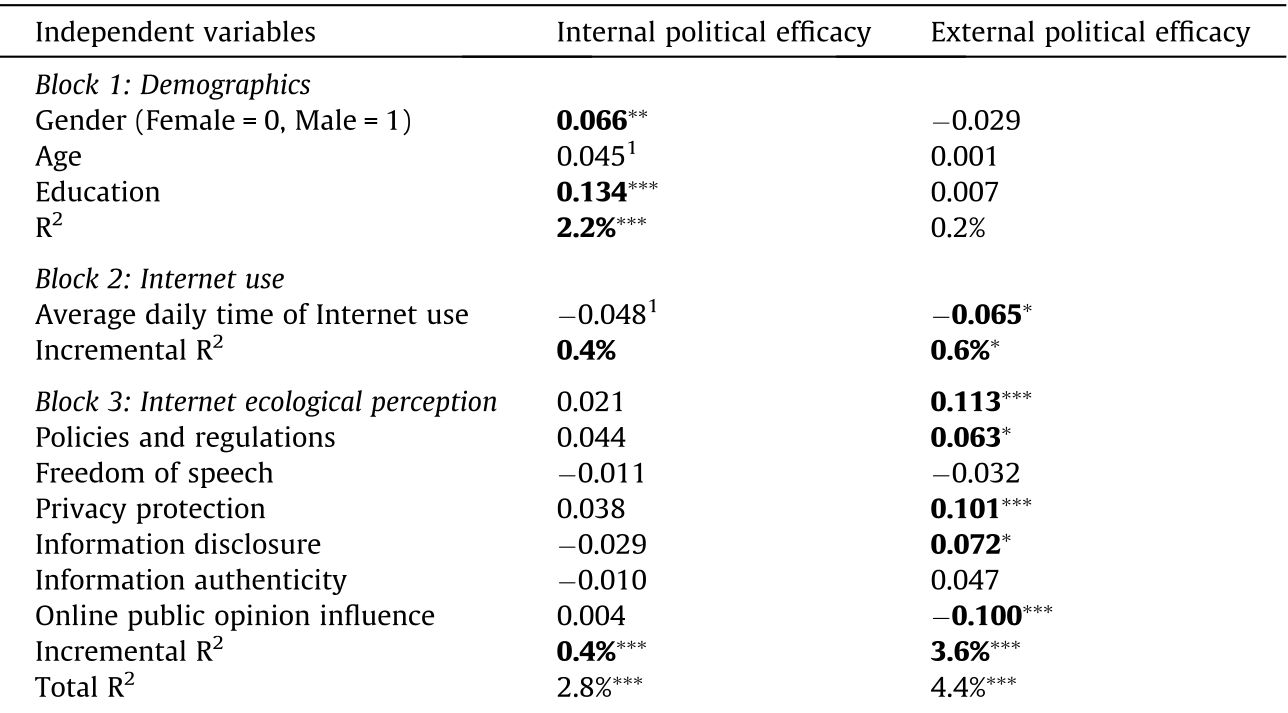 Table showing that Internet ecological perception accounts for a significant portion of the variance in External Efficacy (Incremental R² = 3.6%).
Critical Analysis & Conclusion
This research provides a nuanced "Academic SOTA" for understanding digital authoritarianism. It challenges the techno-optimist view that the Internet inherently democratizes.
Takeaways:
- Privacy is Paramount: Even in a state-heavy environment, the perception of privacy protection is the strongest positive predictor of external efficacy. Netizens want to engage, but they want to feel safe doing so.
- The Government Dilemma: The more the government uses platforms like Weibo to disclose information, the higher the political trust. However, if they fail to actually respond to the increased volume of public demands, they risk a total collapse of external efficacy.
Limitations: The study primarily focused on "ordinary" netizens. "Opinion Leaders" (Big Vs) who interact more directly with redlines might have a vastly different perception of the ecology. Future research should investigate how "Remediation Activities" (like the 2015 crackdown on rumors) have shifted these perceptions in the decade since this data was collected.