
The Internet as a Virtual Rainforest: Navigating the Complexity of Global Governance
7503_The Internet Governance Ecosystem and the Rainforest.
The article "What is Internet governance, and why should ordinary people care" explores the complex, non-hierarchical ecosystem of Internet management. It advocates for a transition from 20th-century multilateralism to a 21st-century multistakeholder model, highlighting the NETmundial conference as a milestone for collaborative, decentralized governance.
TL;DR
Internet governance is evolving from a rigid, government-led 20th-century hierarchy into a fluid, "Level 2" multistakeholder ecosystem. By treating the Internet like a biological rainforest—diverse, unmanageable by a single entity, but easily damaged—this paper argues that sustainable digital growth requires collaboration between governments, tech giants, and civil society through "rough consensus" rather than absolute sovereign control.
Problem & Motivation: The Failure of the "Internet Czar"
We often think of the Internet as a utility, but the authors, Virgilio A.F. Almeida and Wolfgang Kleinwächter, argue it is the planet's "nervous system." The core problem is that traditional political structures—designed for physical borders—cannot manage a "virtual environment" that is infinitely diverse and interdependent.
Prior work often fell into two ineffective camps:
- Strict Multilateralism: Governments trying to exert top-down control, which stifles innovation and ignores technical realities.
- Pure Tech-Autonomy: Technical bodies (like IETF) managing protocols without addressing the social, legal, and human rights implications of their code.
The motivation for this work is to find a "middle way" that recognizes the Internet’s fragility—the "do-not-harm" principle.
Methodology: The Rainforest Analogy and Level 2 Governance
The authors propose a shift from Level 1 (Intergovernmental) to Level 2 (Multistakeholder). In this new paradigm, national sovereignty is not eliminated but is embedded into a larger framework.
The Ecosystem Architecture
The governance structure is broken down into specific functional organs:
- ICANN: Manages the "phone book" of the Internet (IPs and Domains).
- IETF & W3C: Define the "language" (protocols like HTTP, HTML).
- IGF: A forum for discussion without binding power.
- NETmundial: The proposed bridge that combines the "rough consensus" of engineers with the "language negotiations" of diplomats.
 Figure 1: The architecture of formal structures involved in technical and policy governance.
The paper emphasizes that complexity requires complex solutions. There is no "kill switch" or "one size fits all" regulation that can protect the Internet while promoting freedom.
Experiments & Results: The NETmundial Breakthrough
The paper uses the NETmundial conference as a case study. Unlike the World Summit on the Information Society (WSIS), where governments ultimately made the final call, NETmundial utilized a "Multistakeholder Committee" where everyone sat on an equal footing.
Key Outcomes:
- Rough Consensus: Borrowed from the IETF's approach to engineering ("Working code and rough consensus"), this method was successfully applied to political policy.
- Collaborative Decision-Making: The process proved that civil society and the private sector could participate in "language negotiations" traditionally reserved for UN diplomats.
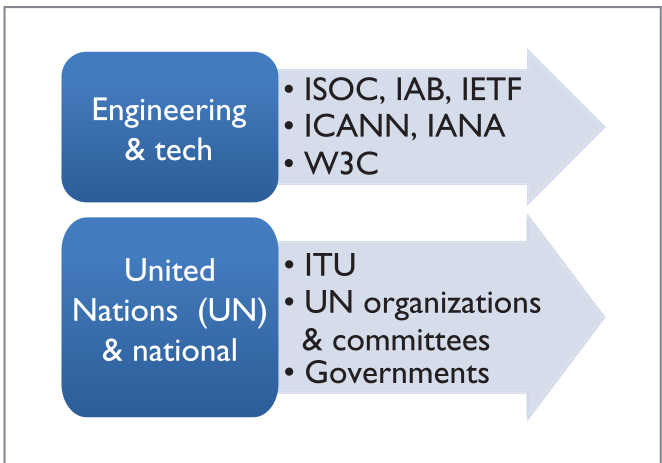 Figure 2: The shift from intergovernmental systems (Level 1) to multistakeholder systems (Level 2).
Critical Analysis & Conclusion
The authors conclude that Internet governance is moving toward "Governance on the Net"—addressing issues like cybercrime, surveillance, and human rights—rather than just "Governance of the Net" (technical protocols).
Takeaway
The success of the Internet depends on a "competitive coexistence" of different regimes. We must treat the digital environment with the same ecological care we give the physical rainforest: preventing "pollution" (crime, surveillance) without destroying the biodiversity of innovation.
Limitations & Future Work
While the paper praises the NETmundial model, it acknowledges that the Internet is becoming "more dangerous and untrustworthy" due to state-sponsored warfare in cyberspace. The real test for the Level 2 model will be its ability to handle binding enforcement in an era of increasing digital nationalism, where countries like Russia or China may seek a "Splinternet" rather than a collaborative rainforest.