
Internet of Underground Things: The Hidden Backbone of Future Precision Agriculture
Internet of underground things: Sensing and communications on the field for precision agriculture
This paper introduces the Internet of Underground Things (IOUT), a specialized IoT paradigm for precision agriculture that integrates buried sensors and communication devices for real-time soil monitoring. It establishes a comprehensive architecture connecting underground things (UTs), mobile sinks, and cloud services to enable autonomous irrigation and variable rate technology (VRT).
TL;DR
As the global population surges toward 2050, agriculture faces a "crop for drop" challenge. This paper presents the Internet of Underground Things (IOUT)—a paradigm shift where sensors and radios are buried to provide real-time, in-situ soil data without obstructing farm machinery. By mastering the complex physics of wireless communication through soil, IOUT enables fully autonomous irrigation and fertilization.
The "Underground" Motivation: Beyond Surface-Level Sensing
Current precision agriculture is often hindered by the "hardware vs. harvester" conflict. Above-ground sensors (Over-the-Air/OTA) provide excellent range but are frequently damaged by tractors or require labor-intensive removal before every harvest.
The authors argue that for Variable Rate Technology (VRT)—the precise application of water and chemicals—to succeed, we need sensors that stay in the ground year-round. However, the soil is a hostile medium for radio waves. Unlike air, soil is a "living" dielectric mixture of sand, clay, and water, where a sudden rainstorm can completely change the communication environment.
Methodology: Engineering the Soil-Air Interface
The IOUT architecture consists of four pillars: Underground Things (UTs), Mobile Sinks (on tractors/pivots), Base Stations, and the Cloud.
The Physics of Underground Communication
The paper identifies six critical factors affecting how "Things" talk through the earth:
- Soil Texture & Density: Clay holds more water, leading to higher signal absorption compared to sand.
- Soil Moisture (The Dielectric Wildcard): Water increases the permittivity of soil, shortening the wavelength and narrowing the coherence bandwidth to mere hundreds of KHz.
- The Lateral Wave Effect: This is the "secret sauce" of IOUT. Waves travel from the buried sender up to the surface, glide along the air-soil interface (where attenuation is lower), and then dip back down to the receiver.
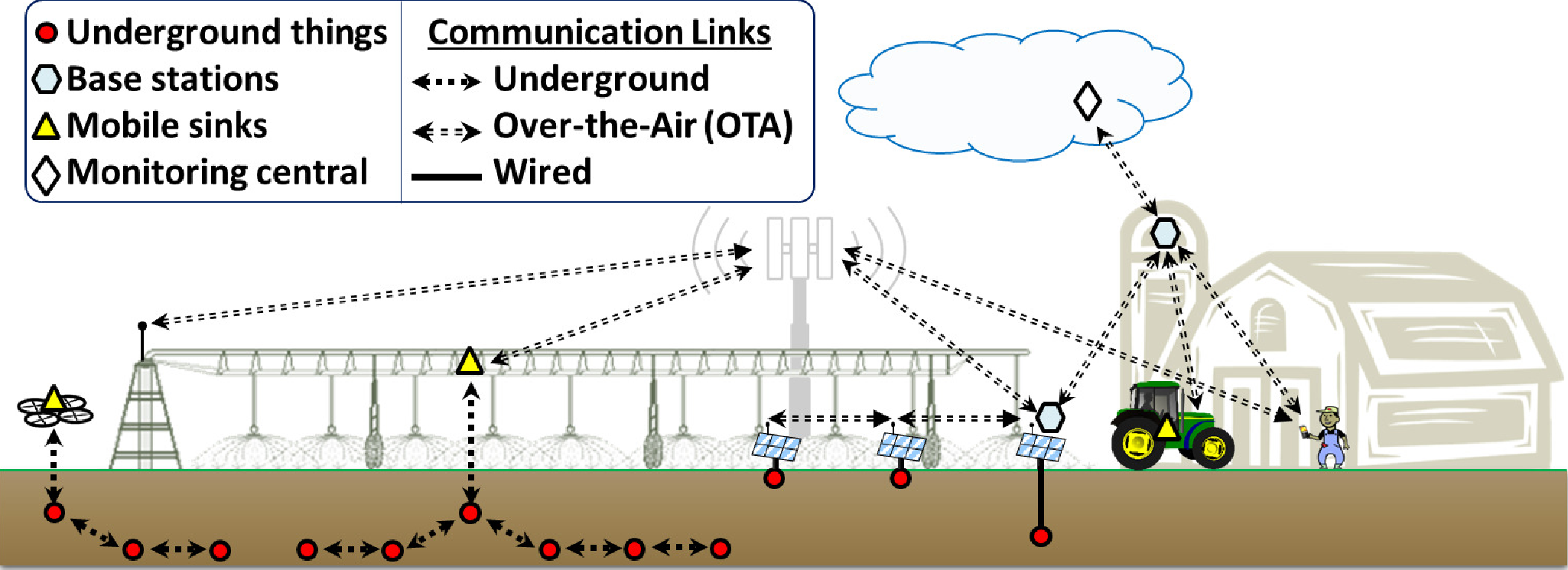 Fig 1: The IOUT Paradigm showing UTs integrated with irrigation systems and cloud decision-making.
Experiments: Real-World Deployment
The authors validated their concepts through two primary testbeds:
- The SCAL Field Testbed: A 41-acre site in Nebraska featuring a mobile sink on a center-pivot irrigation tower. It captures data from sensors buried at 1 to 4 feet depths.
- The Indoor "Sand-Box": A controlled environment where soil moisture is precisely manipulated to measure its impact on signal attenuation and antenna return loss.
Key Performance Insight
While underground-to-underground (UG-UG) links struggle with distance, the Underground-to-Aboveground (UG-AG) link is remarkably robust, reaching over 200 meters. This allows a tractor or an irrigation pivot to "sweep" a field and collect data from buried nodes effortlessly.
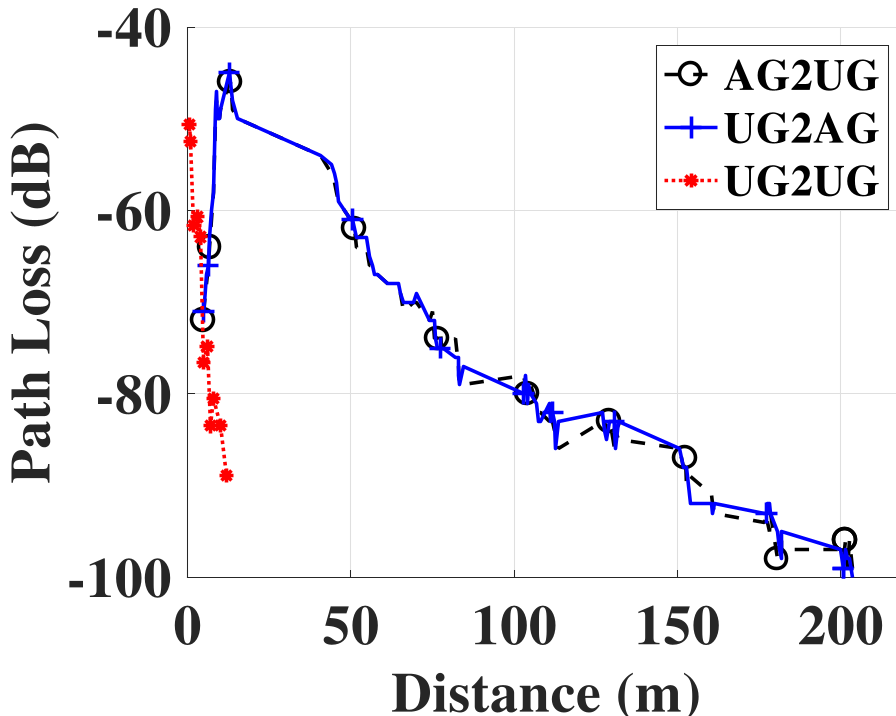 Fig 2: Comparison of path loss across different link types. Notice the sharp decline in signal strength as moisture increases.
Critical Insights & The Road Ahead
The most profound takeaway is that soil moisture is both the data and the disruptor. In a typical IoT setup, the environment is static. In IOUT, the very thing you are trying to measure (moisture) actively changes the channel you use to report it.
Challenges to Solve:
- Cognitive Radios for Soil: Sensors need to detect "wet" soil and automatically switch to lower frequencies or more robust modulation schemes.
- Power Longevity: Digging up sensors to change batteries defeats the purpose. Innovations in soil energy harvesting are mandatory.
- Multi-modal Sensing: Beyond moisture, we need cheap, buried sensors for nitrogen, phosphorus, and potassium (NPK) to automate "fertigation."
Conclusion
The Internet of Underground Things is no longer science fiction. By moving the "eyes" of the farm beneath the surface, we move closer to a truly autonomous agricultural system that maximizes yield while preserving our planet's most precious resource: water.