
Internet Practice and Professional Networks in Chilean Science: Elixir or Affliction?
Internet practice and professional networks in Chilean science: Dependency or progress?
This study investigates the impact of Internet practice on professional networks within the Chilean scientific community, using a communication network survey of 337 researchers. It introduces the "collaboration range" index and identifies how digital engagement correlates with the shift from local to international linkages in a developing nation context.
TL;DR
Based on a comprehensive survey of Chilean scientists, this research explores if the Internet acts as a democratizing "elixir" or a divisive "affliction." While Internet use facilitates a dramatic expansion of international networks and levels the playing field for women and regional researchers, it also correlates with a shrinking of local professional ties, suggesting a shift toward global integration at the cost of local cohesion.
Problem & Motivation: The Dual-Network Trap
Historically, scientists in the developing world have struggled with a "disjointed" identity. They either maintain strong local ties but remain invisible to global "invisible colleges," or they become exogenously dependent—highly connected to the First World but isolated from their own domestic scientific needs.
The researchers identified geo-social asymmetries—where urban male elites hold the lion's share of resources—as a major hurdle. The fundamental question was whether the Internet could resolve this inverse relationship and redistribute resources more equitably across Chile’s regional and demographic divides.
Methodology: Beyond Simple Access
In Chile, unlike in sub-Saharan Africa, Internet access is nearly universal among scientists. Therefore, the researchers moved beyond "access" to measure:
- Intensity: Hours per week on email.
- Diversity: Variety of online tasks (e.g., discussing research with foreign peers, reviewing manuscripts).
- Collaboration Range: A novel index weighting research projects by the geographical distance of collaborators.
 Figure 1: Conceptual matrix of Internet-mediated development possibilities (Elixir vs. Affliction).
Core Findings: The Digital Leveling
The study’s multivariate regression analysis yielded several "Academic Black Mirrors" and "Utopian Glimpses":
1. The Inverse Relationship
The data confirms a significant inverse correlation (r = -0.31) between domestic and international ties. As scientists use the Internet longer, their local networks actually shrink while their foreign networks grow. This suggests a "functional equivalence" where the Internet replaces traditional local networking.
2. Democratizing the Periphery
Contrary to the "urban bias" theory, the research found that scientists in the semi-periphery (Concepcion) and periphery (Puerto Montt) actually enjoyed greater geographical diversity in their networks than those in the capital (Santiago). This suggests the Internet allows researchers in niche industries (like aquaculture) to bypass central gatekeepers.
3. Closing the Gender and Age Gap
In the digital age, Chilean women and younger scientists show comparable network reach to their male and senior counterparts. Email diversity is the "great equalizer," as variety in digital practice directly correlates with a more balanced (symmetrical) professional network.
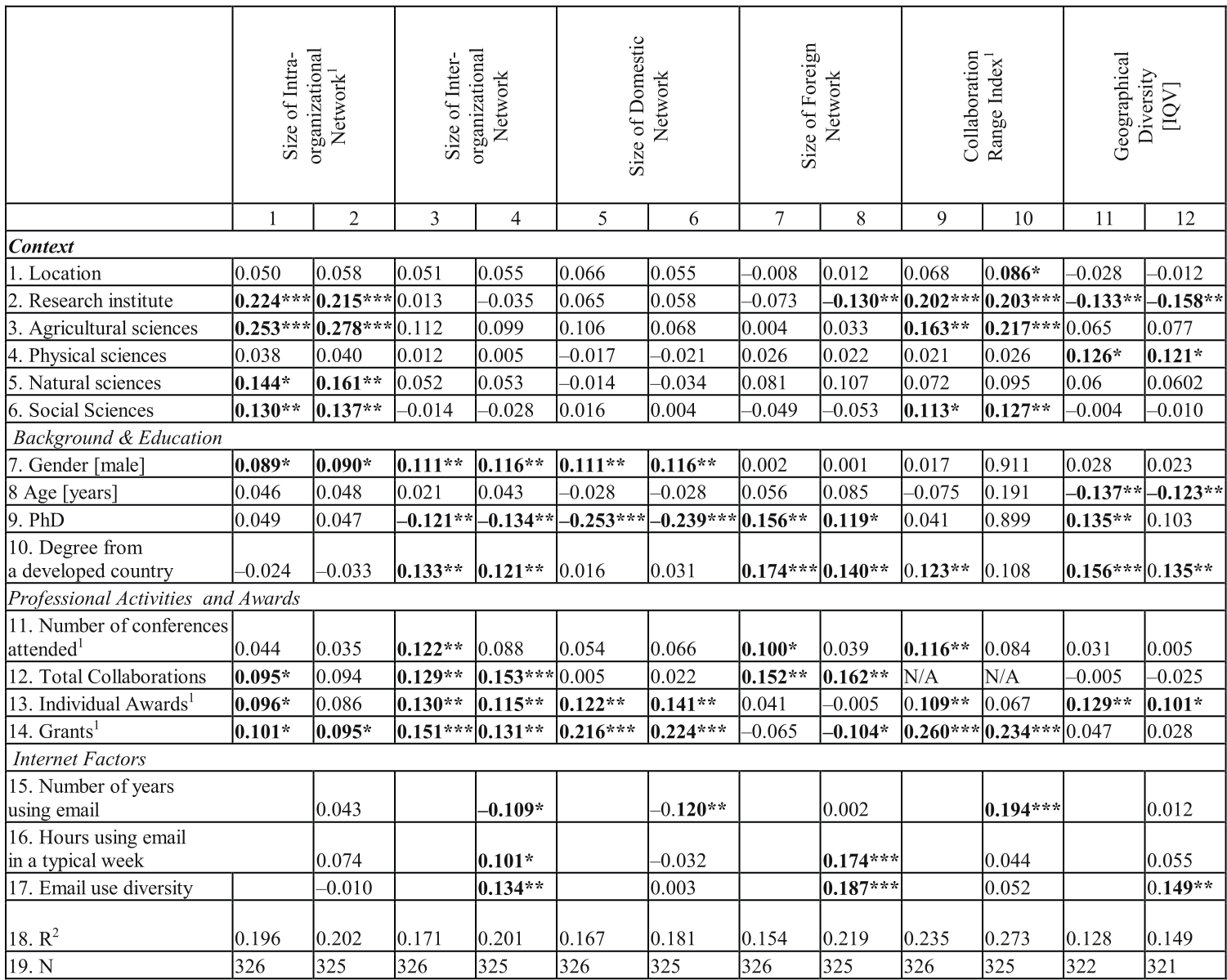 Figure 2: Regression models showing the impact of Internet factors on the size of domestic vs. foreign networks.
Critical Analysis & Conclusion
The paper concludes that the Internet in Chile is largely an "Elixir." It has successfully decentralized access to professional resources, allowing researchers—regardless of gender or regional location—to tap into global knowledge.
Limitations & Warnings:
- Local Dislocation: The "affliction" remains in the potential for local isolation. If the brightest minds are digitally connected to the North but disconnected from their neighbors, the local "Ivory Tower" effect may intensify.
- Brain Drain: While "Diaspora Networks" can help, the pull forces of First World prestige, facilitated by easy digital communication, might accelerate the migration of scientific talent.
In short, the Internet has made Chilean science more symmetrical and globally visible, but the challenge now is to ensure these global weak ties translate into local strong-tie solutions.