
Risk, Trust, and the Digital Social Contract: Why We Shared Too Much in the Early SNS Era
Internet social network communities: Risk taking, trust, and privacy concerns
2008-09-18
Summary
Problem
Method
Results
Takeaways
Abstract
This paper investigates the interplay between risk-taking attitudes, trust, and privacy concerns among college students using social networking sites (SNS). Utilizing survey data from 205 participants, the study reveals that SNS users exhibit higher risk-taking tendencies than non-users, with Facebook garnering significantly higher levels of trust compared to MySpace.
## TL;DR
This seminal 2008 study investigates why college students join social networks despite inherent privacy risks. It finds that SNS users are naturally higher risk-takers, men disclose more sensitive data (like phone numbers) than women, and users fundamentally trusted Facebook more than MySpace because of its original "closed community" feel.
## Background Positioning
Published during the transitional period when Facebook surpassed MySpace, this paper serves as a foundational "timestamp" in social science research. It applies **Social Contract Theory** to digital interactions—the idea that users trade personal info for social utility, provided the platform maintains its end of the bargain.
## The Problem: The Privacy Disconnect
Why do individuals disclose their home addresses and class schedules to total strangers? In 2007-2008, social networking was an "imagined community." Existing research suggested a paradox: users claimed to care about privacy but acted otherwise. This study sought to find the psychological drivers—risk-taking propensity and institutional trust—that explained this gap.
## Methodology: Measuring the "Risk" Factor
The researchers surveyed 205 commuter college students, comparing users vs. non-users and men vs. women across several validated scales:
* **Risk Averseness**: Measuring the general tendency to take chances.
* **Consumer Trust**: Specifically adapted to compare the "walled garden" of Facebook vs. the "open wild" of MySpace.
* **Self-Disclosure Behavior**: Tracking actual "Yes/No" data on sharing emails, IM addresses, and phone numbers.
## Key Insights & Results
### 1. The Profile of an SNS User
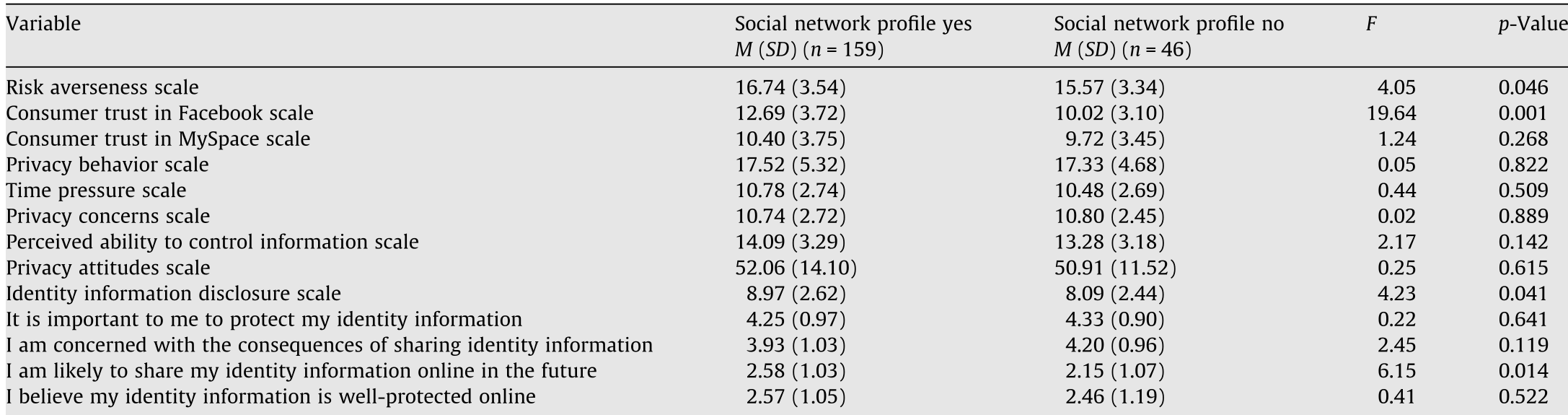
The study confirmed that the act of creating a profile is itself a signal of **higher risk-taking attitude**. Users had significantly higher scores (M=16.74) on risk-taking than non-participants (M=15.57).
### 2. The Facebook vs. MySpace Trust Gap
Perhaps the most striking result was the discrepancy in trust. Even users who had accounts on both platforms trusted Facebook significantly more.
* **Facebook Trust (Mean)**: 13.03
* **MySpace Trust (Mean)**: 10.86
This gap stems from Facebook’s origins as a university-exclusive site, creating a perceived "implied contract" of safety that MySpace, as a public-facing site, lacked.
### 3. Gender and the "Self-Disclosure" Divide
Men were found to be the "risky" demographic across the board:
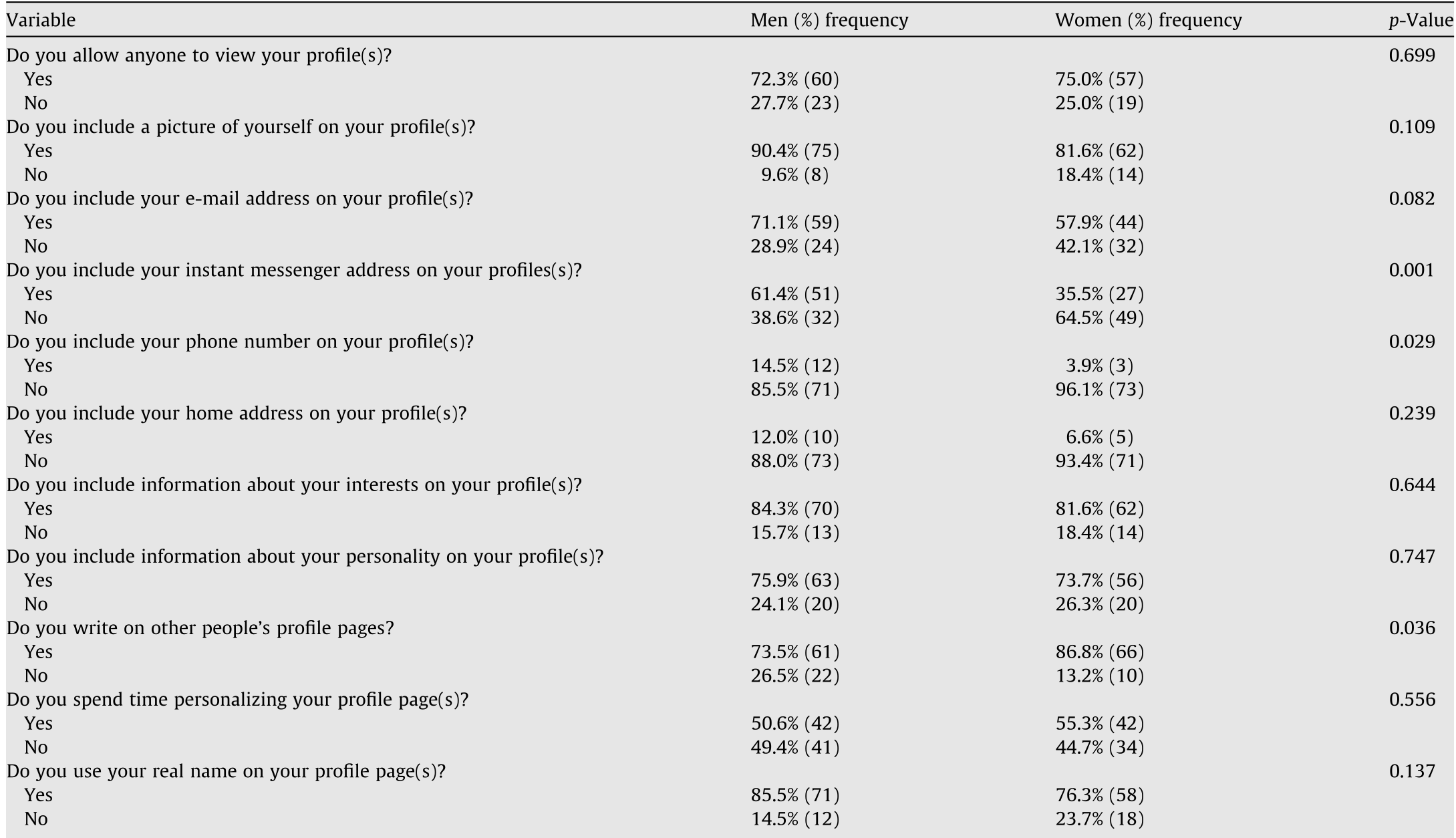
* **Phone Numbers**: 14.5% of men disclosed them vs. only 3.9% of women.
* **Instant Messenger**: 61.4% of men shared theirs vs. 35.5% of women.
* **Privacy Concerns**: Women scored significantly higher on concerns regarding misuse of information submitted online.
## Critical Analysis: The Impact on Future Research
This paper was early in identifying that **trust is platform-dependent**. It suggests that the "Privacy Paradox" isn't just about user laziness, but about the **Inductive Bias** we have toward certain platforms based on their community branding.
### Limitations
The study used a convenience sample from a single commuter college, which may not represent the general population. Furthermore, it relied on self-reporting rather than direct observation of profiles—though the high response rate (96%) lends credibility to the data.
## Conclusion & Takeaway
The core takeaway is that social networking companies must be viewed as "moral agents" in a social contract. Because users—especially men and general risk-takers—tend to underestimate the long-term impact of disclosure, the authors advocate for **interventional warnings** at the point of sign-up. This was a visionary call for the "Privacy by Design" principles we discuss today in the age of GDPR.