
Beyond the Screen: Why Internet Addiction, Not Social Media, Correlates with Teen Depression
Relationship between internet use and depression: Focus on physiological mood oscillations, social networking and online addictive behavior
This cross-sectional study investigates the correlation between internet addiction, social networking site (SNS) usage, and depressive symptoms among 336 high school students in Belgrade. Using established psychiatric scales (IAT and CES-DC), the research identifies a significant positive correlation (r = +0.27) between internet addiction and depression, while surprisingly finding no significant link between depression and time spent on social media or typical Facebook activities.
TL;DR
A study of high school students reveals a startling clarity: while internet addiction is strongly linked to depressive symptoms, the time spent on social networking sites (SNS) like Facebook is not. Contrary to the "Facebook Depression" myth, having more friends or posting more selfies doesn't statistically move the needle on a student's mood—but compulsive internet use does.
The Digital Paradox: Contextualizing Adolescent Mood
For decades, psychologists have debated the "Internet Paradox"—the idea that a tool designed for connection leads to isolation. With over a billion active users on SNS, early 2010s research often pointed to "upward social comparison" (the feeling that everyone else is happier) as a trigger for dysphoria. However, this study by Banjanin et al. asks a more nuanced question: Is it where you go online, or how you go online that matters?
Methodology: Isolating the Addictive Component
The research team analyzed 336 high school students using two gold-standard metrics:
- CES-DC: Quantification of depressive symptoms.
- Young IAT: A measure of compulsive internet behavior and its impact on offline responsibilities.
Crucially, they separated "General Internet Addiction" from "Social Media Metrics" (time on SNS, friend count, and selfies).
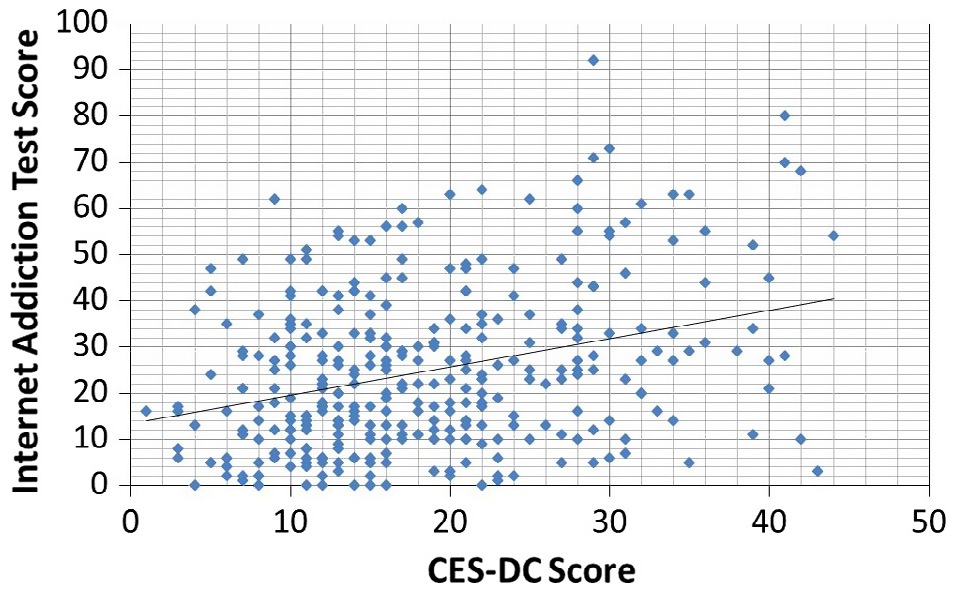 Fig 1: The clear positive slope shows that as addiction scores rise, so do depressive symptoms.
Key Findings: The Great Decoupling
The results provide a sharp rebuke to simplistic anti-social-media narratives:
- The Addiction Link: There is a highly significant positive correlation (r = +0.27) between IAT scores and depression. This was even stronger in females (r = +0.30).
- The SNS Non-Factor: Total time spent on social media, the number of friends, and even the frequency of posting "selfies" (often associated with narcissism and low self-esteem) showed no statistical relationship with depression.
 Table 1: Multivariate analysis showing that only the Young IAT score remains a significant predictor (p < 0.001) of depression.
Why Does This Happen? (The Academic Insight)
The authors suggest a "Dual Effect" of social networking. While excessive use can displace face-to-face interaction, SNS can also be a vital tool for social support (e.g., communicating with distant family).
Because SNS has both positive and negative utility, its net effect on depression is often neutral. In contrast, Internet Addiction represents a loss of control—neglecting school, sleep, and hygiene. This compulsive state reflects a deeper psychological struggle that transcends any specific platform.
Critical Analysis & Future Outlook
Limitations:
- Cross-sectional Nature: We cannot confirm causality. Does the internet make teens depressed, or do depressed teens retreat into the internet?
- Scope: The study defines "depression" as physiological mood oscillations rather than clinical mental illness.
The Takeaway for 2026: As we navigate an era of AI-driven algorithms and even more immersive digital environments, this research reminds us that compulsion is the enemy, not the medium. When evaluating adolescent mental health, we should worry less about "how many friends they have on Facebook" and more about whether their digital habits are disrupting their ability to function in the physical world.
Conclusion
The correlation between addictive internet use and mood is a robust finding that remains independent of social networking behaviors. Future research must look into sedentary behaviors, gaming, and "doom-scrolling" to find the true behavioral culprits behind digital-age depression.