
InternVL-U: Redefining Efficiency in Unified Multimodal Understanding and Generation
InternVL-U: Democratizing Unified Multimodal Models for Understanding, Reasoning, Generation and Editing
InternVL-U is a 4B-parameter unified multimodal model (UMM) built on InternVL 3.5 that integrates understanding, reasoning, generation, and editing within a single framework. It utilizes an MMDiT-based generation head and achieves SOTA performance, outperforming models 3x its size like BAGEL (14B).
TL;DR
InternVL-U is a 4B-parameter powerhouse that proves you don't need massive scale to master both multimodal understanding and high-fidelity generation. By integrating a specialized MMDiT generation head onto the InternVL 3.5 backbone and utilizing a Reasoning-centric data pipeline, it outperforms models triple its size in text rendering, scientific reasoning, and complex image editing.
The "Native vs. Ensemble" Dilemma
Until now, unified multimodal models (UMMs) were stuck in two camps:
- Fully-native models (e.g., Emu3, Chameleon): These treat everything as tokens. While theoretically elegant, they struggle with "pixel perfect" visual fidelity and are notoriously difficult to train from scratch.
- Fully-ensemble models: These glue a pre-trained generator to an LLM. They are often bulky, computationally expensive, and the "handshake" between the LLM's hidden states and the generator's conditioning is often lossy.
InternVL-U finds the "Golden Mean" by proposing Modality-Specific Modularity. It keeps the high-level reasoning in the LLM backbone but offloads the heavy lifting of pixel reconstruction to a dedicated, decoupled generation head.
Technical Deep Dive: The Core Principles
The architecture of InternVL-U is guided by three surgical interventions in model design:
1. Decoupled Visual Representations
The authors argue that what we use to perceive isn't necessarily what we use to draw. InternVL-U uses a ViT encoder for semantic understanding (Context) and a separate VAE for latent reconstruction (Target). This avoids the "optimization trade-off" where an encoder fails to balance high-level abstraction with low-level detail.
2. Hybrid Generative Objectives
The model treats text as discrete tokens (Cross-Entropy) but treats images as continuous signals. It adopts a Flow Matching framework (a generalized diffusion) for the visual generation head, allowing it to tap into the high-fidelity generation industry standards.
3. MMDiT with Gated Attention
The generation head isn't just a basic transformer. It’s a Dual-Stream MMDiT that features a novel Gated Attention mechanism—the first of its kind in this architecture—improving expressivity for high-resolution, long-context scenarios.
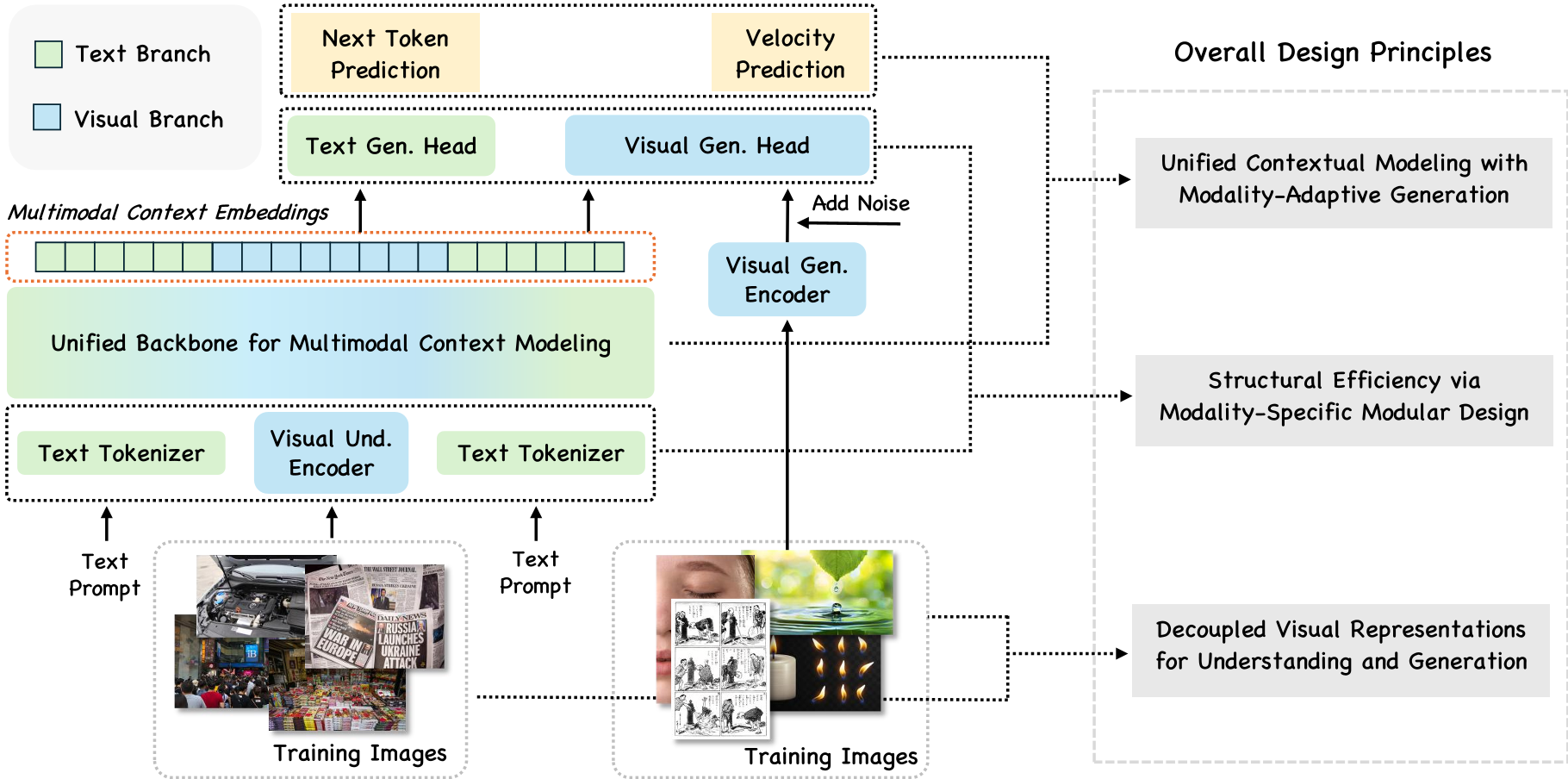 Figure 1: The three design principles: Unified Contextual Modeling, Structural Efficiency, and Decoupled Visual Representations.
Reasoning-Centric Data: Bridging the "Intent Gap"
The most significant contribution might be the Reasoning-centric data synthesis. Most users give abstract prompts like "Make this look like tomorrow." Traditional models fail here.
InternVL-U utilizes a Chain-of-Thought (CoT) paradigm. It translates abstract intent into a concrete planning trace (e.g., "To represent tomorrow, I need to update the calendar date from 15 to 16 and change the sunlight angle"). This reasoning step acts as an explicit bridge, leading to a massive boost in logic-dependent tasks.
 Figure 2: Qualitative results showing InternVL-U’s superior text rendering and instruction following compared to Ovis-U1.
Benchmarking the "Small" Giant
Despite having only 4B parameters, InternVL-U’s performance is startling:
- GenEval: 0.85 (surpassing the 14B BAGEL and even competitive with specialized 20B models).
- Scientific Reasoning: On GenExam, it achieves a score of 22.9, validating its ability to handle physics, chemistry, and biology diagrams.
- Text Rendering: It crushes previous unified models on the TextEdit benchmark with an F1 score of 0.71, matching top-tier commercial models like Nano Banana Pro.
Critical Insight: Why This Works
InternVL-U succeeds because it admits that modality-agnosticism is a myth. By allowing the LLM to "think" in a unified space but "act" through modality-specific heads, it preserves the best of both worlds. The inclusion of the MSRoPE (Multi-Scale Rotary Positional Embeddings) and unified 3D encoding further ensures that when the LLM says "move this object left," the generation head knows exactly which latent coordinates to target.
Conclusion & Future Outlook
InternVL-U is a masterclass in AI "democratization." By proving that a 4B model can handle scientific diagrams, complex text rendering, and multi-step reasoning, it clears the path for on-device AGI-oriented world models. The next frontier? Extending this unified reasoning-generation loop to full-scale video and 3D environment synthesis.
For those looking to dive deeper into the evaluation, the authors have open-sourced the GenEditEvalKit and TextEdit Benchmark.