
The Interoperability Frontier: How the UK, Korea, China, and Singapore are Rebuilding AI Safety
Interoperability in AI Safety Governance: Ethics, Regulations, and Standards
This policy report, "Interoperability in AI Safety Governance," provides a multi-jurisdictional analysis of AI safety frameworks across the UK, South Korea, China, and Singapore. It introduces a "defense-in-depth" model for AI safety and establishes a roadmap for harmonizing ethical, legal, and technical standards in high-stakes domains like autonomous vehicles (AV), education, and cross-border data flows.
TL;DR
The UNU Institute in Macau has released a landmark policy report outlining a new "Governance Architecture" for AI Safety. By analyzing the UK, South Korea, China, and Singapore, the report moves beyond vague ethics to propose a concrete framework for Interoperability, ensuring that when an AI system crosses a border—whether it’s a self-driving car or an educational algorithm—its safety guarantees remain intact.
The "Glaring Gap" in Global Policy
Modern AI safety suffers from a Conceptual Gap. While the Global North focuses on frontier model "catastrophic risks," the Global South and emerging hubs are navigating immediate "structural frictions." The report argues that current frameworks are too fragmented: a car deemed "safe" in Beijing might be a "hazard" in London due to divergent sensor standards and liability laws. This isn't just a technical glitch; it's a governance failure.
Methodology: The Tripartite Analysis
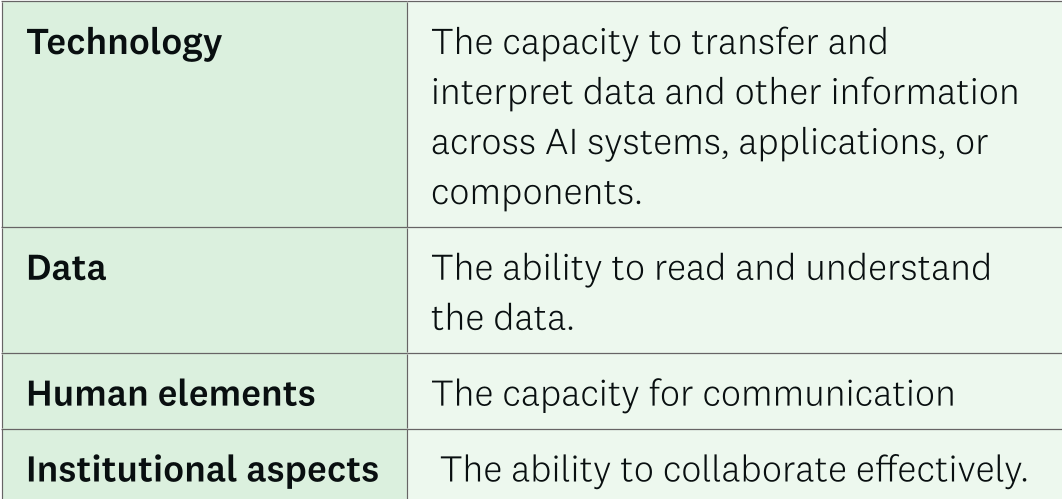
The authors propose a "Tripartite Analysis" to achieve global alignment:
- Ethical Interoperability: Creating a shared moral language (e.g., "Human-in-the-loop").
- Legal Interoperability: Moving from "soft law" guidelines to "hard law" mutual recognition (e.g., the UK-US Data Bridge).
- Technical Interoperability: Implementing "Interoperability-by-Design" using ISO/IEC standards.
Deep Dive: High-Stakes Sectors
1. Autonomous Vehicles (AV)
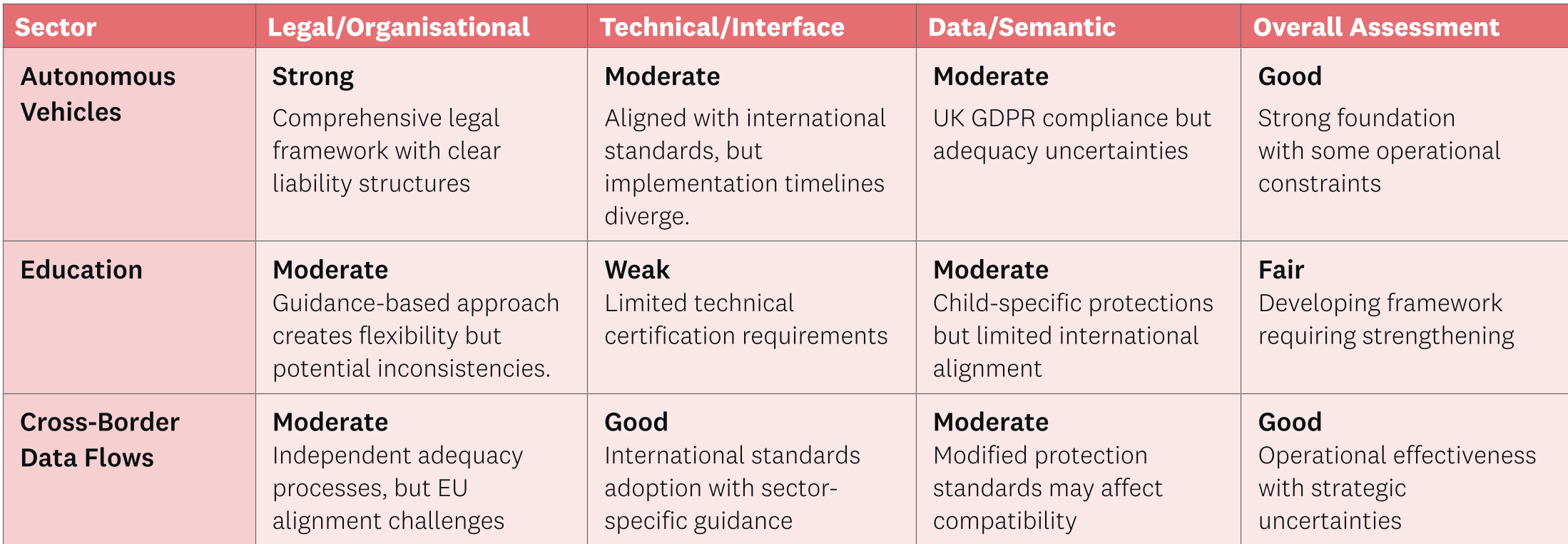
The UK’s Automated Vehicles Act 2024 is highlighted as a global pioneer, shifting liability from driver to software provider. China follows a "scenario-driven" approach, with 34 pilot zones (like Beijing’s L4 zone) feeding data back into national standards.
- The Consensus: All four regions are gravitating toward UNECE WP.29 for cybersecurity, suggesting a rare moment of global technical convergence.
2. Education
While the UK focuses on "safeguarding," South Korea's attempt to mandate AI Digital Textbooks in 2025 faced public backlash, leading to a downgrade from "official" to "optional." This serves as a cautionary tale: technical interoperability fails without Social Trust.
3. Cross-Border Data Flows
Singapore’s "Data Free Flow with Trust (DFFT)" and China’s "Data Sovereignty with Trust" represent the two poles of data governance. The report recommends Privacy-Enhancing Technologies (PETs) and Federated Learning as the "third way" to train models globally without physically moving sensitive raw data.
Critical Insights: Beyond the "Soft Law" Trap
The report's most provocative takeaway is the call to end the "Voluntary Principle Era."
- Ethical Self-Certification: Governments should be required to report how their systems align with UN norms.
- The UNESCO Connection: Aligning domestic policies with UNESCO’s "Recommendation on the Ethics of AI" is the best path to preventing a "Digital Divide."
Future Outlook: A Scientific Panel for AI
Following the UN’s Global Digital Compact, the report looks toward the establishment of an Independent International Scientific Panel on AI. This body would function similarly to the IPCC for climate change—providing the "Scientific Baseline" that allows different legal systems to interoperate.
Conclusion: One Machine, Many Laws
The message is clear: The future of AI safety is Evidence-Based. We can no longer rely on corporate "transparency reports." We need "auditable engineering practices" and "measurable KPIs" (such as AV accident rates per million miles) that are recognized globally.
Senior Editor's Note: This report marks a shift in the AI safety debate from "What should we do?" to "How do we prove we did it?" It is essential reading for CTOs and policy officers navigating multi-national AI deployments.