
We’re in It Together: The Shift from Individual to Collaborative Privacy in Social Networks
We're in it together: interpersonal management of disclosure in social network services
The paper "We’re in it together" investigates how users of Social Network Services (SNSs) manage privacy as an interpersonal rather than a purely individual task. It introduces a comprehensive framework for interpersonal boundary regulation, categorized by Individual/Collaborative, Preventive/Corrective, and Mental/Behavioral strategies, demonstrating that users rely heavily on mutual trust and collaboration to protect their online reputation.
TL;DR
Privacy on social media is often treated as an individual setting—a "lock" you put on your profile. However, this paper argues that privacy is fundamentally interpersonal. By analyzing how users navigate content posted by others, the authors propose a framework that highlights the necessity of collaborative boundary regulation. They suggest that our current tools are failing because they are corrective (fixing blunders after they happen) rather than preventive and collaborative.
Background: The Myth of Individual Control
In the early days of HCI research, privacy was often viewed through the lens of individual agency: What do I choose to share? But in the era of Facebook and Instagram, your "self-presentation" is constantly at the mercy of your friends. Whether it’s an unflattering photo from a party or a comment that reveals a secret to your boss, your privacy is interdependent.
The authors identify a critical gap: while we have "Delete" and "Untag" buttons, we have almost no tools to negotiate disclosure before it happens.
The Interpersonal Privacy Framework
The core contribution of this work is a three-dimensional taxonomy of how we actually manage our boundaries.
1. The Strategy Dimensions
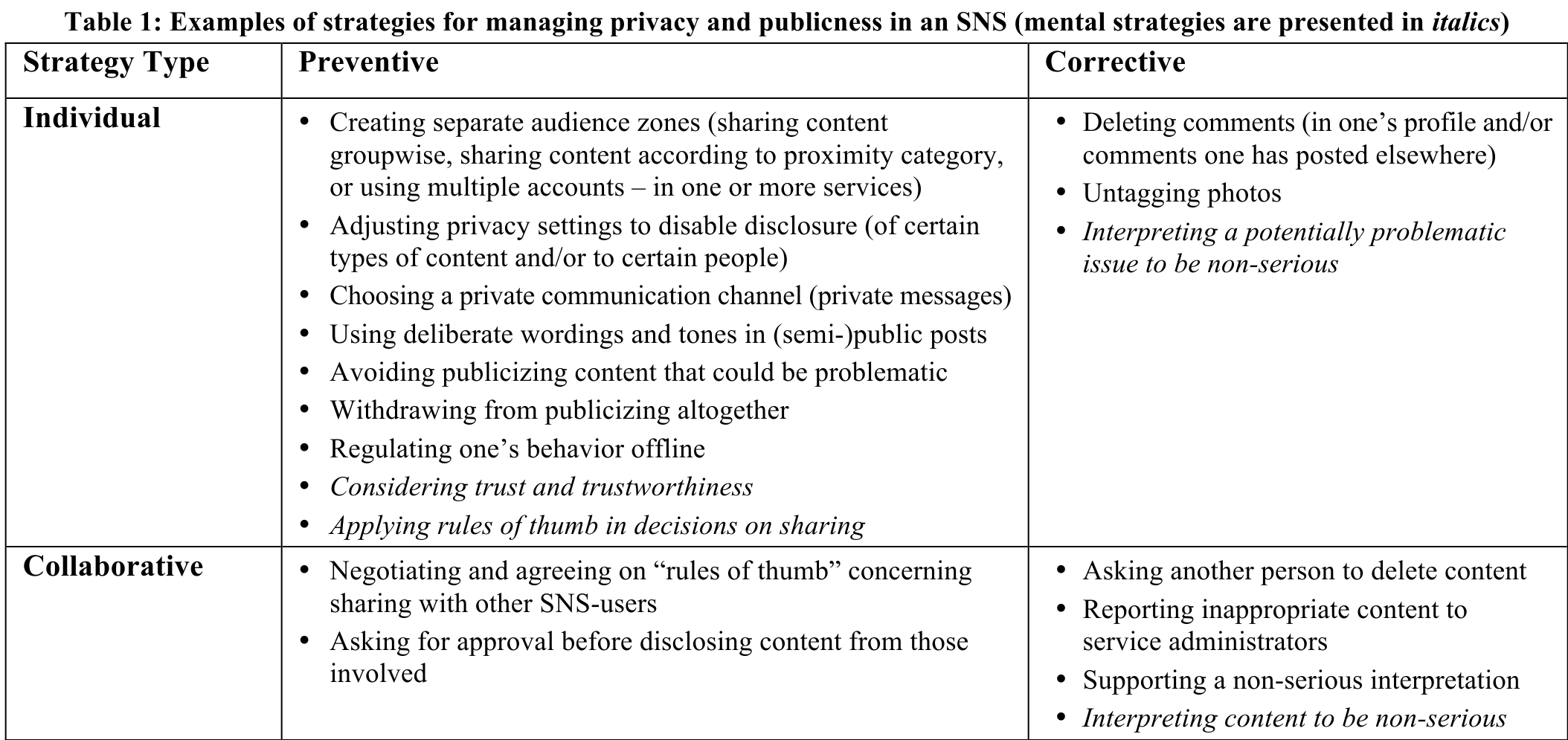
- Preventive vs. Corrective: Do you stop the photo from being uploaded (Preventive), or do you untag it later (Corrective)?
- Mental vs. Behavioral: Do you "trust" your friends to be cool (Mental), or do you actively change your privacy settings (Behavioral)?
- Individual vs. Collaborative: Do you manage your own profile (Individual), or do you call a friend to ask them to take a post down (Collaborative)?
2. The Interaction Matrix
The authors provide a detailed breakdown of these strategies, as seen in their synthesis of the qualitative data:
Key Insights: Why "Corrective" isn't Enough
The study found that Corrective strategies—the ones most supported by current SNS platforms—are deeply flawed:
- Social Awkwardness: Deleting a friend's comment can feel like a personal insult or an admission of guilt.
- The "Streisand Effect": Removing something often draws more attention to the fact that there was something to hide.
- Persistence: In digital spaces, once a photo is seen by a "mixed audience" (e.g., your grandmother and your college friends), the damage is done.
Most participants relied on Mental Preventive strategies, which basically boils down to "Expected Reciprocal Mindfulness." They expect their friends to know what is appropriate. However, "appropriateness" varies wildly between social circles, leading to unavoidable blunders.
Methodology: Listening to the Users
The researchers utilized a qualitative approach with 27 participants, using focus groups and provocative probes (e.g., "My friends take my wishes into account"). This allowed them to capture the tension of "Context Collapse"—where different social spheres (work, family, friends) collide on a single platform.

Design Implications: A Call for "Preview Spaces"
The paper concludes with a radical suggestion for designers: Stop designing for the individual and start designing for the group.
Imagine a "Preview Space": When a friend tags you in a photo, it doesn't go live immediately. Instead, it enters a collaborative holding area where you can approve, suggest an edit, or veto the disclosure privately. This shifts the burden from a social confrontation (after the fact) to a standard workflow (before the fact).
Conclusion and Takeaway
The ultimate takeaway of "We're in it Together" is that social media is not a game of Solitaire. Our digital identities are co-constructed. If SNS platforms want to reduce user anxiety and increase meaningful sharing, they must provide tools that reflect the collaborative nature of our real-world social boundaries.
Future Outlook: As AI continues to make content more "searchable" and "persistent," the collaborative preventive strategies identified here will become the only viable way to maintain a coherent self-presentation across a lifetime of digital traces.