
The Bionic Radiologist: Mastering the Socio-Technical Dynamics of AI Integration
The Interplay of Artificial and Human Intelligence in Radiology – Exploring Socio-Technical System Dynamics
This paper explores the integration of Artificial Intelligence in radiology through the lens of Socio-Technical System (STS) dynamics. It proposes the "Bionic Radiologist" concept, an integrative model that synergizes human expertise with AI-driven diagnostic tools to achieve value-based healthcare.
TL;DR
Integrating AI into radiology is not a simple software upgrade; it is a fundamental transformation of a socio-technical system. This paper introduces the concept of the Bionic Radiologist, arguing that the synergy between human and artificial intelligence hinges on "enactment"—how practitioners interact with and reshape technology within institutional boundaries. By treating radiologists as moderators of clinical processes rather than just image readers, we can overcome the resistance and deskilling risks associated with automation.
Problem & Motivation: Beyond the "Tool" Mentality
While the technical potential of AI in radiology—processing 3.6 billion imaging procedures annually—is undeniable, the path to implementation is fraught with friction. Previous approaches often suffered from a narrow focus on "usefulness" and "ease of use."
The authors argue that this ignores the Socio-Technical System (STS) dynamics. Radiologists often resist AI because they fear:
- Deskilling: A loss of image-reading knowledge for future generations.
- Autonomy Loss: Feeling like they are serving the machine rather than vice versa.
- Patient Risk: The perceived danger of reduced human involvement in critical diagnostic paths.
Methodology: The Structurational Model of Technology
To solve this, the authors utilize a framework that views technology as both a product of human action and a medium for it. The core insight is that Intelligence is Distributed.
The Bionic Radiologist Framework
The paper defines the "Bionic Radiologist" through three pillars:
- Consistent Decisions: Using AI for disease probability to reduce diagnosis ambiguity.
- Augmented Analysis: Enhancing human vision with automated image analysis.
- Process Integration: Moving imaging data seamlessly into therapy recommendations.
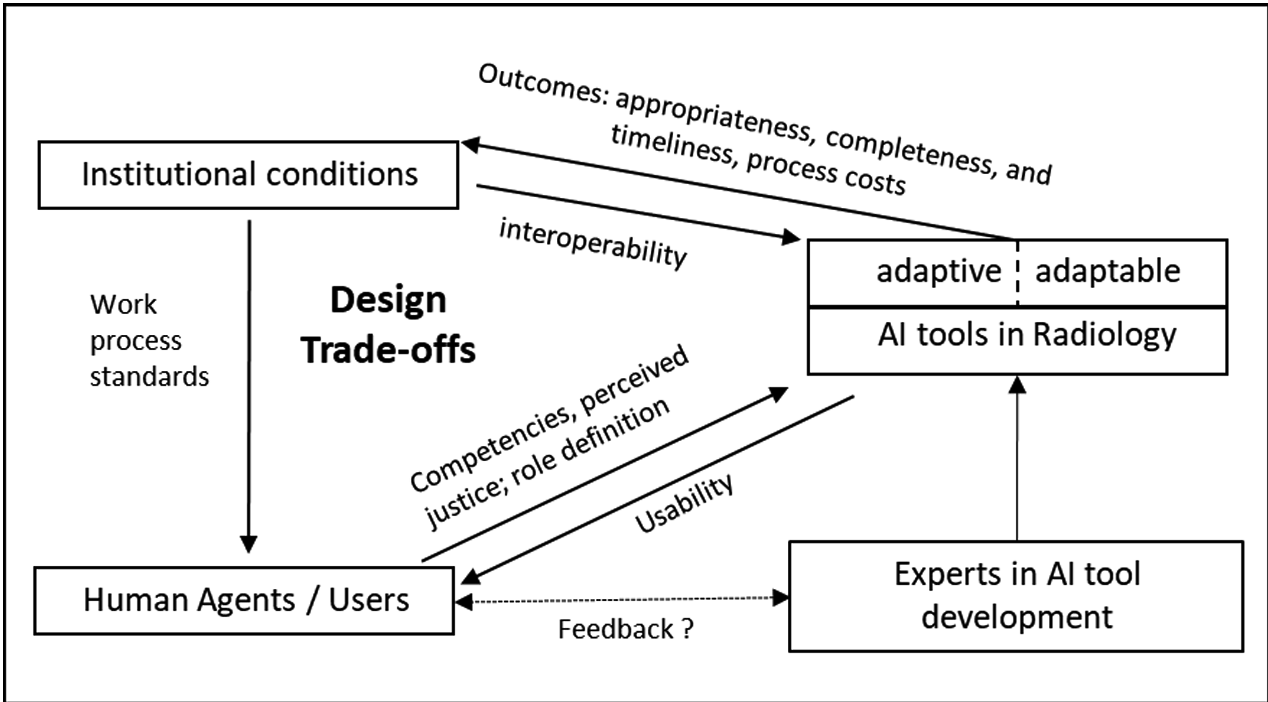 Figure 1: The interplay between individual agents, AI technology, and institutional properties.
The "Enactment" Process
Technology is not "fixed." It is enacted by users. The paper highlights a critical distinction:
- Adaptive Software: Self-learning systems that operate without human intervention (high risk of user rejection).
- Adaptable Software: Systems that allow the radiologist to redirect or control machine action (high social acceptance).
Key Insights & Results
The paper suggests that for AI to move from data to value, three "Implementation Facilitators" must be present:
- Visualization: AI must explain its "black box" decisions to build trust.
- Expertise Maintenance: Establishing feedback loops where radiologists validate AI, ensuring their own skills remain sharp.
- Role Evolution: Radiologists must transition from "readers" to "moderators" of the entire clinical care pathway.
The performance of the system is measured not just by accuracy, but by trade-offs—balancing efficiency with the radiologist's sense of "perceived justice" and control.
Critical Analysis & Conclusion
This work provides a necessary theoretical anchor for the AI revolution in medicine. It moves the conversation beyond "Will AI replace radiologists?" to "How do we design systems where AI empowers humans?"
Limitations: The paper is primarily theoretical/conceptual. While it provides a robust framework, it lacks large-scale empirical data identifying which specific visualization tools most effectively increase "perceived justice" among clinicians.
Takeaway: The future of AI in the workplace isn't about the software's IQ; it's about the Socio-Technical Interoperability. For AI to thrive in high-stakes fields like radiology, it must be designed to be adaptable by the expert, ensuring that the human remains the final moderator of the clinical narrative.