
Beyond the Black Box: Using Genetic Programming and Activity Theory to Predict Student Success
Participation-based student final performance prediction model through interpretable Genetic Programming: Integrating learning analytics, educational data mining and theory
This paper introduces an interpretable student performance prediction model for Computer-Supported Collaborative Learning (CSCL) using Genetic Programming (GP) grounded in Activity Theory. By operationalizing online participation into six semantically meaningful variables, the model achieves a SOTA overall prediction fitness of 80.2% while remaining human-readable.
TL;DR
Predicting which students will fail or excel is easy for an AI, but explaining why is much harder. This research presents a breakthrough model that uses Genetic Programming (GP) and Activity Theory to turn chaotic log data from collaborative math sessions into clear, "if-then" rules. The result? A model that predicts performance with over 80% accuracy while giving teachers specific, actionable insights into student behavior.
Background: The Interpretability Gap
In the world of Educational Data Mining (EDM), we often face a "precision-transparency" trade-off. Deep learning and SVMs might pinpoint at-risk students, but they offer teachers "risk signals" without context. If a teacher doesn't know why a student is struggling—is it a lack of communication? poor tool usage? unequal division of labor?—they cannot provide personalized intervention.
The authors argue that for Learning Analytics to be useful, it must move away from "blunt computational instruments" and toward theory-grounded modeling.
Methodology: Mapping Social Science to Data Science
The core innovation of this paper is the operationalization of Activity Theory. Instead of letting an algorithm pick random features, the researchers used a psychological framework to group data into six pillars of participation:
- Subject: Individual effort (spontaneous actions).
- Rules: Adherence to or utilization of environment constraints.
- Tools: How effectively students use the software (System/Whiteboard).
- Community: Social interaction and chat awareness.
- Division of Labor: Contributions to the group goal (Geogebra actions).
- Object: The overall engagement and task completion.
The GP-ICRM Architecture
By using Genetic Programming (GP), the model "evolves" symbolic solutions. Unlike a static regression, GP generates a tree-structured logic that can be translated directly into human language.
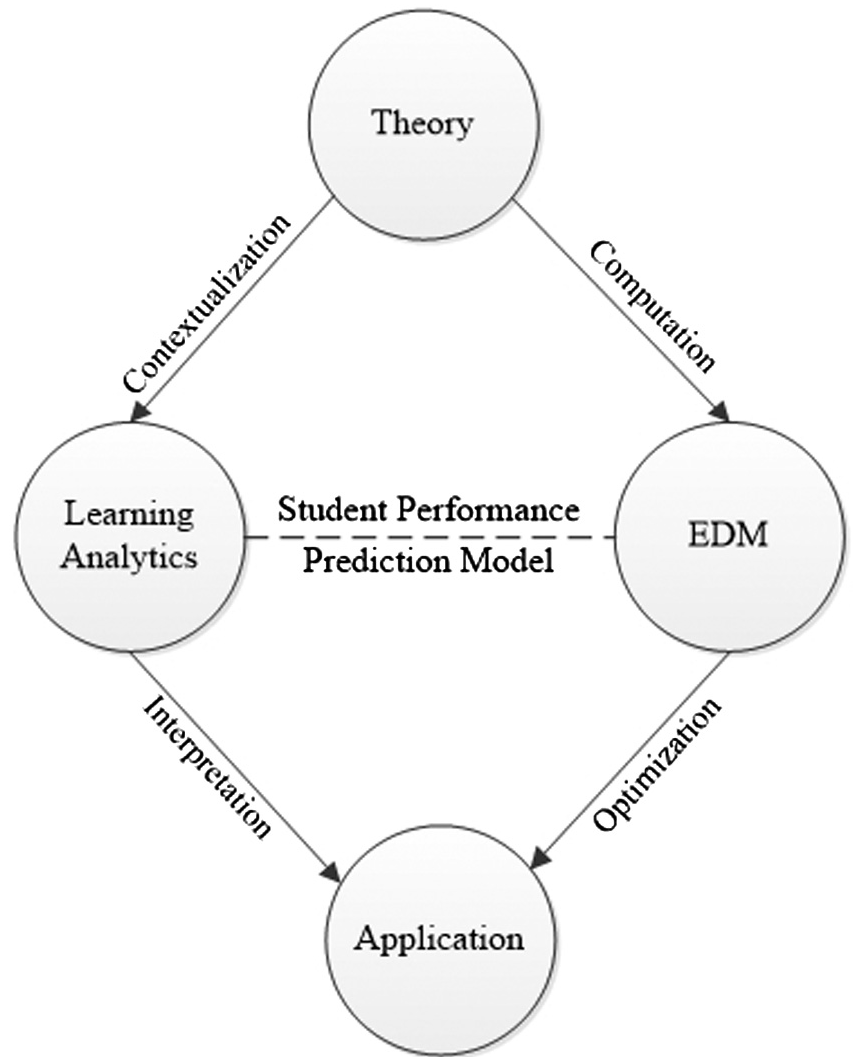 Figure 1: The theoretical framework integrating EDM, Learning Analytics, and Activity Theory.
Experiments and Results
The researchers tested their model against five major baselines, including Naïve Bayes and Artificial Neural Networks.
Performance Highlights:
- Overall Fitness: GP-ICRM achieved 80.2%, significantly higher than the 72.6% of RandomTrees or 36.6% of simple Perceptrons.
- At-Risk Detection: For identifying students in danger of failing, the model reached nearly 90% fitness.
- Interpretability: While NNge produced 27 complex rules, the GP model produced just five elegant rules that a teacher could read and apply instantly.
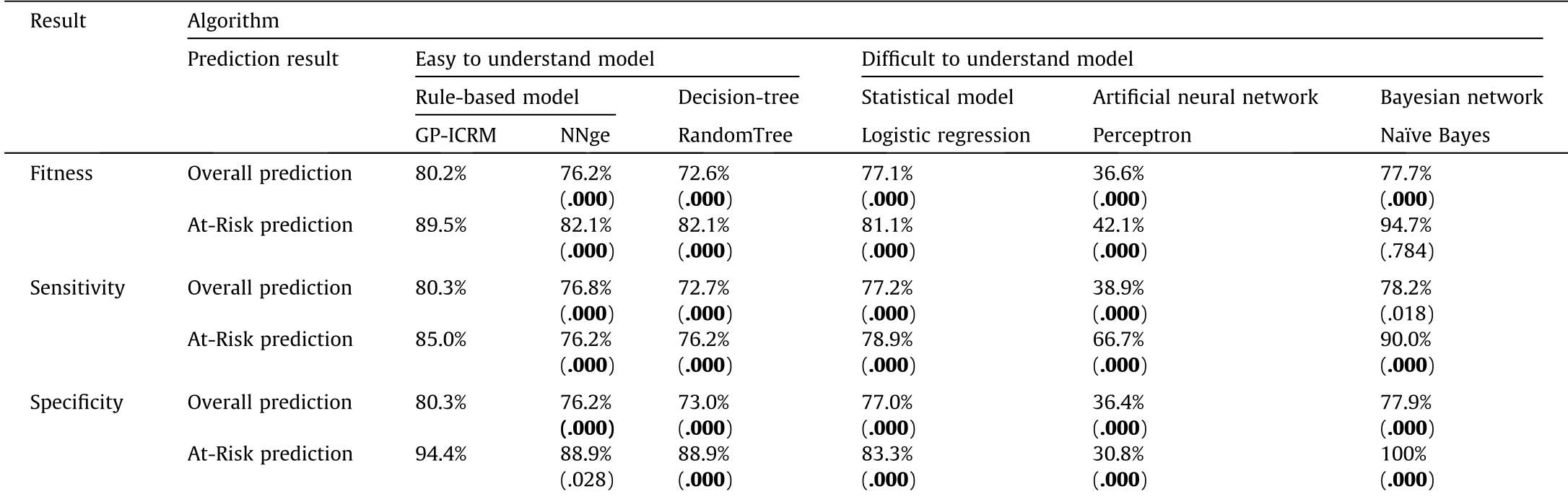 Table 1: GP-ICRM outperforms traditional "white-box" and "black-box" models in overall fitness.
What a "White-Box" Rule Looks Like
A sample rule evolved by the system looks like this:
IF (Rules <= 10.6 AND Tools <= 25.8) THEN Result = FAIL
This tells the teacher exactly what is wrong: the student isn't exploring the tools enough and isn't following the environmental rules. The intervention is then obvious: encourage tool exploration.

Critical Insight & Conclusion
This paper proves that theory is a powerful dimensionality reduction tool. By filtering data through the lens of sociocultural activity, the authors reduced thousands of raw logs into six meaningful variables.
The success of Genetic Programming in this study serves as a reminder that in sensitive fields like education or healthcare, Symbolic AI (which explains itself) often has an edge over pure Connectionist AI (which acts as a black box).
Limitations & Future Work
The study’s main limitation is its focus on quantitative counts over qualitative content (e.g., the quality of chat messages). The authors suggest that future iterations should incorporate Natural Language Processing (NLP) to enrich the "Community" dimension, potentially pushing the predictive accuracy even higher without sacrificing the "White-Box" transparency.