
The Past, Present, and Future of Interpretable Machine Learning: Beyond the Black Box
Interpretable Machine Learning – A Brief History, State-of-the-Art and Challenges
This paper provides a comprehensive taxonomic survey of Interpretable Machine Learning (IML), tracing its historical evolution from 19th-century linear regression to modern model-agnostic techniques. It categorizes the state-of-the-art into component analysis, sensitivity-based explanations, and surrogate modeling while highlighting critical roadblocks to scientific adoption.
TL;DR
Interpretable Machine Learning (IML) is no longer a niche academic interest but a prerequisite for deploying AI in critical sectors. This work by Molnar et al. provides a roadmap of how we moved from simple 19th-century regressions to complex post-hoc explainers like SHAP and LIME. While the tools have matured, the field still struggles with "statistical truth"—specifically regarding causality and feature correlation.
Background: The Interpretability Crisis
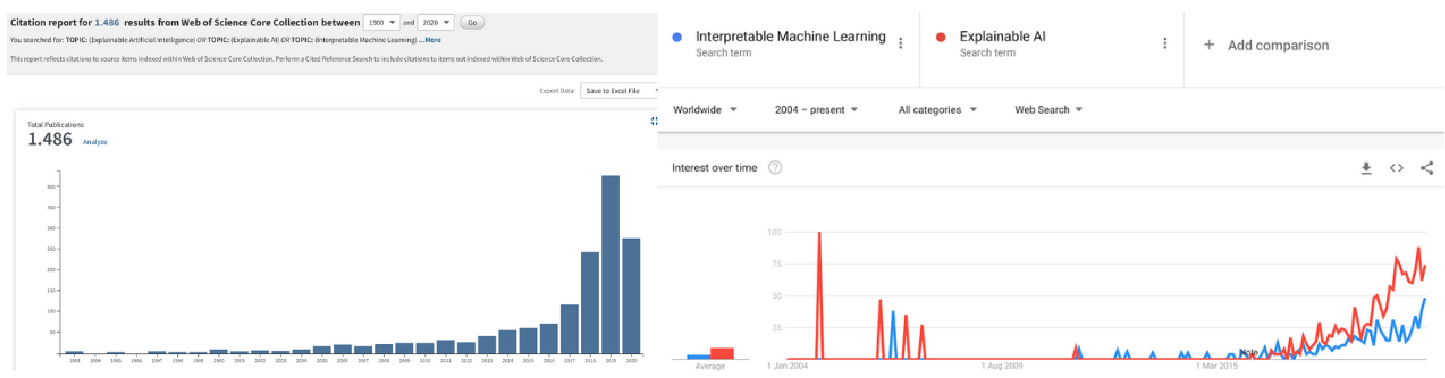
In the quest for the highest Accuracy on ImageNet or GLUE, the AI community embraced black-box models (Deep Neural Networks, Tree Ensembles). However, as these models entered healthcare, finance, and law, the "Why" became as important as the "What." The authors argue that IML is currently at a "state of readiness," yet it sits on a shaky theoretical foundation due to the lack of a formal definition of "interpretability."
The Taxonomy of Modern IML
The paper categorizes interpretation methods into three distinct archetypes:
1. Component Analysis (White-Box)
These are models that are "interpretable by design," such as Linear Regression or shallow Decision Trees.
- The Limitation: As dimensionality increases (hundreds of features), even a "simple" linear model becomes a cognitive burden for humans.
- The Fix: Sparsity constraints like LASSO or tree pruning are essential to maintain human-scale understanding.
2. Sensitivity Analysis (Black-Box Explanations)
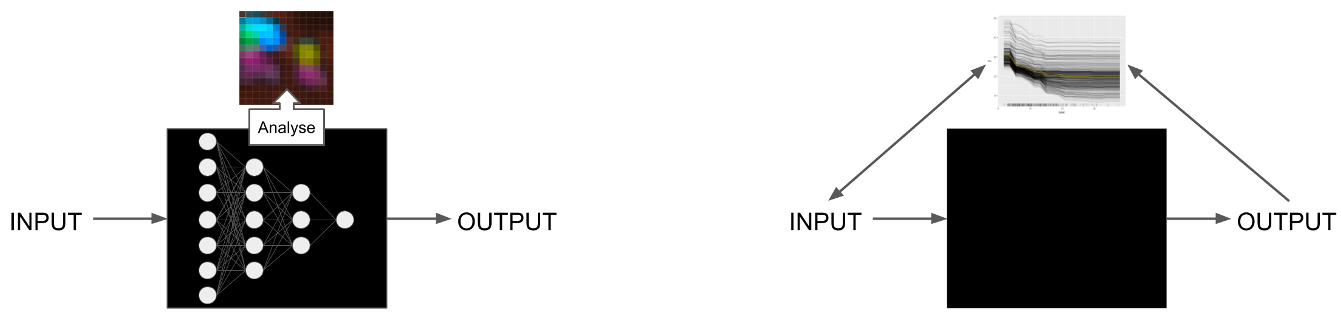
This is where most modern innovation lies. These methods treat the model as a closed system and observe how input perturbations change the output.
- Local Methods: Explaining a single prediction (e.g., "Why was this loan denied?"). Key techniques include Counterfactuals (what change would flip the result?) and Shapley Values (fairly distributing the "credit" for a prediction among features).
- Global Methods: Explaining average behavior across the dataset, such as Permutation Feature Importance.
3. Surrogate Models
A surrogate is an interpretable model (like a small tree) trained to mimic the behavior of a complex model. LIME (Local Interpretable Model-agnostic Explanations) is the most famous example, fitting a local linear model around a specific data point to provide a "summary" of the black-box's logic in that neighborhood.
Critical Pitfalls: Why We Aren't There Yet
The authors provide a sobering look at the "dark side" of IML:
- The Dependency Trap: Most sensitivity methods (like permutation importance) assume features are independent. When features are correlated, these methods create "implausible" data points that the model never saw during training, leading to deceptive results.
- Correlation vs. Causality: A model might rely on a "proxy" feature (e.g., "wet ground" to predict rain). While predictive, this is causally backward. Interpreting these proxies as "causes" can lead to dangerous real-world decisions.
- Uncertainty of Explanations: We often provide an importance score without a "confidence interval." If the explanation itself is unstable, can we really trust it?
Future Outlook: Reclaiming Statistical Roots
The paper concludes with a call to action: IML must move back toward its roots in Statistics and Causal Inference. We need to stop treating interpretability as a "nice-to-have" add-on and start treating it as a rigorous scientific requirement.
Key Takeaways:
- Software is Ready: Toolkits like
InterpretMLandDALEXare production-grade. - Theory is Lagging: We need a community-accepted definition of interpretability to measure progress.
- Cross-Disciplinary Needs: Interpretability is as much about Psychology and Social Science (how humans process explanations) as it is about Mathematics.
The path forward requires not just better algorithms, but a deeper understanding of the human in the loop.