
Decoding Human Habits: Using Fuzzy Formal Concept Analysis for LBSN Recommendations
Interpreting and analyzing a location-based social network by fuzzy formal contexts
This paper introduces a lifestyle analysis and recommendation framework based on Fuzzy Formal Concept Analysis (FCA) applied to Location-Based Social Networks (LBSN). By transforming Foursquare check-in data into seven day-specific fuzzy formal contexts, the authors identify user habits such as work schedules and mealtimes to provide targeted recommendations.
TL;DR
This research leverages the mathematical rigor of Fuzzy Formal Concept Analysis (FCA) to transform messy Foursquare check-in data into actionable behavioral insights. By treating time and location topics as fuzzy relations across seven distinct daily contexts, the authors can accurately predict a user's work schedule, sleep patterns, and dining preferences—even when the underlying data is ambiguous.
Background: The Noise in Location Data
Location-Based Social Networks (LBSNs) like Foursquare provide a goldmine of geo-tagged data. However, translating a "check-in" into a "habit" is difficult. A user might check into a venue that serves both as a "Nightlife Spot" and a "Food" venue. Standard binary systems struggle with this overlap. Moreover, human behavior is cyclical based on the day of the week—your Monday morning at the office looks nothing like your Sunday morning at the beach.
The Mathematical Intuition: Why Fuzzy FCA?
The authors argue that Formal Concept Analysis is the ideal tool for discovering hidden relations between sets of objects (hours) and attributes (location topics).
By moving to a Multi-Adjoint Frame, the research allows for degrees of truth (fuzzy logic). Instead of saying a user is or is not at a workplace, they assign a truth value (e.g., 0.8) if a location has multiple potential characteristics. This prevents the "system noise" from penalizing ambiguous check-ins while still maintaining a sharp mathematical structure via Galois connections.
Methodology: From Raw Check-ins to Concept Lattices
The process follows a clean four-stage pipeline:
- Temporal Partitioning: Splitting the dataset into seven subsets (Monday–Sunday).
- POI Clustering: Grouping similar hours and topics for a specific user.
- Fuzzy Truth Assignment: Calculating the truth value of the statement: "The user u is in a place with characteristic r at hour h."
- Global Normalization: Ensuring that values across all seven days are comparable by dividing by a universal maximum value.
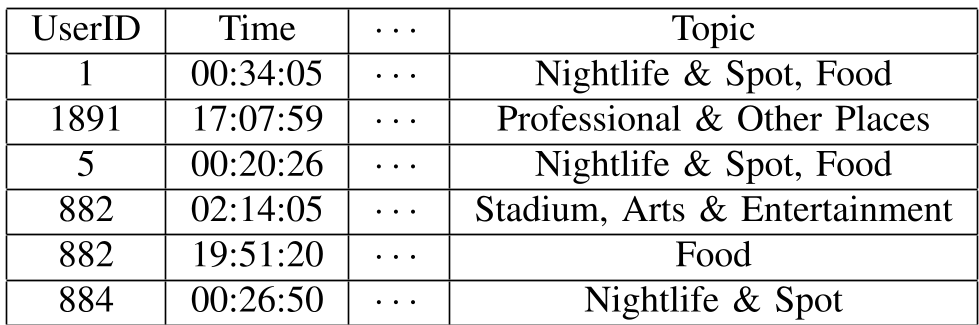 Table 1: Example of raw check-in data showing UserID, Time, and ambiguous Topics.
Experimental Analysis: Profiling a "Night Owl"
The study analyzed a user with over 1,000 check-ins. By applying the concept-forming operators, they calculated the "extension" of specific attributes like "Professional & Other Places."
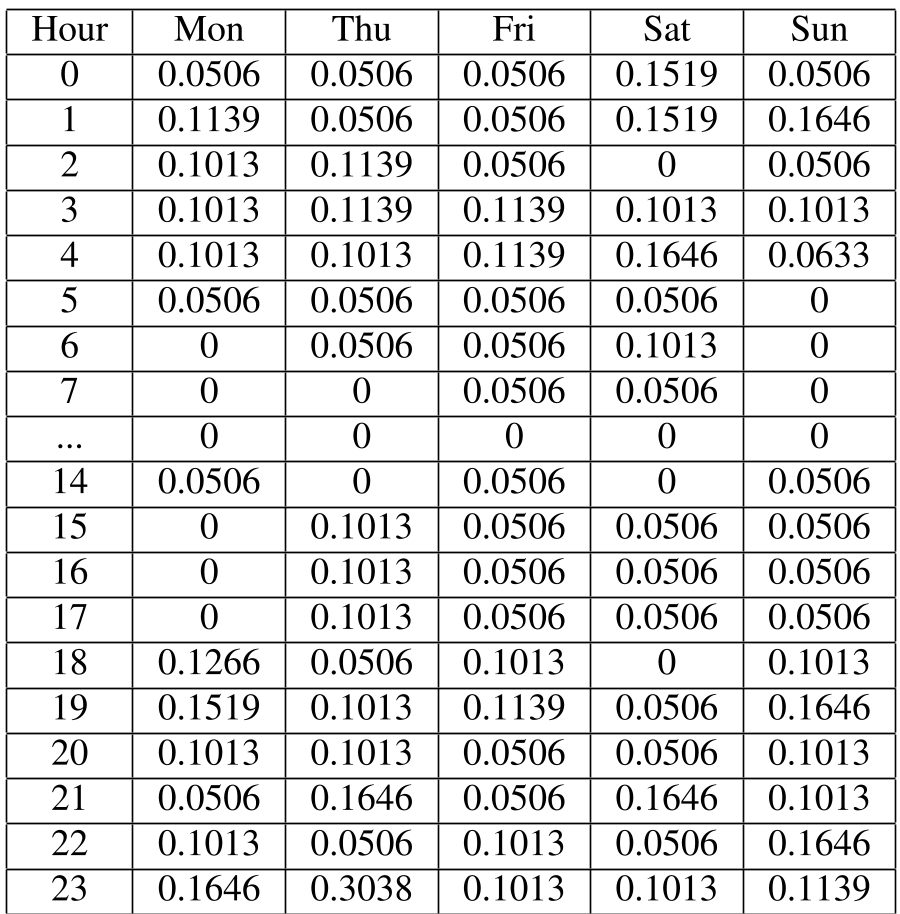 Table 2: Fuzzy extensions of "Professional" attributes across the week, revealing a night-shift work pattern.
Key Findings:
- The Lifestyle Discovery: The user showed high fuzzy membership for "Professional" topics between Midnight and 4 AM, but nearly zero between 8 AM and 2 PM. Conclusion: The user likely works a night shift (e.g., security) and sleeps during the day.
- Mealtime Regularity: Data showed a high probability for "Food" topics at 20:00 (8 PM) on non-work days, allowing the system to recommend restaurants at precisely that hour.
- Weekend Dissonance: Behavioral patterns shifted significantly on Fridays and Saturdays, showing that a one-size-fits-all recommendation model would fail.
Critical Insight & Conclusion
The power of this approach lies in its interpretability. Unlike black-box neural networks, FCA provides a "Concept Lattice" that explicitly maps why a recommendation is being made based on derived human habits.
However, a notable limitation is the reliance on active check-ins. If a user doesn't "open the app" while at work, the system remains blind. Future work must integrate passive sensing (GPS traces) with this fuzzy logical framework to create a truly omnipresent recommendation engine.
Takeaway for the Industry: If you want your AI to understand lifestyle, stop looking at raw locations and start looking at the fuzzy intersections of time, day, and intent.