
Interpreting Social Group Interactions: When Formal Verification Meets Human Talk
Interpreting Models of Social Group Interactions in Meetings with Probabilistic Model Checking
This paper introduces a formal framework for analyzing human communication dynamics in meetings by applying Probabilistic Model Checking (PMC) to Markov Reward Models. Using the PRISM tool and Probabilistic Computation Tree Logic (PCTL), the authors quantify complex temporal interactions within the AMI meeting corpus, achieving a rigorous method for validating social patterns and discovering behavioral insights.
TL;DR
Researchers have successfully applied Probabilistic Model Checking (PMC)—a technique usually reserved for debugging hardware and software—to the messy world of human conversation. By modeling meeting interactions as Markov Reward Models, they can answer complex questions about social dominance, sentiment flow, and decision-making efficiency with mathematical precision using the PRISM tool.
Context: This work bridges the gap between Computational Social Science and Formal Methods, moving social sequence analysis from simple descriptive statistics to rigorous, queryable temporal logic.
The Problem: The Complexity of "Who Said What"
Understanding small group dynamics is incredibly difficult because human interaction is inherently temporal and stochastic. Traditional methods often look at total counts (e.g., "how many times did the manager speak?"). However, they struggle with high-order dependencies like:
- "What is the average interaction count between two decisions?"
- "How likely is a negative sentiment to follow a specific type of suggestion?"
Existing Markov Reward Models required tedious manual algorithm implementation for every new query. There was no "SQL-like" language to ask deep questions about the flow of a meeting.
Methodology: Coding Human Behavior
The authors utilized the AMI Meeting Corpus, a dataset of 4-person role-playing groups (Project Manager, Marketing Expert, etc.).
1. The State Representation
Every utterance in a meeting is mapped to a 5-tuple state:
[Role] - [Dialogue Act] - [Sentiment] - [Decision Status] - [Action Status]
2. Probabilistic Model Checking (PMC)
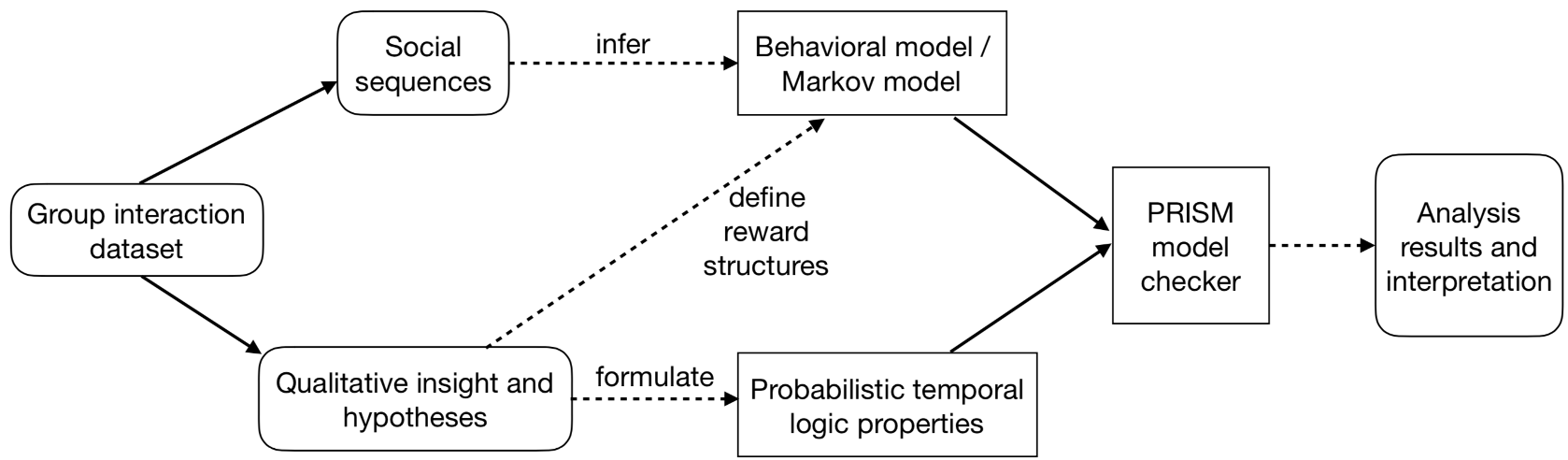
By treating the meeting as a Discrete-Time Markov Chain (DTMC), the researchers used Probabilistic Computation Tree Logic (PCTL) to define properties. This allows for checking "Path Formulae" (what happens across a sequence) rather than just "State Formulae" (what is true at one moment).
3. The Power of Rewards
By assigning "Rewards" (numerical values) to specific transitions, the PRISM tool can calculate:
- Cumulative Rewards: Total interventions by a specific role.
- Time-Bounded Probabilities: Probability of a decision within 50 steps.
Experiments and Results
The study validated several sociological intuitions while uncovering hidden patterns:
- Role Dominance: Project Managers (PM) were found to be the primary initiators, taking only 2.13 steps on average to start a discussion.
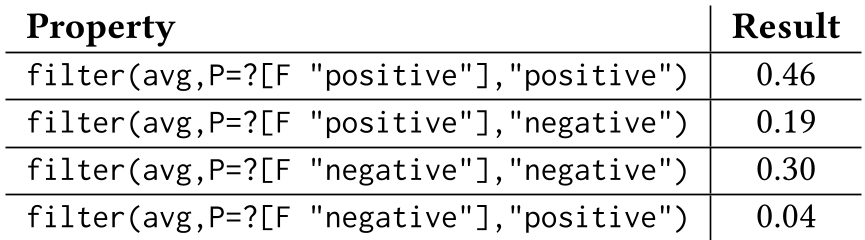
- The "Positive Response" Loop: The experiment (Q12) showed that positive sentiment is significantly more likely to trigger more positive sentiment (Prob: 0.46) than it is to trigger negative sentiment (Prob: 0.04).
- Decision Catalysts: States involving non-decision tasks belonging to the PM were highly associated with subsequent decision-making, reinforcing the PM's role as a facilitator.
Deep Insight: Query 13 (Causality)
The researchers tested if a PM's positive sentiment "causes" others to be positive. They found that the Marketing Expert (ME) is twice as likely (Prob: 0.1 for N=100) to respond positively to the PM compared to the Industrial Designer or UI Designer. This highlights the ME as a "secondary leader" in the AMI scenario.
Critical Analysis & Conclusion
Takeaways
The marriage of PCTL and Social Science is a powerful one. It allows researchers to treat social sequences as a "system" that can be verified for "correctness" or "efficiency."
Limitations
- Domain Specificity: The results are highly tied to the "corporate persona" roles of the AMI corpus.
- First-Order Assumption: The Markov model assumes the next state depends only on the current one, potentially missing longer-range conversational context.
Future Outlook
The authors propose moving toward Admixture Models to identify more latent, complex behavioral patterns and incorporating demographic data (gender, language) into the states. This logic-based approach could eventually lead to AI meeting assistants that can predict when a meeting is "going off the rails" in real-time.
Reference: Andrei, O. & Murray, G. (2018). Interpreting Models of Social Group Interactions in Meetings with Probabilistic Model Checking. ICMI '18.