
Deciphering the Pulse of Video Popularity: An Epidemic Lens on Recommendation Mechanisms
Interpreting Video Recommendation Mechanisms by Mining View Count Traces
This paper proposes a framework based on extended epidemic models to quantify and interpret video recommendation mechanisms using view count traces. The authors develop the Combined Model (CModel), which distinguishes between Direct (provider-driven) and Word-of-Mouth (user-driven) recommendations, achieving superior fitting accuracy on large-scale datasets from Tencent Video.
TL;DR
Understanding how a video goes viral—whether through a "push" from the platform or a "pull" from social sharing—is notoriously difficult. This paper introduces a novel framework using epidemic models to mine video view count traces. By splitting influence into Direct Recommendation and Word-of-Mouth (WOM), the authors provide a mathematical microscope to evaluate why certain videos succeed while others stall.
Background: Beyond the Black Box
Why do we care? For platforms like Netflix or YouTube, knowing the ROI of a front-page feature versus the organic growth of a viral clip is the billion-dollar question. Traditional metrics are often implicit or segmented. This study treats view count evolution as a physical process of "infection," where information flows through a population of potential viewers.
Problem & Motivation: The Resource Constraint
Existing popularity models often treat information diffusion as an infinite process. However, in the real world, recommendation resources are finite. A homepage only has so many slots. The authors identified that prior works (like the EvoModel) failed to capture this "resource-aware" nature, leading to poor fitting of real-world traces where a video's growth abruptly plateaus or starts with a significant delay ().
Methodology: The CModel Framework
The core innovation is the Combined Model (CModel), which treats the total cumulative views as the sum of two distinct epidemic flows:
- Direct Model (DModel): Represents deliberate promotion by the provider. It is characterized by a "push" rate and a starting time .
- Word-of-Mouth Model (WModel): Represents the "viral" component where one viewer "infects" others with a social sharing coefficient .
The authors mathematically prove that without sufficient "seed" users or a high enough social sharing rate (), organic growth will likely fail, necessitating the "direct" intervention of the platform.
 The Equation (8) demonstrates the non-linear ODE used to capture the social diffusion characteristics.
Experiments & Results: Real-World Validation
The models were tested on a massive dataset from Tencent Video, covering Movies, TV series, News, and Music Videos (MV).
SOTA Comparison
Compared to 7 other benchmarks (Ad-hoc, Weibull, etc.), CModel showed significantly higher robustness. For instance, in Movie categories, CModel had 0% failed cases (NMSE > 10), whereas Ad-hoc models failed in over 58% of scenarios.
Key Insights from Mining
- The Power of the Push: For nearly all categories, Direct Recommendation () outweighed WOM (). Platforms are the primary drivers of traffic.
- Time Sensitivity: News videos have the shortest (delay), meaning they are pushed immediately. Movies often have a longer delay while the system gathers early user feedback.
- The WOM Threshold: The authors show a "concave/convex" relationship for , proving that unless social sharing hits a specific threshold, it is highly inefficient for diffusing information.
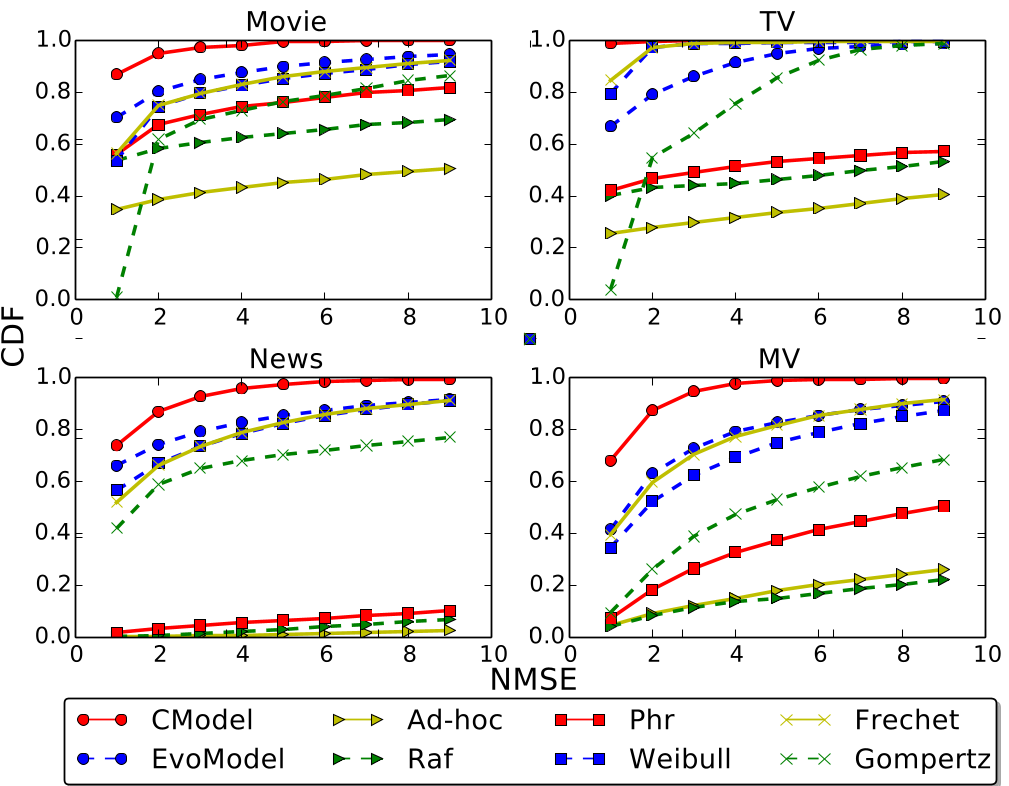 Figure 4. Scatter plots showing the correlation between Direct and WOM views across different content types.
Critical Analysis & Conclusion
Takeaway
The CModel provides a "reverse engineering" tool for video platforms. By fitting historical data to this model, a manager can identify "under-recommended" videos—those with high intrinsic attractiveness () and high viral coefficients () that were never given enough direct push ().
Limitations
The model struggles with extremely unpopular videos (under 1000 views) because their traces are too noisy. It also assumes a fixed total potential population (), which might not hold for long-tail videos that stay relevant for years.
Future Outlook
This work paves the way for "active" recommendation. Instead of just reacting to views, systems could use the early-stage fitting of and to predict which videos deserve a "premium" spot on the front page, optimizing the allocation of finite recommendation resources.