
Beyond Analytics: How Text Visualization Inoculates Against Political Framing
18262_Interpretive Impacts of Text Visualization Mitigating Political Framing Effects.
This research investigates the interpretive impacts of text visualizations—specifically Word Clouds and a custom-designed "Word Web"—on the perception of political framing. The study demonstrates that visual disruptions of linear prose can effectively mitigate subconscious framing effects and induce a "transfer effect" in subsequent, un-visualized tasks.
TL;DR
Can a simple word cloud protect you from political manipulation? A landmark study by Baumer et al. argues that it can. By disrupting the linear "flow" of prose, text visualizations like Word Clouds and interactive Word Webs force our brains out of autopilot and into a "deliberate cognitive mode," effectively neutralizing the subconscious power of political framing.
The "Invisible" Power of Framing
In political communication, framing is the art of selection and emphasis. Whether a policy is described in terms of "Equality" or "Economic Cost" significantly alters public support, often without the reader ever realizing they are being influenced. This happens because we typically read prose linearly, internalizing the author's narrative structure through fast, heuristic processing.
The researchers hypothesized that if we break this linearity, we might break the frame.
Methodology: Designing the Disruptor
The study compared traditional prose with two visual formats:
- Word Clouds: Familiar, frequency-based representations that remove sentence structure entirely.
- Word Webs: A more sophisticated tool that uses a force-directed layout. It calculates the "Association Strength" between words using a harmonic progression—words appearing closer together in sentences are physically linked by thicker lines.
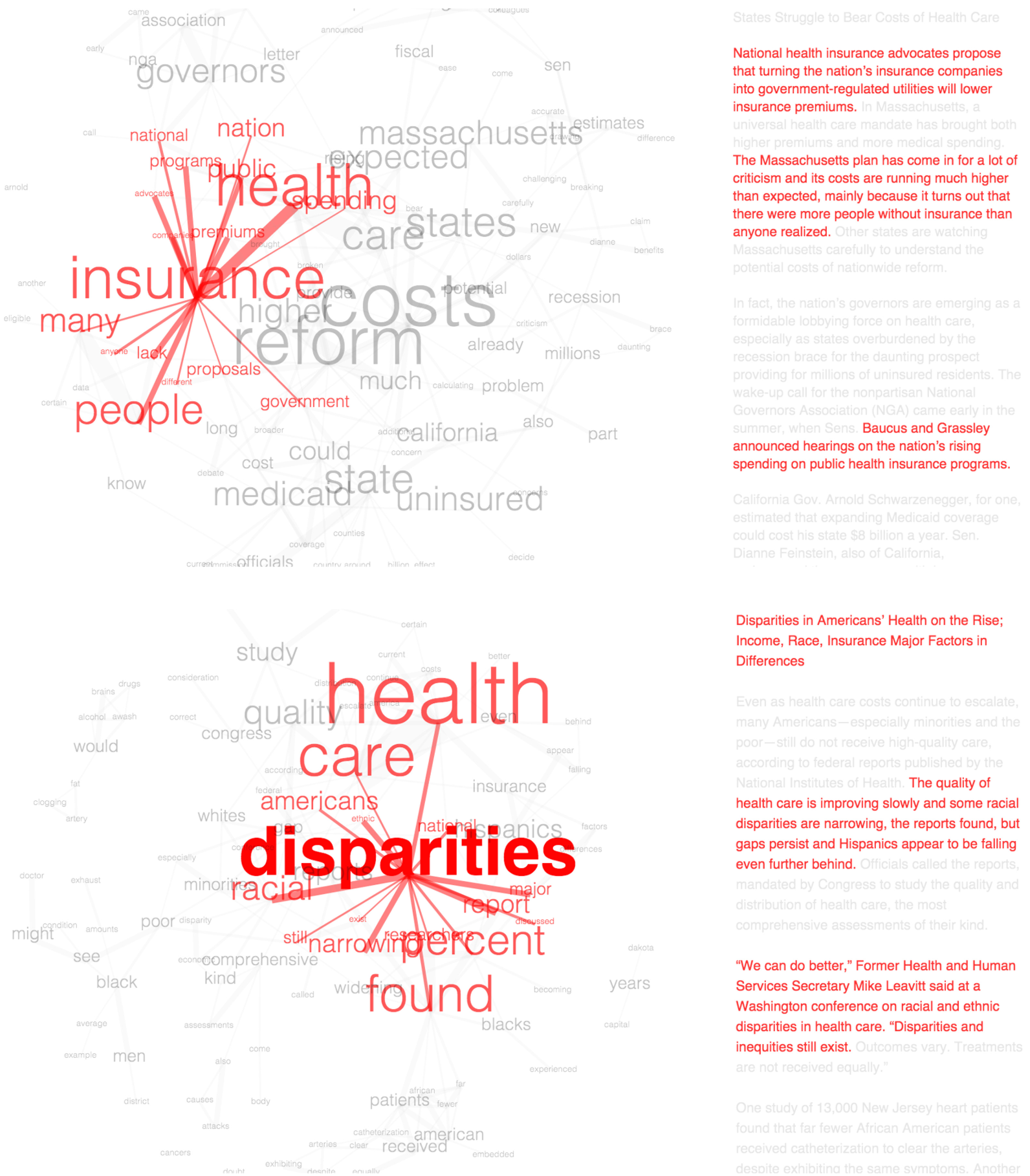 Figure 1: The Word Web allows users to explore "neighborhoods" of meaning, such as the connection between "disparities," "racial," and "minorities."
The core insight here is Spatial Proxemics: humans naturally interpret distance as relatedness. By making co-occurrence explicit and interactive, the Word Web surfaced the "hidden" associations that constitute a frame.
Experimental Results: The Shield and the Echo
The experimental design exposed participants to healthcare articles framed as either "Cost" or "Equality."
1. Mitigation of Bias
In the "Text Only" control group, the framing effect was stark: ideology and framing interacted to swing opinions. However, for those using the Word Web or Word Cloud, the framing effect virtually disappeared. The visualization acted as a cognitive "speed bump," forcing more analytical thinking.
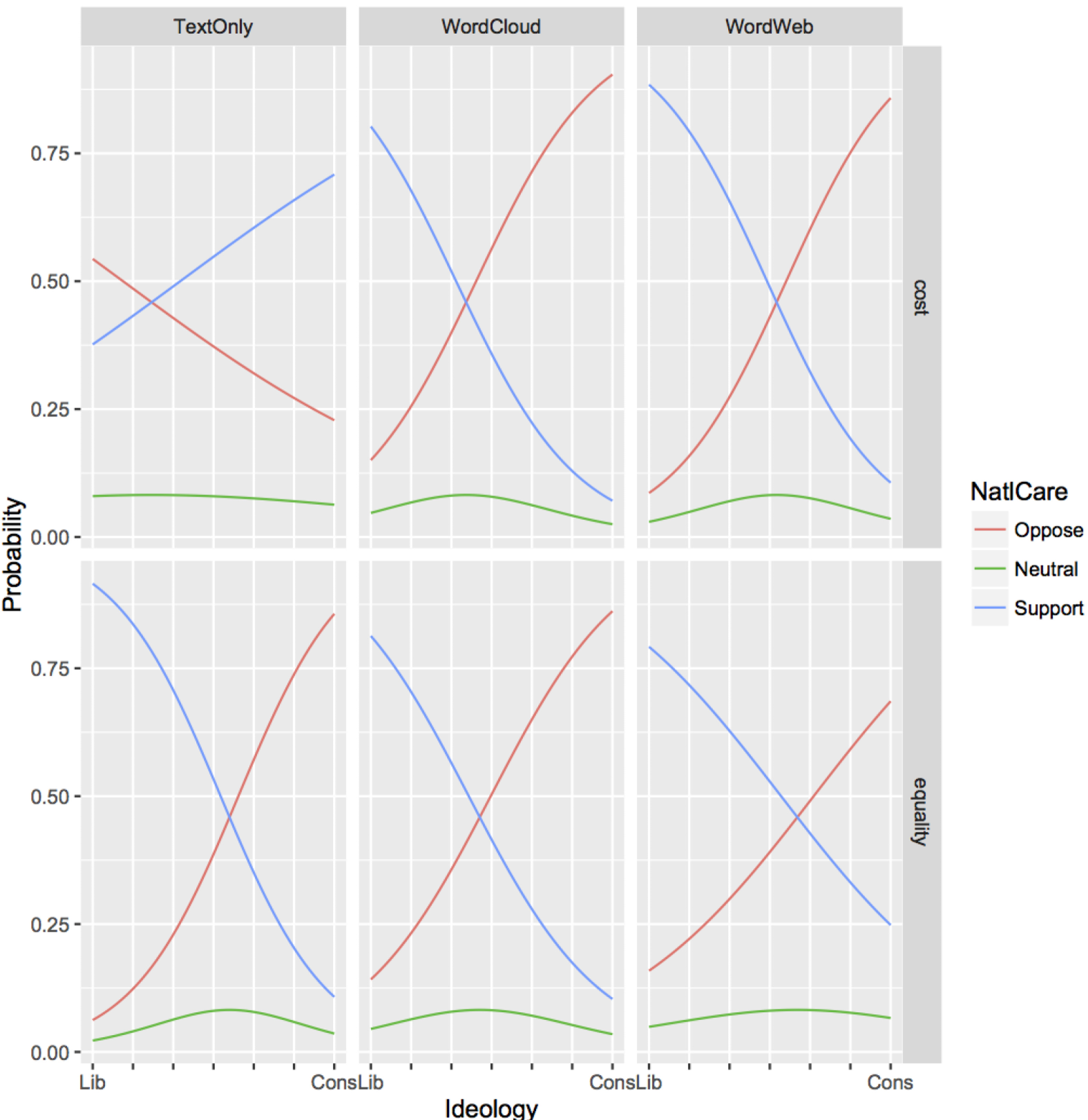 Figure 2: Probability of support based on ideology. Notice how the "Text Only" slopes (left) diverge based on framing, while the visualization groups (center/right) show stabilized, ideology-consistent responses.
2. The Transfer Effect
Perhaps the most startling find was the Transfer Effect. After using a visualization for the first article, participants remained resistant to framing in subsequent articles—even those presented as plain text without any visual aid. This suggests that the visualization "trained" the participants to read more critically, an effect known in psychology as priming.
Critical Analysis & Conclusion
This work challenges the visualization community to look beyond "time and error" metrics. The value of a visualization isn't always how fast it helps you find a fact; sometimes, its value is in how effectively it makes you stop and think.
Limitations:
- The study used a student-skewed sample.
- The "Transfer Effect" was measured over a short duration; whether this "inoculation" lasts for days or weeks remains unknown.
The Takeaway for Designers: If you are building tools for the public or for newsrooms, consider that the structure of your data (linear vs. network) is not just an aesthetic choice—it's an interpretive one. Visualizations can be a powerful defense mechanism in an era of polarized rhetoric and algorithmic "bubbles."
Summary Quote: "We change our tools and then our tools change us." — Harold Innis.