
From Users to Teachers: Democratizing AI Literacy via Machine Teaching
Introducing Children to Machine Learning Through Machine Teaching
This paper introduces "Machine Teaching" as a pedagogical framework to foster AI literacy in children aged 7-13. By utilizing interactive, no-code interfaces like Google’s Teachable Machine and custom AR applications, the research demonstrates how children can understand complex ML concepts by acting as "teachers" for classification algorithms.
TL;DR
Artificial Intelligence is no longer a "future" technology; it is the infrastructure of the present. However, teaching AI to children has traditionally been hindered by the steep learning curve of programming. This research explores Machine Teaching—a paradigm shift where children (ages 7-13), including those who are blind, learn AI concepts by directly training algorithms through intuitive, no-code interfaces.
The Context: Is Programming a Prerequisite for AI?
In the current educational landscape, AI literacy is often tethered to programming. Students are expected to master Scratch or Python before they can even touch a Neural Network. This creates two major issues:
- Cognitive Overload: Children must learn "how to code" and "how AI works" simultaneously.
- Exclusion: Visual-heavy programming environments often exclude children with disabilities, such as the blind or visually impaired.
Utkarsh Dwivedi’s research challenges this status quo by asking: Can we teach AI by letting children act as the teacher?
The Methodology: The Child as the "Data Architect"
Machine Teaching, as defined in this research, involves a teacher (the child) who understands how to separate positive and negative data and constructs a training set for a learner (the algorithm).
The Evolutionary Path of the Research
The dissertation progresses through four key stages to bridge the gap between abstract algorithms and tangible understanding:
- Exploratory Co-design (Study 1): Using existing tools like Google's Teachable Machine, children engaged in "Classifier Swaps." They trained a model, gave it to a peer, and analyzed why it failed on new data—introducing the concept of Generalization.
- Augmented Reality Integration (Study 2): An iPad app where children train models to recognize objects and trigger their own digital artwork. This provides immediate, creative feedback on the success of their "teaching."
- Game-based Challenges (Study 3): A proposed game where "leveling up" requires solving real-world ML problems like Noisy Data or Dataset Bias.
- Inclusive Design (Study 4): Expanding the interface to support both sighted and blind children, using audio and tactile feedback to represent data.
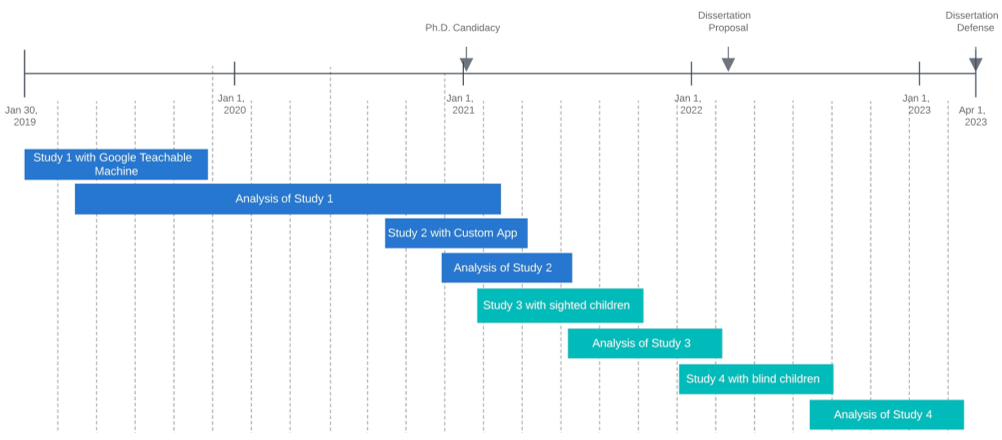 Figure 1: The research roadmap, moving from initial explorations to inclusive dissertation studies targeting both sighted and blind children.
Why Machine Teaching Works: The Intuition
The core insight here is that Data is the new Language. By shifting the focus from writing lines of code to selecting "representative examples," machine teaching leverages a child's natural ability to categorize the world.
- Inductive Bias: Children learn that the machine only knows what it is shown. If they only show it red squares, it won't recognize a blue one.
- Iterative Testing: The "Teach-Test-Refine" loop mimics the scientific method, encouraging children to hypothesize why a model failed (e.g., "The background was too messy!") and fix it.
Experimental Insights
In the initial workshops, children aged 7-13 demonstrated a surprising ability to handle Ablation-style reasoning. When their classifiers failed, they didn't just give up; they experimented with:
- Sample Quantity: Realizing that 10 images aren't enough for complex objects.
- Environmental Factors: Adjusting lighting and camera distance (addressing the "domain shift" problem in a playground setting).
- Data Diversity: Learning that "balanced datasets" lead to fairer outcomes.
Critical Analysis & Future Directions
This work is a vital contribution to Universal Design for Learning (UDL). By de-coupling AI from syntax-heavy coding, Dwivedi opens the door for a much broader demographic to become AI-literate.
Limitations & Challenges
- Conceptual Depth: While children learn how to train models, do they understand the mathematical why? Finding the balance between "magic" and "math" remains a challenge.
- Scaling Accessibility: Creating a truly inclusive interface for blind children to "see" training data through alternative modalities is a significant engineering hurdle.
Conclusion
The future of AI education isn't just about making more programmers; it's about making informed citizens who understand how data shapes the algorithms that govern our lives. By turning children into "Machine Teachers," we move away from viewing AI as an inscrutable "black box" and toward seeing it as a student that reflects the quality of its education.