
Flow Matching & Diffusion: The Mathematical Engine of Generative AI
An Introduction to Flow Matching and Diffusion Models
This paper provides a comprehensive technical introduction to Flow Matching and Diffusion Models, formalizing generative modeling as a process of transforming a simple noise distribution into a complex data distribution via ODEs and SDEs. It establishes Flow Matching as the modern SOTA framework for training large-scale models like Stable Diffusion 3 and Meta Movie Gen, achieving efficient simulation-free training and high-fidelity sampling.
TL;DR
Generative AI has evolved from a niche curiosity to a creative powerhouse capable of dreaming up photorealistic images and cinematic videos. At the heart of this revolution is a transition from complex probabilistic modeling to a more elegant framework: Flow Matching. By treating generation as a trajectory-solving problem—converting Gaussian noise into structured data via Differential Equations—researchers have unlocked a scalable, simulation-free way to train the world's most powerful models like Stable Diffusion 3 and Meta's Movie Gen.
The Intuition: From Noise to Order
Generative modeling is often described as "creating data from noise." While creating noise from data is trivial (simply add randomness), reversing the process is the ultimate challenge.
The core insight of this paper is to identify objects (images, videos, proteins) as high-dimensional vectors . Generation then becomes a task of sampling: finding a path from a simple, known distribution (usually a Standard Gaussian) to the complex, unknown data distribution .
The Problem with Prior Work
Early Diffusion models (like DDPM) were restricted to "Forward Processes" where data was gradually destroyed by noise. These models required a "Time-Reversal" approach that was mathematically heavy and often restricted to fixed schedules. Furthermore, they often relied on the Evidence Lower Bound (ELBO), which is merely a proxy for the true objective.
Methodology: The Flow Matching Breakthrough
Flow Matching sidesteps these complexities. Instead of simulating the full diffusion process during training, it uses a simulation-free objective.
- Probability Paths: We define a path that interpolates between noise () and data ().
- Vector Fields: An Ordinary Differential Equation (ODE) defines how samples move along this path.
- The Marginalization Trick: While the total "Marginal" vector field of the entire dataset is unknown, we do know the "Conditional" vector field for a single data point. The paper proves that regressing against the conditional field is mathematically equivalent to learning the global marginal field.
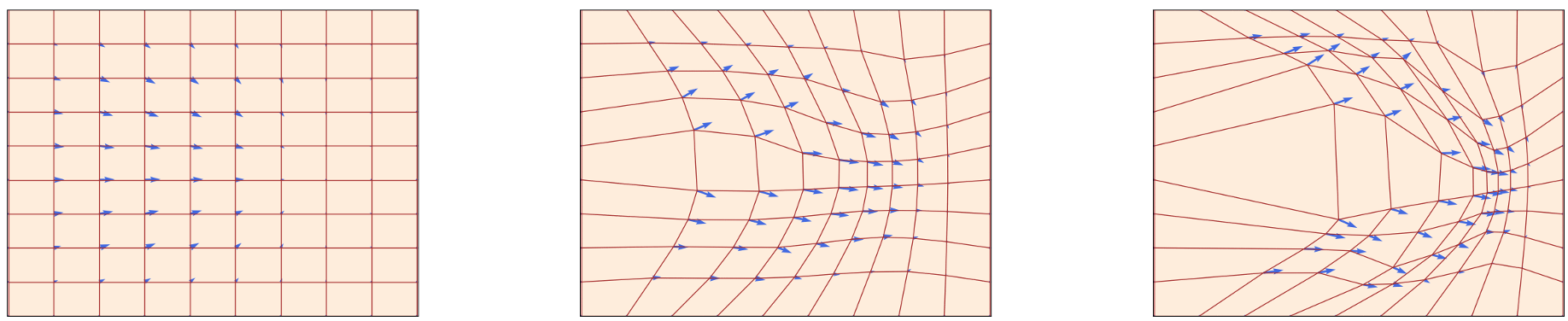 Figure 1: How a vector field "warps" space to transform a noise grid into a structured data distribution.
From ODEs to SDEs (Diffusion)
A unique strength of this framework is its versatility. By adding a noise term to our ODE, we transform it into a Stochastic Differential Equation (SDE). This allows us to toggle between deterministic "Flow" and stochastic "Diffusion" sampling after the model is already trained.
Architecture: The Scalability Stack
To handle millions of pixels, the framework relies on two engineering pillars:
1. Latent Diffusion (VAEs)
Modeling pixels directly is prohibitively expensive. Instead, we train a Variational Autoencoder (VAE) to compress the image into a lower-dimensional "Latent Space." The Flow Matching model then operates on these compressed features, drastically reducing computation.
2. Diffusion Transformers (DiT)
While U-Nets were the early standard, the industry has shifted toward Transformers (DiT). By treating image patches as "tokens" (similar to words in ChatGPT), models like Stable Diffusion 3 can scale to billions of parameters and better attend to complex text prompts.
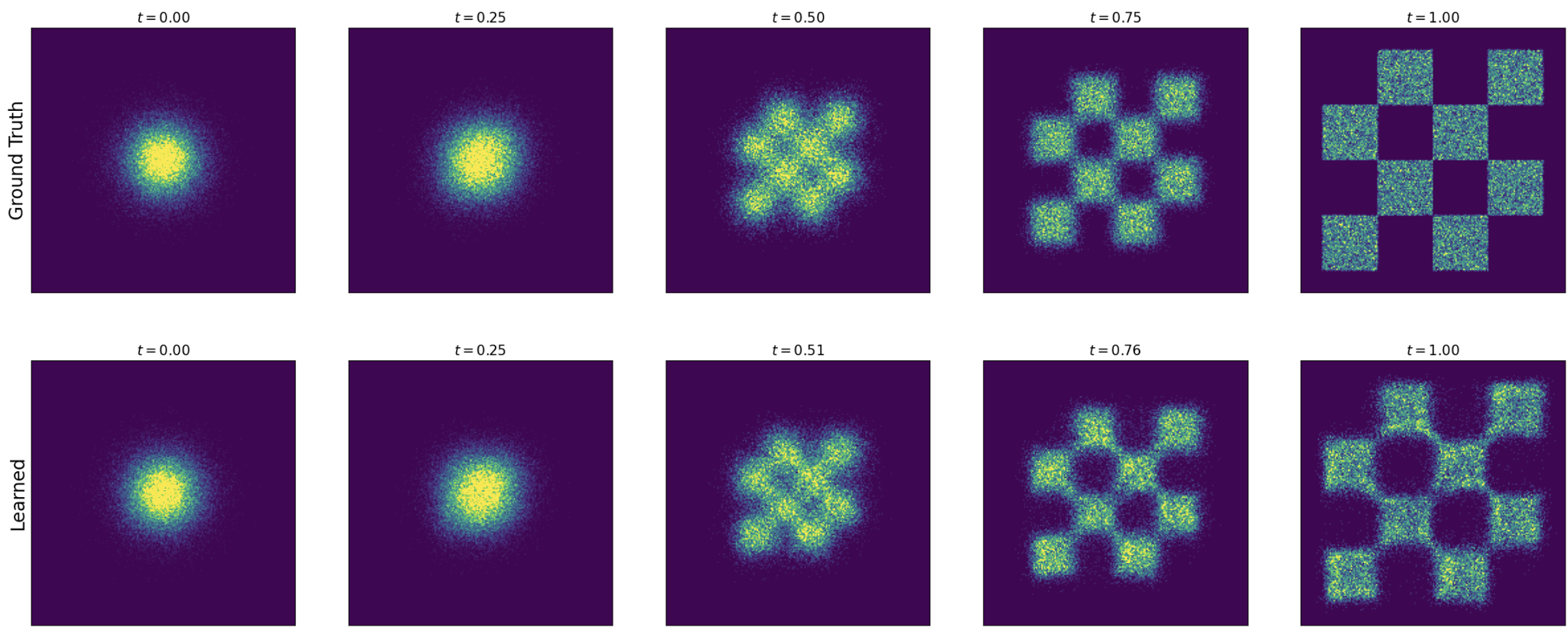 Figure 2: The training result: After training on a toy "chessboard" distribution, the model successfully transports noise samples into the target pattern.
Case Study: Video and Language
The principles aren't limited to images:
- Video (Meta Movie Gen): Extends the logic into the temporal dimension, using 3D "patches" and temporal autoencoders to maintain consistency across frames.
- Language (Discrete Diffusion): Surprisingly, even text can be "diffused." By using Continuous-Time Markov Chains (CTMC), models can "jump" between discrete tokens (like words), offering an alternative to the standard auto-regressive (one-word-at-a-time) approach of GPTs.
Conclusion: A Unified Future
The "Generator Matching" framework suggests that we are heading toward a unified theory of AI. Whether it's the smooth curves of an image or the discrete jumps of a sentence, the mathematical principles of Flow and Diffusion provide a single, robust engine for creativity.
Critical Insight
Flow matching's biggest contribution is decoupling training from sampling. You can train a model once and then spend months optimizing a faster ODE solver or a better SDE sampler to get higher quality results without ever touching the GPU for retraining.