
SN-IDS: Reimagining Ad Hoc Security through the Lens of Social Network Analysis
An Intrusion Detection System in Ad Hoc Networks: A Social Network Analysis Approach
This paper introduces SN-IDS, an innovative Intrusion Detection System for ad hoc networks that leverages Social Network Analysis (SNA) metrics like centrality and ego networks. By treating mobile nodes as social actors and communication patterns as ties, it effectively identifies anomalies such as Blackhole and TCP SYN flooding attacks.
TL;DR
SN-IDS shifts the paradigm of Intrusion Detection Systems (IDS) from heavy data mining to Social Network Analysis (SNA). By modeling ad hoc network interactions as social ties and using metrics like Betweenness Centrality, it detects malicious actors with 100% accuracy in specific scenarios while being roughly 2.5x faster than traditional association-rule-based methods.
The Motivation: Moving Beyond "Rule-Heavy" Detection
Ad hoc networks are notoriously difficult to secure because they lack a fixed perimeter or central authority. Previous research attempted to solve this using association rule mining (like the Apriori algorithm). However, these methods are "heavy"—they generate thousands of rules that require manual pruning and consume massive CPU cycles, which is a death sentence for battery-powered mobile nodes.
The authors' key insight: Network attacks aren't just data anomalies; they are social disruptions. A Blackhole attack, for instance, fundamentally changes how a node is "perceived" by its neighbors. Why not use the mathematics of sociology to detect these shifts?
Methodology: The Power of Ego Networks and Centrality
Instead of trying to map the entire network (which is impossible in highly mobile environments), SN-IDS focuses on Ego Networks. Each node acts as an "Ego," monitoring its "Alters" (immediate neighbors) and the ties between them.
1. Centrality as a Security Metric
The system monitors three primary metrics:
- Degree: How many connections a node has. A sudden spike might indicate a flooding attack.
- Betweenness: How often a node acts as a bridge on the shortest path between others. In a Blackhole attack, an attacker's betweenness skyrockets as it tricks Others into routing through it.
- Closeness: How easily a node can reach all others in the network.
2. Multi-Relational Analysis
The paper emphasizes that one view isn't enough. By combining different socio-matrices (e.g., MAC layer data traffic vs. physical overheard traffic), the system can eliminate false positives. For example, a node might stop sending data simply because the buffer is empty (Single Relation error), but physical overheard traffic proves the node is still "socially active" and not malicious.
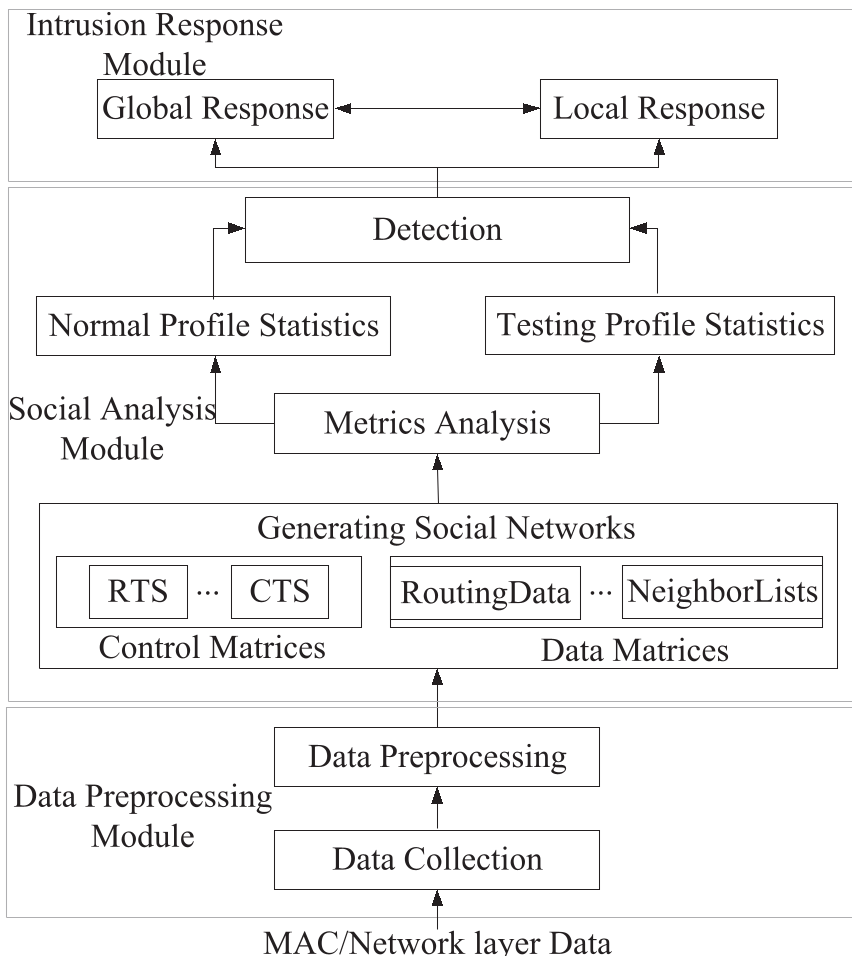 Figure 1: The SN-IDS framework, showing the flow from Cross-layer data collection to Social Metric Analysis.
Performance: Efficiency Meets Accuracy
Using NS-2 simulations, the team tested SN-IDS against Blackhole and Sleep Deprivation attacks.
Key Findings:
- High Detection Rates: The system maintained a 100% single-node successful detection rate across various mobility levels (pause times).
- The Mobility Paradox: Interestingly, higher mobility actually helped detection. This is due to the "Small World" phenomenon—as nodes move, the social impact of an attack propagates more widely, allowing more "witnesses" to catch the anomaly.
- Complexity Win: SN-IDS showed a detection delay of only 0.424 seconds, whereas the association rule-based Apriori IDS lagged at 1.051 seconds.
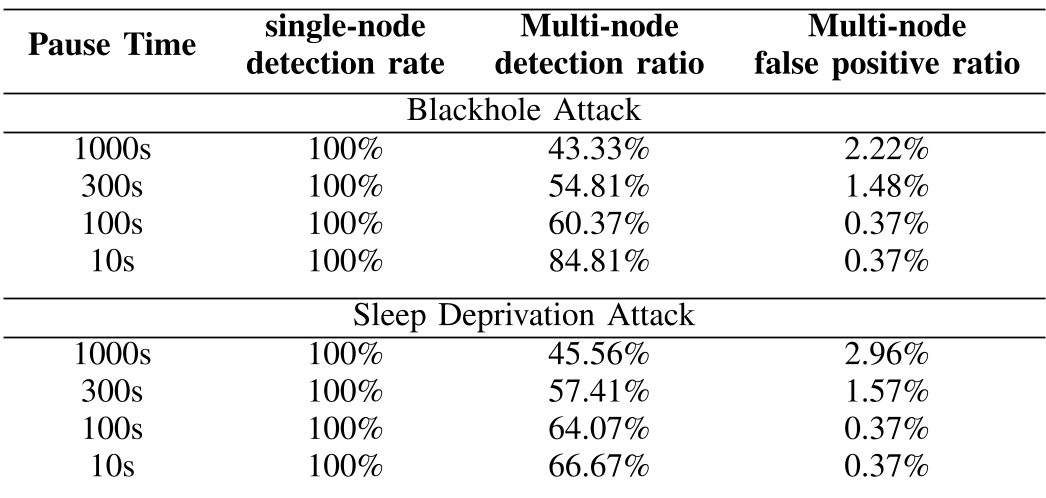 Table: Performance of SN-IDS under different attack and mobility scenarios.
Deep Insight: Why Centrality Works
The most compelling evidence comes from the Betweenness fluctuations. During a Blackhole attack, the attacker's betweenness increases sharply because it advertises itself as the best route for everything. Conversely, the "victim" nodes see their betweenness drop as their neighbors lose trust or find other paths.
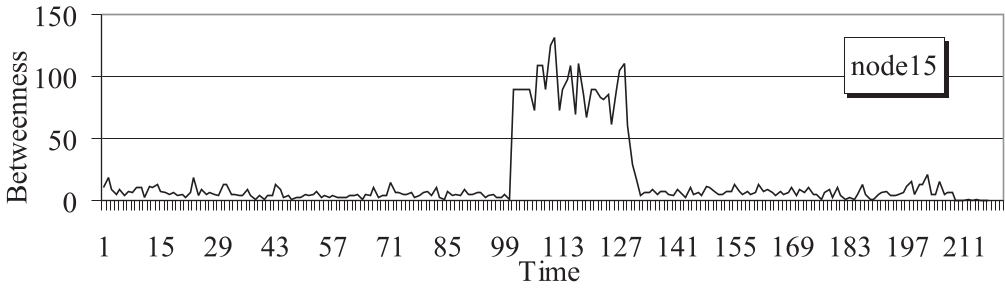 Graph: The dramatic spike in an attacker's betweenness allows for near-instant detection.
Conclusion & Future Outlook
SN-IDS proves that social metrics are a lightweight, high-fidelity alternative to traditional data mining in network security. By shifting the focus from "what packets are sent" to "how nodes interact," the system gains an inductive bias that aligns perfectly with the cooperative nature of ad hoc networks.
Limitations: While effective for structural attacks (Blackhole, Flooding), more "silent" attacks that don't alter the topology might still require deeper packet inspection. Future work could integrate these SNA metrics with Bayesian networks or Machine Learning to handle evolving zero-day threats.
Main Takeaway: For decentralized networks, the "social status" of a node is often the most accurate indicator of its integrity.