
The Geometry of Logic: Mapping the Invariant Manifold of Transformer Reasoning
Invariant Learning Dynamics of Transformers in Inductive Reasoning Tasks
The paper introduces the Invariant Manifold of Inductive Reasoning (IMIR), a theoretical framework that unifies diverse inductive tasks like associative recall and multi-hop reasoning. It proves that Transformer training dynamics for these tasks are confined to a low-dimensional, interpretable manifold where circuit formation can be analyzed through a few coordinates rather than millions of parameters.
Executive Summary
TL;DR: Researchers from ETH Zurich and Stanford have uncovered the "Invariant Manifold of Inductive Reasoning" (IMIR)—a hidden, low-dimensional "track" in the parameter space that Transformers follow when learning to reason. By proving that training dynamics are confined to this manifold, the authors provide a unified mathematical explanation for how induction heads form, why they compete with memorization, and how data statistics like "burstiness" dictate the speed of skill acquisition.
Academic Positioning: This paper moves beyond the "what" of mechanistic interpretability (e.g., identifying induction heads) to the "how" and "why" of learning dynamics. It provides a rare bridge between dynamical systems theory and Transformer circuit analysis, offering a predictive framework for model behavior.
The Problem: The "Black Box" of Skill Acquisition
Why do Transformers suddenly exhibit in-context learning (ICL)? Why does a model sometimes choose to memorize (In-Weights Learning/IWL) instead of reasoning? Current answers are mostly phenomenological—we see it happen, but we can't mathematically predict the competition between these circuits. Previous work was often task-specific (e.g., only looking at associative recall), leaving us without a "Unified Field Theory" for inductive reasoning.
Methodology: The Invariant Manifold of Inductive Reasoning (IMIR)
The core insight of this paper is that inductive tasks share fundamental Data Symmetries.
- Token Symmetry: The logic of "associative recall" doesn't change if you swap 'apple' for 'banana' globally.
- Positional Symmetry: Relevant blocks can appear anywhere in the sequence; their relative distance matters more than their absolute index.
By formalizing these symmetries, the authors prove that if a model starts on a specific low-dimensional manifold (the IMIR), gradient descent cannot push it off. The manifold is spanned by basis matrices representing actions like "look back steps" or "map token A to its partner B."
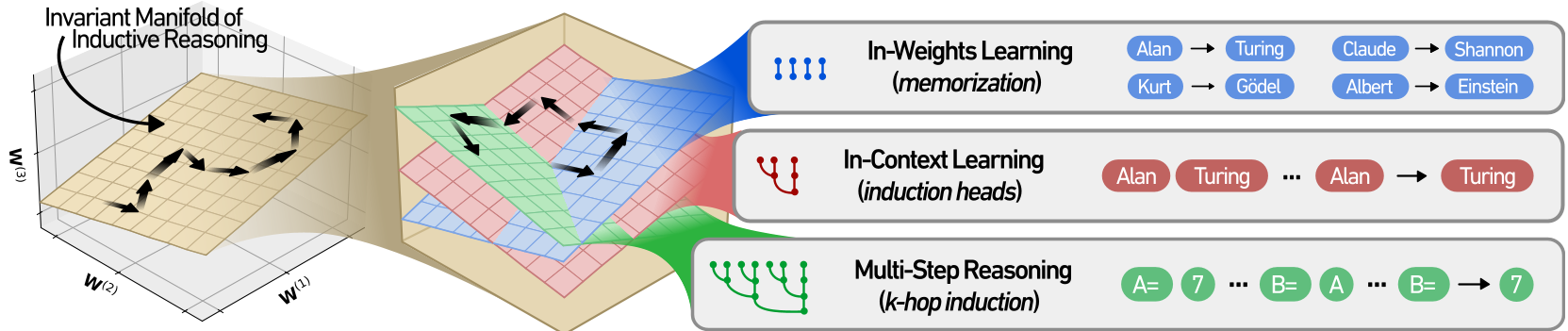 Figure 1: The IMIR is a low-dimensional subspace where specific induction circuits (colored planes) reside and evolve.
Competition: Why Memorization "Starves" Reasoning
One of the paper's most salient contributions is the mathematical proof of Circuit Competition. In a two-layer model, the model can solve a task in two ways:
- ICL (Induction Head): Uses Layer 1 to find a pattern and Layer 2 to copy it.
- IWL (Memorization): Uses a direct mapping (in-weights) to predict the next token based on current identity.
The authors prove Theorem 2: When a model starts to memorize (IWL), it "starves" the reasoning circuit (ICL) of gradients. The reasoning circuit only receives gradients from the data that the memorization circuit cannot solve (i.e., rare or scrambled tokens).
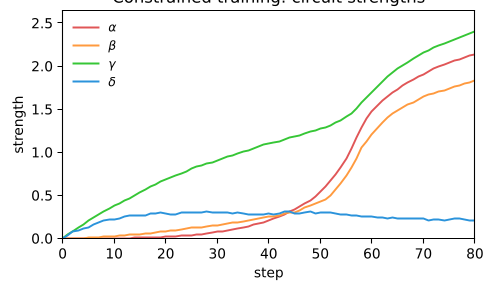 Figure 2: Empirical evidence of circuit units (α, β, γ for ICL; δ for IWL) competing during training.
The Role of Data: The "Multiplicative Boost" of Burstiness
Why does "burstiness" (repeating a pattern multiple times in a context) help LLMs learn? The authors provide a rigorous answer in Theorem 3. They show that burstiness acts as a linear multiplier on the population gradient for the reasoning circuit. If an association appears times, the induction head receives a gradient times stronger than it would in a non-bursty environment, effectively "winning the race" against memorization.
Automated Circuit Discovery
The interpretability coordinates provided by the IMIR allow for far more granular circuit detection than previous "head-level" methods. By projecting a trained model onto the manifold, the authors could identify "Aiding Directions"—weight structures that don't fit the standard induction head template but optimize performance by suppressing noise.
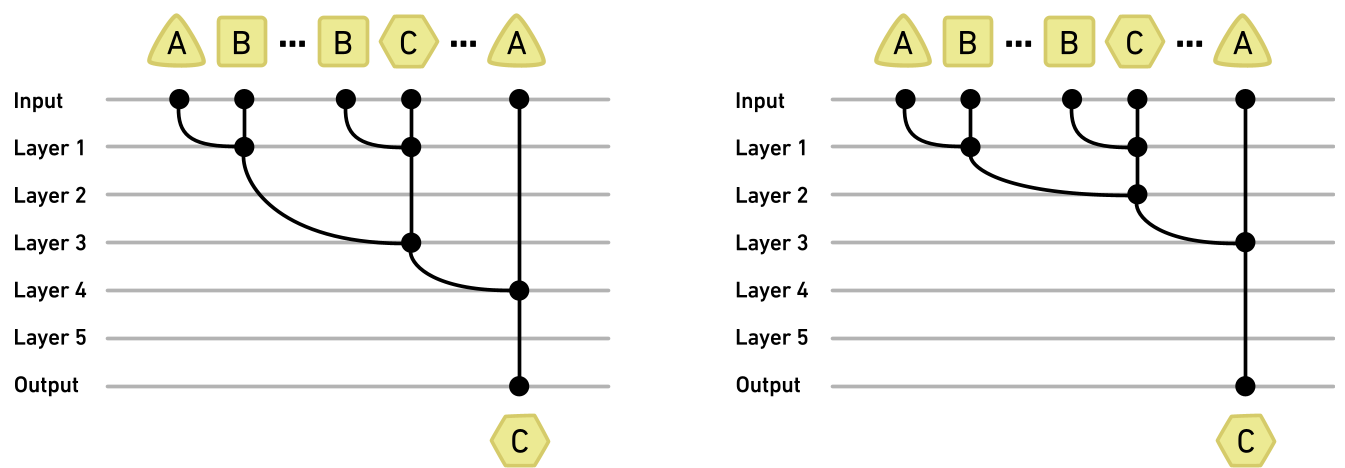 Figure 3: Two auto-discovered circuits for 2-hop induction, showing granular weight-level paths.
Critical Analysis & Conclusion
Takeaway
The IMIR transforms mechanistic interpretability from a "post-hoc" forensic exercise into a "predictive" science. We can now describe the evolution of logic within a Transformer using just a few interpretable coordinates.
Limitations
The theory currently relies on an associative-memory view (orthonormal embeddings and fixed value maps). While the authors sketch how this extends to fully learnable FFNs and LayerNorm, the rigorous proof for modern, high-dimensional, non-linear Transformers at scale remains a challenge.
Future Outlook
This framework opens the door to constrained training: by forcing models to stay on the IMIR, we could potentially train reasoning-capable models with significantly less data and fewer parameters, or "steer" models away from memorization Toward generalizable in-context reasoning.