
Beyond Black Boxes: A Systematic Methodology for Quantum and Invertible Logic Oracles
Inverse problems, constraint satisfaction, reversible logic, invertible logic and Grover quantum oracles for practical problems
The paper proposes a unified methodology for designing Grover Quantum Oracles and Invertible Logic Oracles to solve complex Constraint Satisfaction Problems (CSP) and optimization tasks. By reducing optimization to repeated CSP instances and employing systematic hardware blocks (Selectors, Permuters, Arithmetic Checkers), the author demonstrates significant speedups in tasks like Crypto-arithmetic puzzles and Minimum Set of Support problems.
TL;DR
This research establishes a rigorous framework for building hardware "Oracles"—the core engines of search algorithms. It bridges the gap between Grover’s Quantum Search and the emerging field of Invertible Logic (spin-based computing). By treating optimization as a repeated Constraint Satisfaction Problem (CSP), the author demonstrates that specialized hardware circuits can outperform traditional software by factors of millions.
Background: The Oracle Problem
In quantum computing, Grover's algorithm is famous for providing a quadratic speedup for searching unsorted databases. However, most academic papers treat the "Oracle" (the function that recognizes a solution) as a theoretical black box.
This paper argues that the Oracle is the most critical part of the design. Whether implemented in Reversible Logic for quantum bits or Invertible Logic for magnetic spins, the systematic construction of these circuits is what makes quantum and post-CMOS computing practical for real-world AI and CAD problems.
The Core Insight: Optimization as Repeated CSP
The author posits a fundamental "physics intuition": Every optimization problem (e.g., finding the shortest path) can be reduced to a sequence of decision problems (e.g., "Is there a path of length K?").
- Define constraints for the problem ().
- Build a hardware Oracle.
- If the Oracle finds a solution, reduce and repeat.
This shift allows us to focus entirely on building efficient Constraint Satisfaction hardware.
Methodology: Building the Oracle Hierarchy
The paper introduces a systematic architecture for oracles, moving away from "hand-crafted" designs to a modular approach.
1. The Classical/Quantum/Invertible Pipeline
The design process follows a specific flow:
- Problem Mapping: Choosing between "Subset of Set", "Permutation", or "Mapping" representations.
- Encoding: Utilizing One-Hot, Gray, or Thermometer encoding to reduce the search space.
- Block Synthesis: Using standard arithmetic/predicate blocks (Adders, Comparators) converted into their reversible or invertible counterparts.
2. The Invertible Logic Paradigm
Perhaps the most exciting contribution is the discussion of Invertible Logic. Unlike classical gates where signals flow one way (), Invertible gates allow bidirectional flow.
- Intuition: If you fix the output of an AND gate to "1", in Invertible Logic, the inputs automatically settle into the state .
- Speedup: While Grover offers quadratic speedup, Invertible Logic can sometimes find solutions in a single evaluation by propagating values backward from the constraint to the variables.
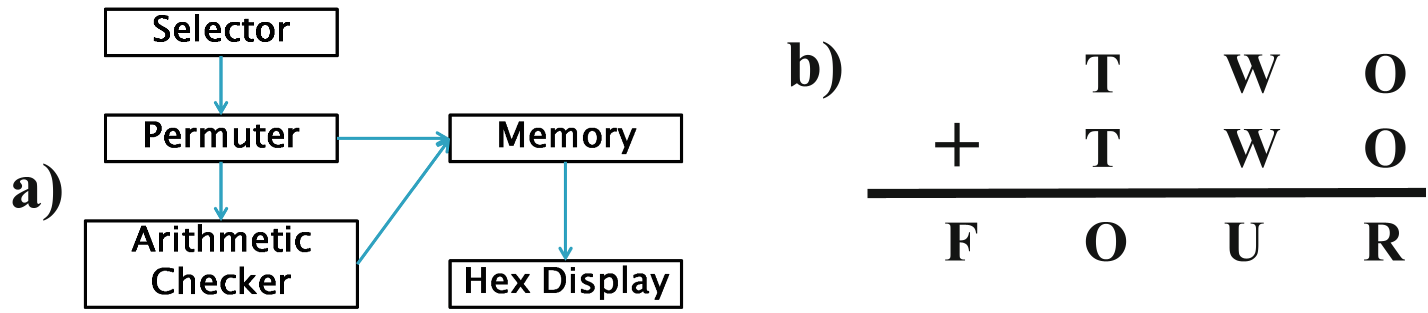 The Figure above illustrates the systematic decomposition of a hardware oracle into a Selector, Permuter, and Arithmetic Checker.
Case Study: Minimum Set of Support
The paper applies this methodology to a classic CAD problem: finding the minimum variables required to express a Boolean function.
- Quantum Approach: The author designs a Grover Oracle consisting of a POS (Product of Sums) satisfiability block and a threshold counter.
- Iterative Refinement: By incrementing the threshold and "inhibiting" previously found solutions (using an ESOP-based block), the quantum computer systematically harvests all minimal solutions.
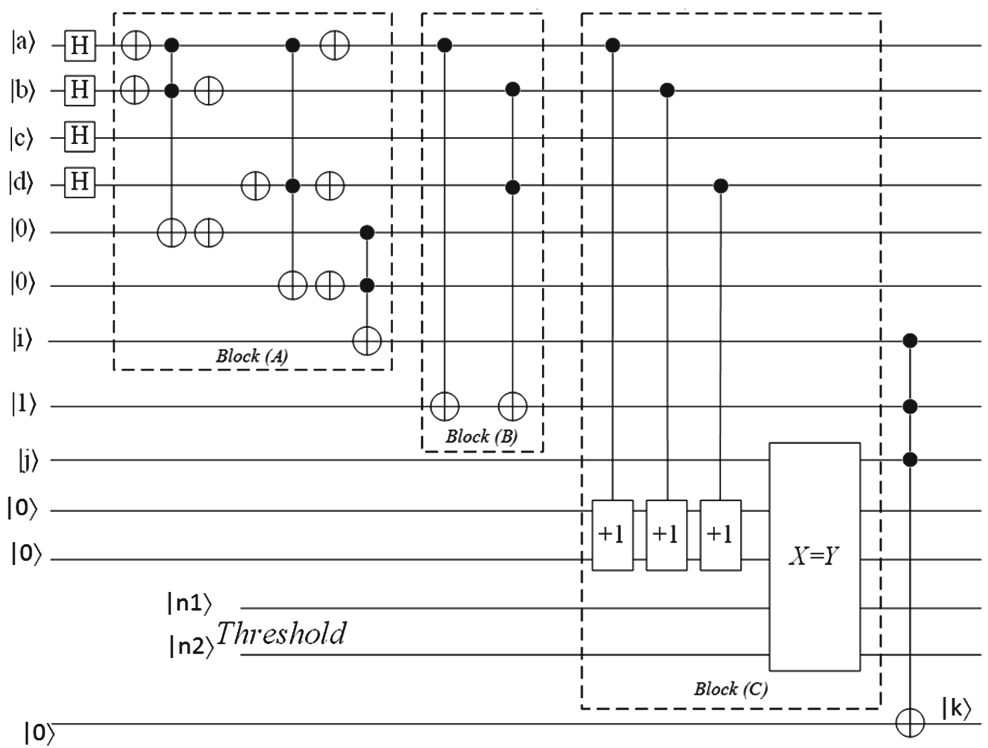 The Proposed Quantum Oracle block diagram, showing the interaction between the POS check (A), the exclusion of old solutions (B), and the cost threshold (C).
Experimental Evidence
In a brute-force test using the "TWO+TWO=FOUR" crypto-arithmetic puzzle, the difference was staggering:
- Software (i5 CPU): ~1,126,368 ms.
- Hardware (FPGA Oracle): 0.3024 ms.
- Improvement: A 3.7 million-fold speedup.
While FPGAs are still classical, they serve as the "logical blueprint" for what will eventually be implemented in Magnetic Spin (Invertible) or Superconducting Qubits (Quantum).
Critical Insight & Future Outlook
The paper makes a compelling case that the future of computing isn't just "faster clocks," but "smarter logic."
- Invertible Logic is particularly promising because it mimics Hamiltonian dynamics—the system naturally "falls" into the solution (lowest energy state).
- Prolog as a Simulator: The author suggests using Logic Programming (Prolog) to verify these oracles, as its backtracking mechanism naturally mirrors the bidirectional nature of Invertible Logic.
Limitations
- Input-Output directionality: While trees of AND gates are easy to invert, complex circuits with many-to-one mappings create "probabilistic" states on the inputs, requiring stochastic mechanisms (like p-bits) to settle.
- NISQ Constraints: In the quantum realm, these deep oracles might exceed the coherence time of current Noisy Intermediate-Scale Quantum (NISQ) devices.
Conclusion
This work provides the "missing link" for practitioners looking to use Grover’s algorithm or Stochastic computing for industrial problems. By standardizing high-level blocks like "Set Partition Algebra" into hardware oracles, the transition to quantum and invertible hardware becomes a matter of logic synthesis rather than abstract physics.